8. Imperial Globalization – The Presence of the Past and the Crucible of Empire

Editor’s Note: It is hard to believe that the Imperial & Global Forum went live just a year ago. In the weeks leading up to the new year, please help us celebrate by checking out the year’s 10 most popular posts.

8. Imperial Globalization – The Presence of the Past and the Crucible of Empire

Andrew Thompson

Centre Director Andrew Thompson explains that if globalization is not to silence the past, we need to delve back into its history – its imperial history.
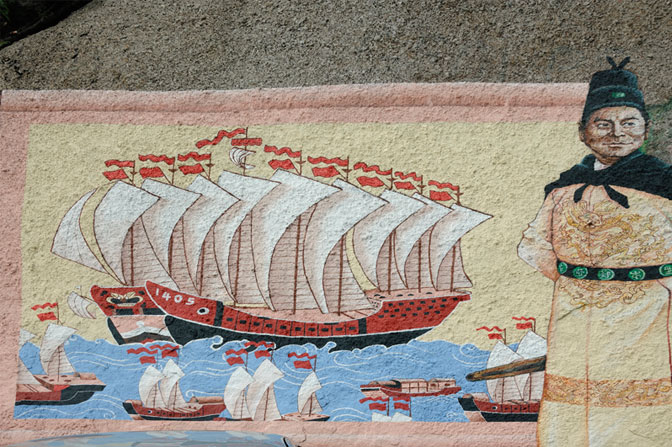
Almost a century before Christopher Columbus 'discovered' the Americas, Admiral Zheng He of the Ming Dynasty undertook voyages across the Indian and the Western Pacific Oceans. Photo credit: © Chris Hellier/Corbis
Admiral Zheng He. Almost a century before Christopher Columbus ‘discovered’ the Americas, Admiral Zheng He of the Ming Dynasty undertook voyages across the Indian and the Western Pacific Oceans. Photo credit: © Chris Hellier/Corbis

‘Globalization’ is among the biggest intellectual challenges facing the humanities and the social sciences today. It is a concept that conveys the sense that we are living in an age of transformation, where change is the only constant, nothing can be taken for granted, and no-one knows what the future might bring. But globalization is also much more than that. To borrow the phrase of the historical sociologist, Mike Savage, it is an ‘epoch description’, something that seeks to define for the current generation the very meaning of social change. By thinking of ourselves as part of a globalized world, we are saying something about how over time our identity has changed. We are locating ourselves in time, differentiating ourselves from our predecessors, signalling a break with what went before.

Champions of globalization are invariably concerned with the present. Their notion of time is unapologetically linear. Crudely exponential assumptions about the ever-increasing pace and scale of scientific and technological change are built into globalization’s teleology, and the belief that what we are experiencing today is as much incomparable as it is irreversible. ‘History’ is thus set to mean less and less for the present generation; the sense of the future as an outgrowth of the past is becoming less and less plausible. [continue reading]
History Carnival #140

Marc-William Palen
History Department, University of Exeter
Follow on Twitter @MWPalen

The veritable treasure trove of historical blogging never ceases to amaze me. It is therefore a pleasure to be hosting History Carnival #140 here at the Imperial & Global Forum for the month of December.

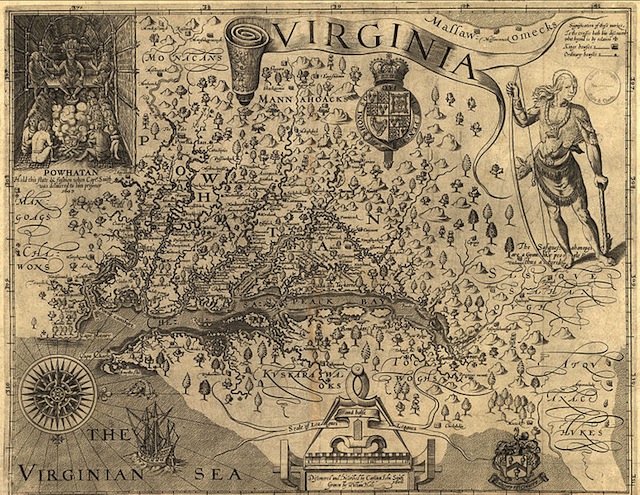
Map of Virginia, discovered and as described by Captain John Smith, 1606; engraved by William Hole (Via Wikimedia commons)

Some cautionary pieces to start off with: George Gosling offers a timely critique of historians’ ill-defined overuse of “transnational” in “The Trouble with Transnational History,” and Matt Houlbrook at the Trickster Prince warns that longue durée historians must be careful lest their focus upon policymakers shuts out the public.

Offering some new perspectives, Bradley Dixon, imagines how small the North American colonies of the British Empire would have appeared from the high vantage point of the Andes for Not Even Past. Unique views are also offered by Heather Campbell, who shifts the focus from Western Europe to the Muslim Middle East during the First World War over at Unspoken Assumptions, and Kelli Huggins, who gives a more literal meaning to dogs of war through her engaging and pictorial account of the canine veterans of the Second World War.

assassinscreedunityimagen

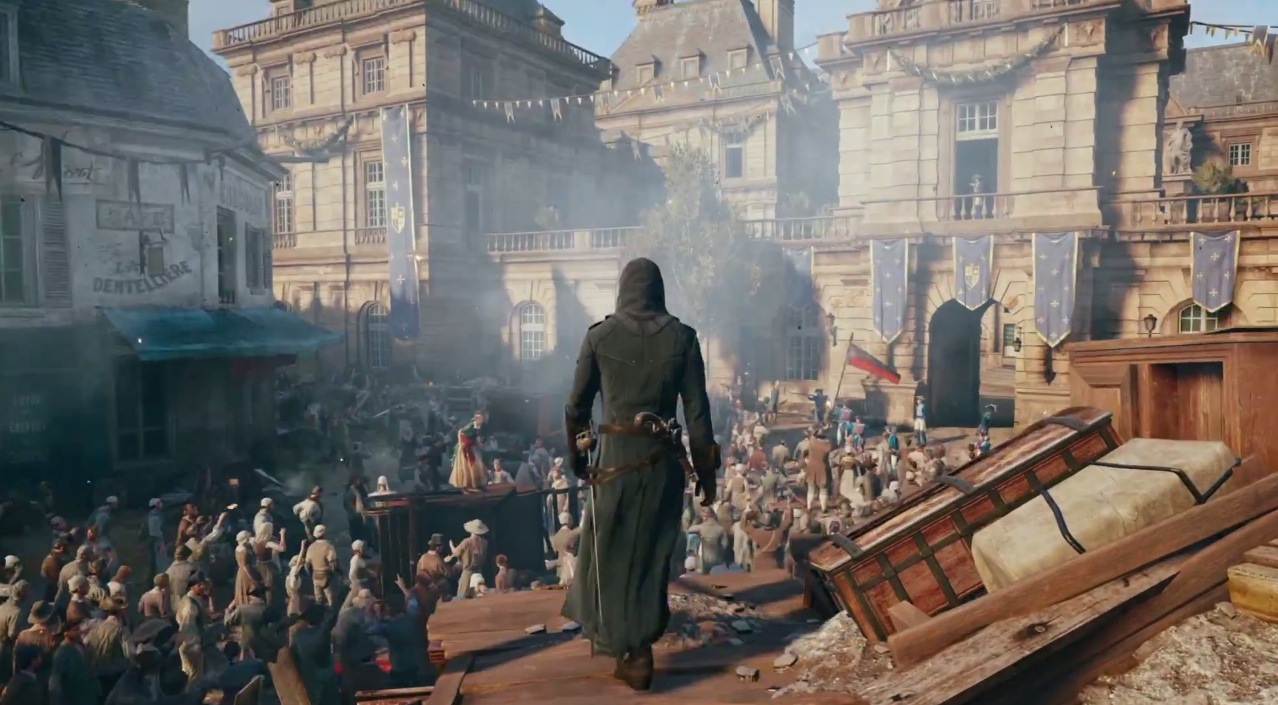
The French Revolution received its share of attention. With the example of the popular first-person game Assassin’s Creed Unity, which is set amid the 1790s French Revolution, David Andress argues that historians need to take video games seriously when they dip into the realm of history. And what about the ghost problem during the French Revolution’s Reign of Terror?

Some great detective work from medical historians, as well. Caroline Rance has a guest post at Victorian Supersleuth on the blackmail case “The Soldier and the Quack Doctor,” and Angela Buckley explores an encounter between the ‘real Sherlock Holmes’ and the case of a quack doctor’s dodgy elixir.

Jessica Borge provides a fascinating look at how “the Pill” transformed the 1960s contraceptive industry for the blog Perceptions of Pregnancy, and the Pirate Omnibus explores how the introduction of the communication chord transformed the railway. And we may love finding pieces of history at our local charity shop, but what about the change-over-time history of the charity shop itself?

oyster eating

Last but not least, if you haven’t yet encountered Dando the famous 19th-century gormandizing oyster eater, you can read all about him at All Things Georgian.

I hope you enjoy the posts in this month’s History Carnival. The next will be hosted at Performing Humanity on January 1st.