
Katie Baker, Emily Cooper, Gabriel Labrie, Nicla Pennacchio, and Esther Roza
Faculty: Kurt Feyaerts, KU Leuven; Richard Toye, University of Exeter; Matteo Basso, Iuav University of Venice; Geert Brône, KU Leuven; Claire Holleran, University of Exeter; Eliana Maestri, University of Exeter; Michela Maguolo, Independent researcher; Luca Pes, Venice International University; Paul Sambre, KU Leuven
As part of the Summer School, Linguistic Landscapes: Using Signs and Symbols to Translate Cities, our team was tasked with carrying out a case study starting from the Santa Maria Gloriosa dei Frari Basilica in the sestiere of San Polo, Venice.
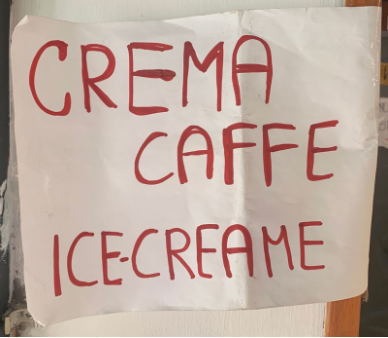
While exploring the area around the Frari, we noticed the following sign in front of a bar:
What does this divergent text tell us about the potential audience? What do the spelling mistakes tell us about the owner or the creator? (cf. Spolsky Handwritten bottom-up sign with divergent text 2008, 31). in Italian and English (Calle de le Chiovere)
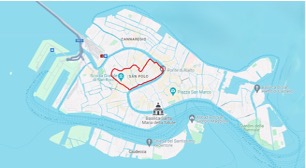
The questions raised by this image piqued our curiosity about multilingual signage. Therefore, we decided to focus on signs containing more than one language (cf. Backhaus 2005 on Tokyo and Moser 2020 on Luxembourg City). Due to time constraints, the shaded area of the sestiere was omitted for this analysis, thus limiting our evaluation to the streets immediately surrounding the Santa
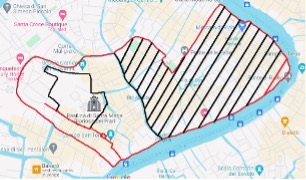
Maria Gloriosa dei Frari Basilica, which permeates the insulae of Frari and Nomboli. We also examined the shortest path from the Basilica to its closest vaporetto stop, San Tomà, as this is a common route taken by ourselves and other tourists (cf. Lynch 1960, 46−49).
Furthermore, only signs of the A4 format or larger were included. The size and language criteria allowed for systematic, thorough data collection in the defined area. Our final corpus accounts for 105 signs.
Continue reading “The Creame of the Crop: an Analysis of Multilingual Signs around the Frari, Venice”
 Imperial & Global Forum
You must be logged in to post a comment.