
Marc-William Palen
History Department, University of Exeter
From abandoning the delusions of empire to decolonizing sanctions, here are this week’s top picks in imperial and global history.
Britain needs to abandon its delusions of empire – giving up the Chagos Islands is a good start
Simon Jenkins
Guardian
The British empire still sends governments mad. Labour’s Foreign Office minister in charge of its lasting shreds, Stephen Doughty, has granted the isolated Chagos Islands in the Indian Ocean to the sovereignty of independent Mauritius. This modest act of decolonisation makes sense. But the government wants to retain a joint US-UK military base there. Why? Britain no longer rules India or Singapore. A base off India, even a shared one, is pure imperial show.
Doughty has 14 other “overseas territories” in his charge. Among them are Bermuda, Pitcairn, Montserrat, the Caymans, Ascension and Tristan da Cunha. The union flag will still fly over them; the Royal Navy will keep guard and sing the national anthem. Over the past half-century many territories, such as Belize, Tuvalu, the Seychelles and the Bahamas, have slid quietly into independence. Others have remained “dependent” on the king, with British citizenship and protection. [continue reading]
The Sordid History of Organized Labor’s Foreign Policy Sins
Hamilton Nolan and Jeff Schuhrke
How Things Work
If you have ever heard the derisive term “AFL-CIA,” you will want to read Jeff Schuhrke’s new book. In “Blue Collar Empire,” Schuhrke, a long time labor journalist and scholar, lays out the entire disturbing history of the American labor movement’s decades of close involvement in anticommunist crusades around the world. The reality of the AFL-CIO’s ties with the Cold War, the CIA, and America’s bloody foreign policy is, I assure you, much more astounding than you might think.
As the labor movement of today struggles to revive its power in the workplace, bring in new members, and act as a political force for peace in Gaza and elsewhere, the history that Schuhrke’s book covers burns with continued relevance. I spoke to him about the AFL-CIO’s sins of the past, what today’s union members should know, and how to make the labor movement less evil. Our interview is below. [continue reading]
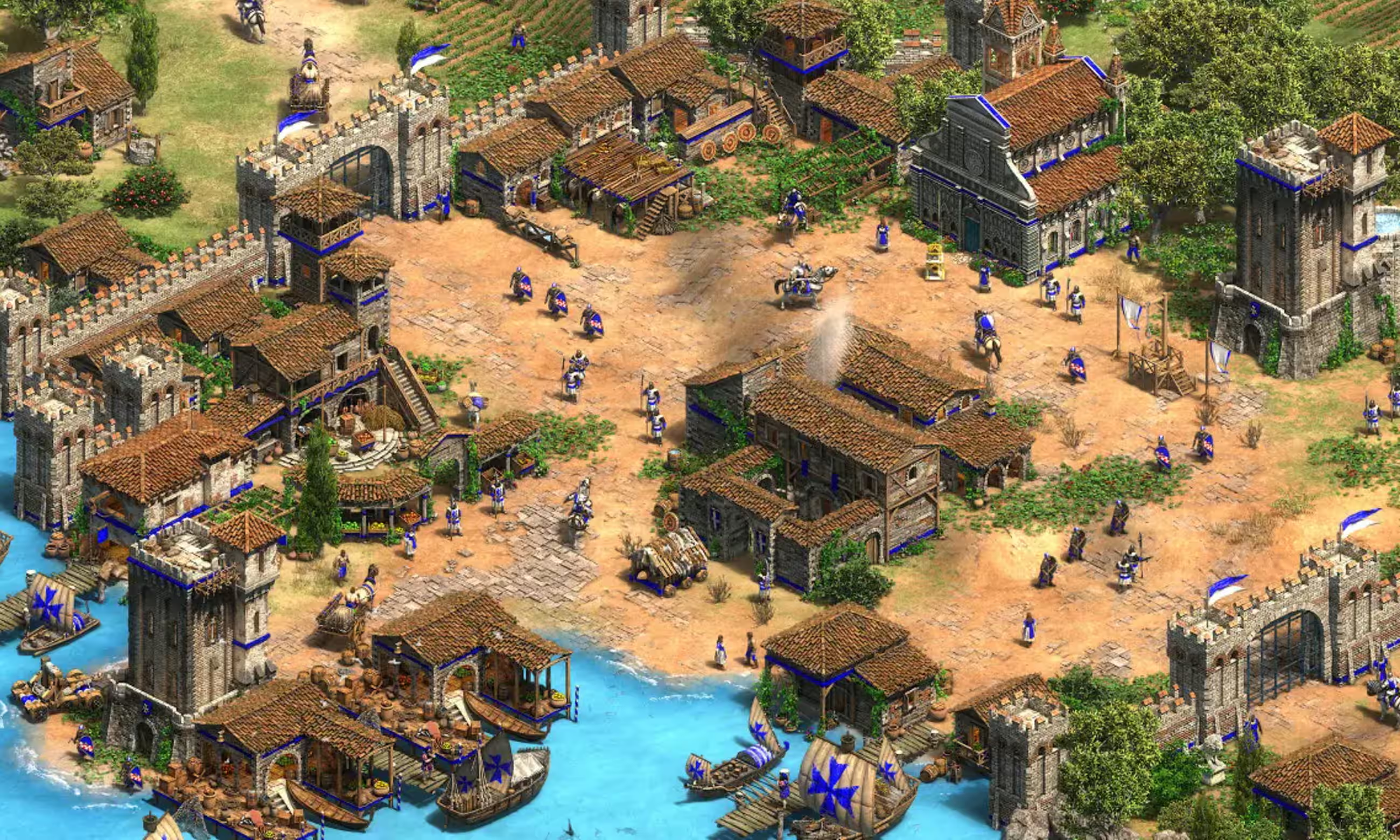
Age of Empires II at 25: the strategy game that inspired a generation of historians
Holly Nielsen
Guardian
My dad is the kind of man who will find a game he enjoys and stick to it. While I have always flitted about, hopping between different genres, he remains the only person I know who does absolutely everything it has to offer. When people ask, “who actually finishes these enormous games?”, I can respond with confidence that it is a geordie man in his 60s with a love of Lego and creative swearing. Age of Empires II had a grip on him for well over a decade.
The game came out in 1999, when I was five years old, and I am not exaggerating when I say that it was a permanent feature of our domestic life right up to when I moved out thirteen years later. The only thing that changed were the laptops he played on, which became progressively less bulky over the years. The sound effects, from the iconic “wololo” of the priests and the villagers’ warbles of acknowledgment as you sent them to chop wood, were the soundtrack to my childhood. [continue reading]
Decolonizing Sanctions
Jeena Shah
LPE Project
As Ntina Tzouvala has recently argued on this blog, a political-economic understanding of genocide can help explain what is unfolding in Gaza. It shows that the genocide should not be seen as an exceptional or isolated event, but as a violent tool to expedite what decades of settler apartheid couldn’t achieve on its own. It also elucidates why the solidarity efforts of the past two decades, particularly centered around “boycott, divestment, and sanctions” (BDS), transcend mere symbolism. Indeed, as recent student uprisings have stressed, BDS stands as a crucial instrument that, had it been more widely employed by the international community in support of broader Palestinian resistance, could have potentially averted the ongoing genocide.
Such calls for sanctions, however, may seem to stand in tension with another position widely held on the left: the condemnation of the United States’ deployment of economic sanctions as effectively neo-imperial warfare by other means. These justified critiques frequently overlook the important role that sanctions have played, first in support of the anti-apartheid struggle in South Africa, and today in support of Palestinian liberation. This unintentional oversight has, unfortunately, provided fodder for those who accuse current BDS campaigns of unfairly singling out Israel as a target, while ignoring the multitude of other states that commit grave human rights abuses. [continue reading]
 Imperial & Global Forum
You must be logged in to post a comment.