
Marc-William Palen
History Department, University of Exeter
From the Soundtrack to a Coup d’Etat to how China joined the global capitalist economy, here are this week’s top picks in imperial and global history.
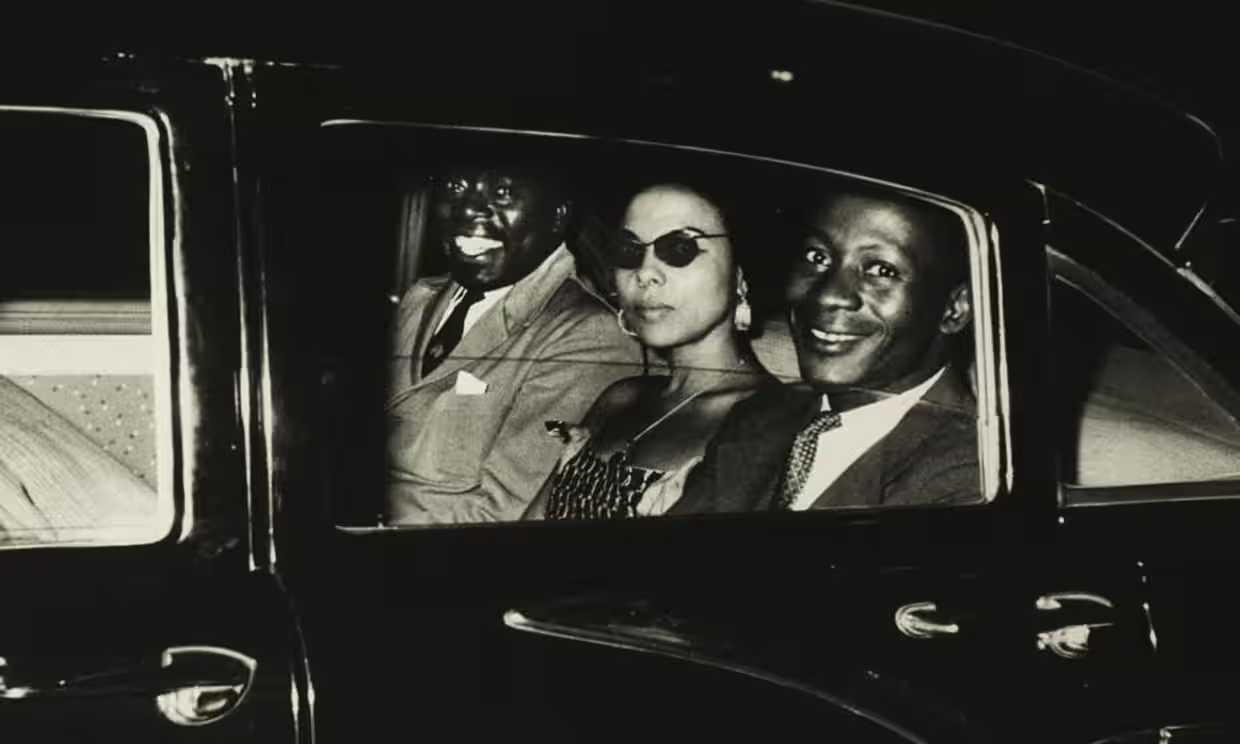
Soundtrack to a Coup d’Etat review – superb study of how jazz got caught between the cold war and the CIA
Wendy Ide
Guardian
It’s been quite a year for thrillingly inventive music documentaries. First there was Gary Hustwit’s Eno, a groundbreaking portrait of the pioneering musician, producer and artist that tore up the rules of cinema and reinvented itself with each new screening. And now there’s Belgian film-maker Johan Grimonprez’s dazzling Soundtrack to a Coup d’Etat, a breathtaking, ideas-packed journey that weaves together American jazz and the geopolitical machinations of the 1950s and 60s.
It’s almost reductive to describe this extraordinary essay film as a music documentary – it’s about so much: the cold war; the bloody fingerprints of colonialism in Africa; the 1961 assassination of Patrice Lumumba, prime minister of the newly independent Democratic Republic of the Congo; Nikita Khrushchev’s shoe. But linking it all is an eye-opening exploration of the politics of jazz, and the music itself, freewheeling and skittish and pulsing through every frame. [continue reading]
Documentary – Britain’s Nuclear Bomb scandal: Our story
BBC Two
This is the extraordinary story of Britain’s postwar atomic weapons programme and its devastating legacy. The film reveals the full extent of the British government’s nuclear tests in Australia and the South Pacific in the 1950s and 1960s.
39,000 British and Commonwealth servicemen witnessed 45 atomic and hydrogen bombs and hundreds of radioactive experiments. The documentary exposes the debilitating health conditions that have blighted the lives of veterans, descendants and indigenous communities ever since. [watch here]
I’m used to outsiders mangling Belfast’s history. So Say Nothing was a breath of fresh air
Rachel Connolly
Guardian
will admit that when I heard there was to be a TV adaptation of Say Nothing, based on Patrick Radden Keefe’s book of the same name, released on Disney+, I thought: “Oh no.” I had images of Florence Pugh or whoever got up in a red wig and painted-on freckles, prancing about the Ormeau Road with a petrol bomb in one hand and an Irish tricolour in the other. I pictured plummy English or haughty southern Irish accents with a few mangled Belfast “nowwws” thrown in for colour.
On reflection this wasn’t really to do with the book, a sober and well-researched account of a brutal murder. But more because there can tend to be a slightly goofy way of depicting, and interacting with, the complexity of the history in the place where I am from. Perhaps especially of late. [continue reading]
Was the USSR Producing Enough Food?
James David
National Security Archive
The failure of the U.S. intelligence community to adequately warn policymakers about the poor Soviet grain harvest of 1972—resulting in higher food prices in the U.S. and severe criticism of the Nixon administration—led the Central Intelligence Agency (CIA) to begin to rely on imagery from LANDSAT and classified photoreconnaissance satellite programs to improve its estimates of Soviet agricultural output, according to documents featured in a new National Security Archive Electronic Briefing Book written by James David, retired curator of national security space programs at the Smithsonian National Air & Space Museum.
The new collection consists of declassified intelligence reports, top-level policy memos, and other formerly secret records that illustrate and describe the evolution of U.S. efforts to monitor Soviet agricultural production during the Cold War—from the early reliance on human intelligence (HUMINT) reports to the use of sophisticated space technologies in the 1970s. [continue reading]
Odd Arne Westad on how China First Joined the Global Capitalist Economy
Odd Lots (Bloomberg)
How did China become the economic behemoth that it is today? One pivotal moment was, obviously, it’s ascension into the WTO. Prior to that, the era of reform under Deng Xiaoping was obviously crucial. But obviously no single event or turning point can really tell the story.
In a groundbreaking new book — The Great Transformation: China’s Road from Revolution to Reform — historians Odd Arne Westad and Chen Jian tell the full story of how China went from being an impoverished, highly planned communist economy to the dynamic capitalist economy it is today. We spoke with Westad, a professor at Yale, about this book, and what people get wrong about China’s big opening up. [listen here]
 Imperial & Global Forum
You must be logged in to post a comment.