
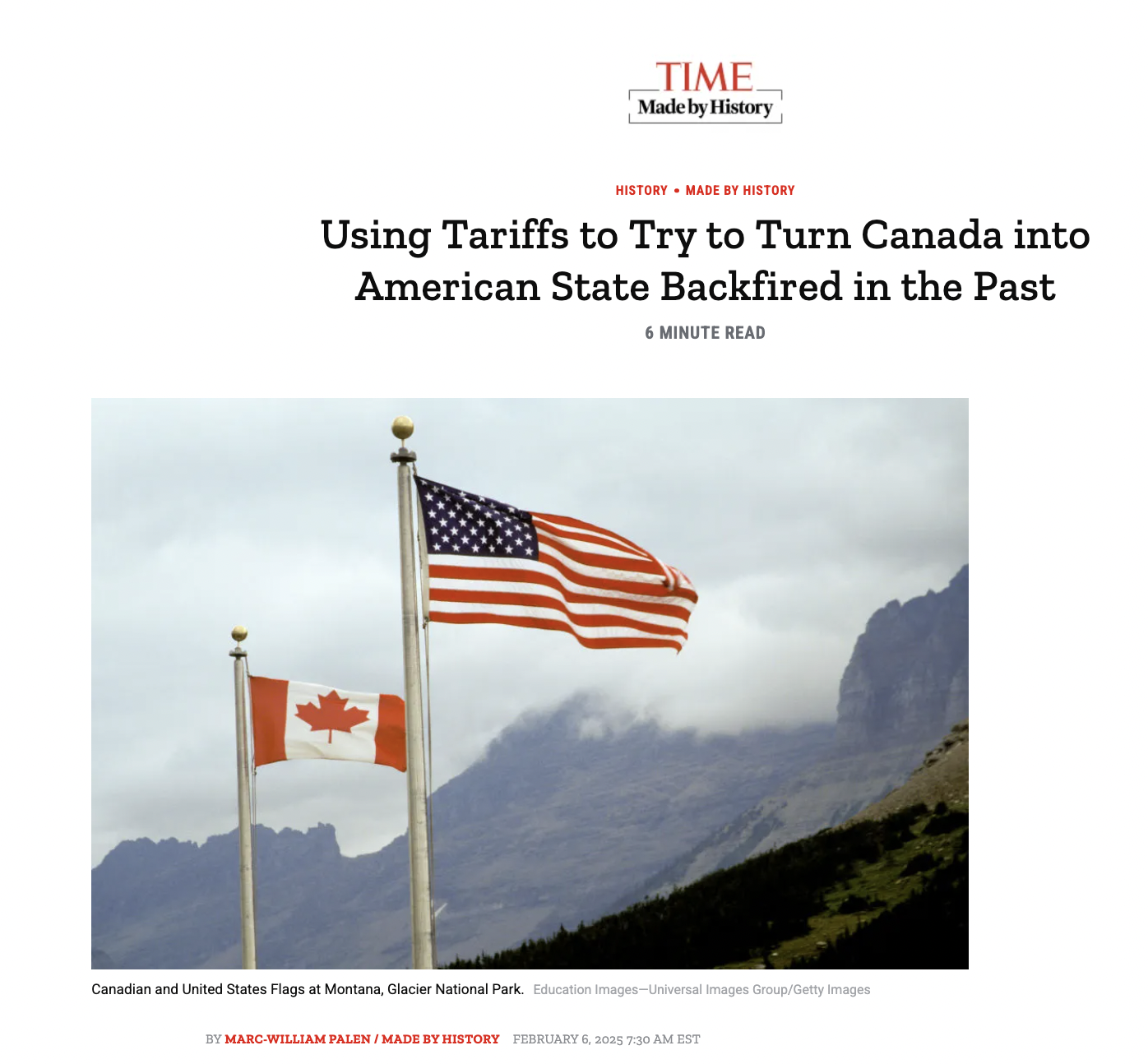
Marc-William Palen
History Department, University of Exeter
“Tariff Man” Trump continues to tear up the trading system while also making imperial demands for territorial expansion. To just about everyone’s surprise, his grand colonial scheme to “make America great again” now includes making Canada the 51st state – and using the threat of punitive tariffs to get what he wants.
Some, like the Washington Post‘s Max Boot, have been making the case that Trump’s coercive use of tariffs to obtain concessions “unrelated to trade” is “novel.”
But though Trump often cites 19th-century pro-tariff President William McKinley as his inspiration, Trump is using tariffs quite differently from the way that most other U.S. presidents — or other world leaders — have used them. Typically, tariffs are enacted either to raise revenue or to protect domestic industries from foreign competition. Trump, by contrast, is using tariffs as a coercive instrument of statecraft to achieve aims that are unrelated to trade.
Boot’s piece raises good points of comparison, including parallels with Chinese economic coercion today. And I agree that the results of Trump’s tariffs will likely be a net negative for the United States.
But I disagree that Trump’s coercive use of tariffs is new; rather, it’s straight out of the GOP’s old protectionist playbook.
GOP’s Coercive Use of Tariffs to Annex Canada in 1890s
I’ve recently laid out one such case for Time, about when the GOP used the highly protectionist 1890 McKinley Tariff with the aim of coercing the annexation of Canada.
And let’s just say that it didn’t work as planned.
To pressure Canada into joining the U.S., the McKinley Tariff explicitly declined to make an exception for Canadian products. Republicans hoped that Canadians, who were becoming ever more reliant on the U.S. market, would be eager to become the 45th state to avoid the punishing tariffs.
Secretary of State James G. Blaine saw annexation as a way to eliminate continued and contentious competition over fish and timber. Blaine, who co-authored the McKinley Tariff, publicly stated that he hoped for “a grander and nobler brotherly love, that may unite in the end” the United States and Canada “in one perfect union.” Blaine declared himself “teetotally opposed to giving the Canadians the sentimental satisfaction of waving the British Flag. . . and enjoying the actual remuneration of American markets.” Privately, he admitted to President Benjamin Harrison that by denying reciprocity, Canada would “ultimately, I believe, seek admission to the Union.”
[…] Like Trump, Republicans in the late 19th century wanted to annex Canada—which was then still a British colony. The push to make Canada part of the U.S. reached a fever pitch following passage of the highly protectionist McKinley Tariff in 1890, which raised average tariff rates to around 50%
[…] Once again, an American president is on the brink of imposing tariffs against Canada and pushing for annexation. The two issues will undoubtedly be central in the 2025 Canadian elections. Trump’s threats could easily backfire as the McKinley Tariff did—leading to the election of Canadian politicians who promise to stand up to him, respond tit-for-tat to any tariffs he enacts, and seek other trade partners instead. The result would be U.S. consumers paying the price at checkout lines. U.S. manufacturers might also decide to relocate to Canada. And the tariff spat could spark further conflicts with Canada down the road. In other words, “Tariff Man” Trump would once again be cutting off his country’s nose to spite Canada.
So that’s how the GOP tried to use punitive tariffs, alongside the witholding of reciprocal trade, to annex Canada through the 1890 McKinley Tariff, a pivotal moment that is explored in much greater detail in my 2016 book, The “Conspiracy” of Free Trade: The Anglo-American Struggle over Empire and Economic Globalisation, 1846-1896 (Cambridge University Press, 2016).

GOP’s Coercive Use of Tariffs to Expand Political Control in Cuba, c. 1901
At other times, however, the protectionist GOP proffered reciprocity for coercive political ends.
As I’ve previously discussed for the Washington Post during Trump’s first term, his “favorite word” – reciprocity – had provided the GOP with a go-to coercive unilateral and conditional tool of retaliation since the 1890s that, in some cases, allowed for the US to assert political as well as economic control over reluctant signatories, as with Cuba.
The Gilded Age GOP, paranoid about the threat posed by the free-trading British and fearful of multilateralism, implemented its restrictive trade vision through the reciprocity provisions contained in the highly protectionist 1890 McKinley Tariff. Then, as with Trump today, the GOP’s version of reciprocity was bilateral and conditional. Any mutually agreed upon tariff reductions would apply only to the United States and the other signatory, thereby limiting the extent of trade liberalization to the two countries involved.
[…] In 1892, Republican President Benjamin Harrison ran for reelection on the campaign slogan “Protection and Reciprocity.” (He even owned two pet opossums named “Mr. Reciprocity” and “Mr. Protection.”) The 1896 Republican platform likewise called these “twin measures of Republican policy” that “go hand in hand.”
The coercive connotations of Republican-style reciprocity took on ever more imperial dimensions by the turn of the century. After the War of 1898, the United States formally acquired numerous colonies in the Caribbean and the Pacific from the vanquished Spanish Empire. While the former Spanish colony of Cuba remained independent in principle at the turn of the century, Republican President Theodore Roosevelt worked to make it akin to a U.S. colony in practice through reciprocity.
In his 1901 message to Congress, Roosevelt recognized that “reciprocity must be treated as the handmaiden of protection” and should be extended to Cuba. Elaborating on this, he then explained that reciprocity would give the United States informal control of “the Cuban market and by every means to foster our supremacy in the tropical lands and waters south of us.”
The last paragraph is worth highlighting here, and not just because Trump, to inaugurate “Made in America” week in 2017, declared that “reciprocity must be treated as the handmaiden of protection” — a phrase lifted straight from Teddy Roosevelt’s 1901 message. But also because it was in the context of using “protection and reciprocity” not only to expand US economic control over signatories, but also political control.

GOP Use of Tariffs to Limit Immigration
I’m not persuaded that immigration issues are “utterly disconnected to trade,” as one expert was quoted in Boot’s Washington Post piece referenced at the start. But for the sake of argument let’s assume they are disconnected.
If so, then here, too, we can find historical precedents from the GOP’s protectionist past where they used tariffs for political anti-immigration ends: during the presidency of William McKinley, and with the explicit support of the Republican-controlled Supreme Court by way of the 1901 Downes v. Bidwell decision.
As I’ve discussed previously for the History News Network, the Australian, and here at the Imperial & Global Forum, the Supreme Court’s legislative backing of tariffs against its own colony – Puerto Rico – transcended trade issues.
By declaring that the Constitution did not apply to the newly acquired US colonies (et al. Puerto Rico and the Philippines) following the recent US war with Spain – that “the Constitution follows the flag…but doesn’t quite catch up with it” as Secretary of War Elihu Root put it in 1901 – it meant that the US government could levy tariffs against them. As I noted back in 2017:
The Supreme Court’s legal decision in Downes v. Bidwell (1901) became the first of the now-infamous Insular Cases. By allowing McKinley and Congress to implement protective tariffs upon Puerto Rican goods rather than granting them free access to the American market, the decision “decreed” that the Constitution “does not follow the flag.”
In The “Insular Cases” and the Emergence of American Empire, Bartholomew Sparrow has reminded us how the Supreme Court’s decisions had long-lasting ramifications for American imperialism. As late as 1922, in Balzac v. Porto Rico, the Supreme Court held that Puerto Ricans, while U.S. citizens, were not guaranteed the rights of the U.S. Constitution.
The decision also made it easier to restrict immigration from the colonies to the mainland United States.
Why? Because if the Republican protectionist administration had allowed for the Constitution to follow the flag, this would have meant treating the colonies like the mainland US states and territories. This, then, would have meant that the colonial inhabitants could have migrated to the United States without restriction.
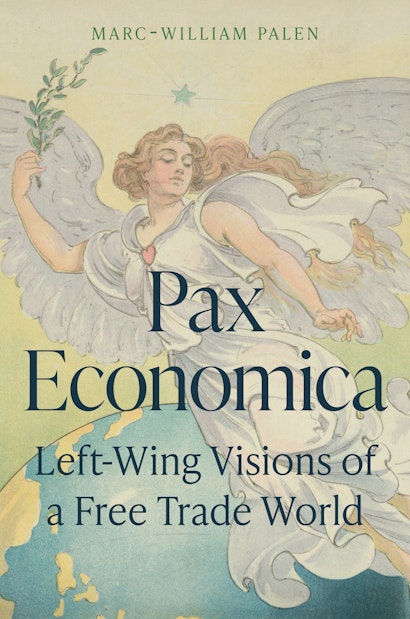
I’ve made this very point in my newest book Pax Economica: Left-Wing Visions of a Free Trade World (Princeton University Press, 2024).
“Your votes for Free-Trade, your votes for the phantom [anti-imperial] politics of the flag following the Constitution,” warned Congressman Charles Grosvenor (R-OH) in 1900, “is but a declaration that the Sulus, the Tagals, the Filipinos and all the enormous horde of foreigners in Asia that have come to us as a possession” could pour into the United States in “overwhelming columns of cheap — oh, how cheap! — low, degraded labor.” Similar fears were raised about migrants from the nation’s Caribbean colonies. The protectionist news organ American Economist reiterated Gunton’s Magazine’s racialist demand that Puerto Rico and Hawai’i “be permanently annexed as colonies, with no rights of American citizenship or statehood,” so as to restrict immigration and foreign representation in Congress, and to set an imperial “precedent for Cuba, if it should eventually be annexed.” The US Supreme Court gave the xenophobic protectionist empire its legal seal of approval beginning with its 1901 decision in Downes v. Bidwell, which effectively ruled that the US government could inforce ad hoc tariff policies upon its colonies, in contrast to an internal policy of free trade that existed among the US states.
The Insular Cases, stemming from a US tariff on Puerto Rican oranges, have since been used to justify detainment of prisoners at the US naval facility in Guantánamo Bay, Cuba (“acquired” by the US in 1903).
You know, that place that Trump has just refashioned into a migrant detention camp.
Conclusion
The GOP’s imperial brand of protectionism has a long and checkered history that stretches back to the 1890s and early 1900s: a coercive past that remains with us still. It’s been used to annex territory, to exert political control over foreign states, to restrict immigration, and, now, to detain migrants in Cuba.
In other words, Trump’s coercive use of tariffs for issues beyond trade isn’t new – it’s a return to the Republican Party’s protectionist roots.
 Imperial & Global Forum
You must be logged in to post a comment.