
Marc-William Palen
History Department, University of Exeter
From life in Cuba under sanctions to liberal internationalism after USAID, here are this week’s top picks in imperial and global history.
Life in Cuba Under Sanctions
David Montgomery
Nation
Germinares Cardero Céspedes lives in hilly Segundo Frente, a coffee-growing community at the eastern end of Cuba where Fidel Castro’s rebels established a second front in their 1959 revolution. At 89, Cardero seems full of vigor, but his heart is failing, just when his country is suffering its worst economic crisis since the revolution. He grew up working the land outside Santiago, Cuba’s second-largest city. He raised five children, who gave him 15 grandchildren and eight great-grandchildren. He retired from an agricultural cooperative with a pension of 1,550 pesos a month. That used to provide a meager living but now won’t even buy two bottles of cooking oil.
Two years ago, this man who’d hardly been sick a day in his life began having fainting spells, says his grandson Lisneydi Cardero Diéguez, 40, a physical education teacher. Doctors said he urgently needed a pacemaker—but there was a national shortage. The only option was to harvest a device from the chest of a patient who had died of other causes, sterilize it, and implant it in Cardero Céspedes. Afterward, the retired campesino felt as good as new. The catch was that the recycled pacemaker had just two years of battery life left. [continue reading]
Eurodeterrent: A Vision for an Anglo-French Nuclear Force
James Cameron
War on the Rocks
Recently published Signal discussions in which senior Trump administration officials admit they “hate bailing out” America’s “pathetic” European allies have cast fresh doubt on the U.S. commitment to defending Europe. Even before these revelations, what Poland’s Prime Minister Donald Tusk described as “a profound change of [sic] American geopolitics” had already provoked reappraisals across Europe of the future of nuclear deterrence on the continent.
In this new reality, Washington’s European allies are faced with three options: continue to rely on what they consider a weakened security guarantee backed by U.S. extended nuclear deterrence; pursue further nuclear proliferation; or develop an independent deterrent comprising the nuclear forces of France and the United Kingdom. [continue reading]
The Exorbitant Price of Trump’s Tariffs
Daniel W. Drezner
Drezner’s World
This week the Trump administration is scheduled to announce yet more tariffs. The president has characterized this as “Liberation Day” for the United States.1 But the economic price of these tariffs has become visible. The stock market just experienced its worst quarter in three years “as the Trump administration’s evolving trade policies rattle Wall Street,” according to the Washington Post.
But surely the tariffs will yield some economic gains, right? Well… the Economist is, shall we say, skeptical about how this will play out. [continue reading]
The US government is effectively kidnapping people for opposing genocide
Moira Donegan
Guardian
he abductors wore masks because they do not want their identities known. On Tuesday evening, Rumeysa Ozturk exited her apartment building and walked on to the street in Somerville, Massachusetts – a city outside Boston – into the fading daylight. Ozturk, a Turkish-born PhD student at Tufts University who studies children’s media and childhood development, was on her way to an iftar dinner with friends, planning to break her Ramadan fast.
In a video taken from a surveillance camera, she wears a pink hijab and a long white puffer coat against the New England cold. The first man, not uniformed but wearing plain clothes, as all the agents are, approaches her as if asking for directions. But he quickly closes in and grabs her by the wrists she has raised defensively toward her face. She screams as another man appears behind her, pulling a badge out from under his shirt and snatching away her phone. Soon six people are around her in a tight circle; she has no way to escape. They handcuff her and hustle her into an unmarked van. Attorneys for Ozturk did not know where Immigration and Customs Enforcement (Ice), the US homeland security department that has become Trump’s anti-immigrant secret police, had taken the 30-year-old woman for almost 24 hours. [continue reading]
Quakers condemn police raid on Westminster Meeting House
Quakers in Britain
Quakers in Britain strongly condemned the violation of their place of worship which they say is a direct result of stricter protest laws removing virtually all routes to challenge the status quo. Just before 7.15pm more than 20 uniformed police, some equipped with tasers, forced their way into Westminster Meeting House. They broke open the front door without warning or ringing the bell first, searching the whole building and arresting six women attending the meeting in a hired room.
The Police, Crime, Sentencing and Courts Act 2022 and the Public Order Act 2023 have criminalised many forms of protest and allow police to halt actions deemed too disruptive. Meanwhile, changes in judicial procedures limit protesters’ ability to defend their actions in court. All this means that there are fewer and fewer ways to speak truth to power. [continue reading]
Liberal internationalism after USAID
Margot Tudor
Africa is a Country
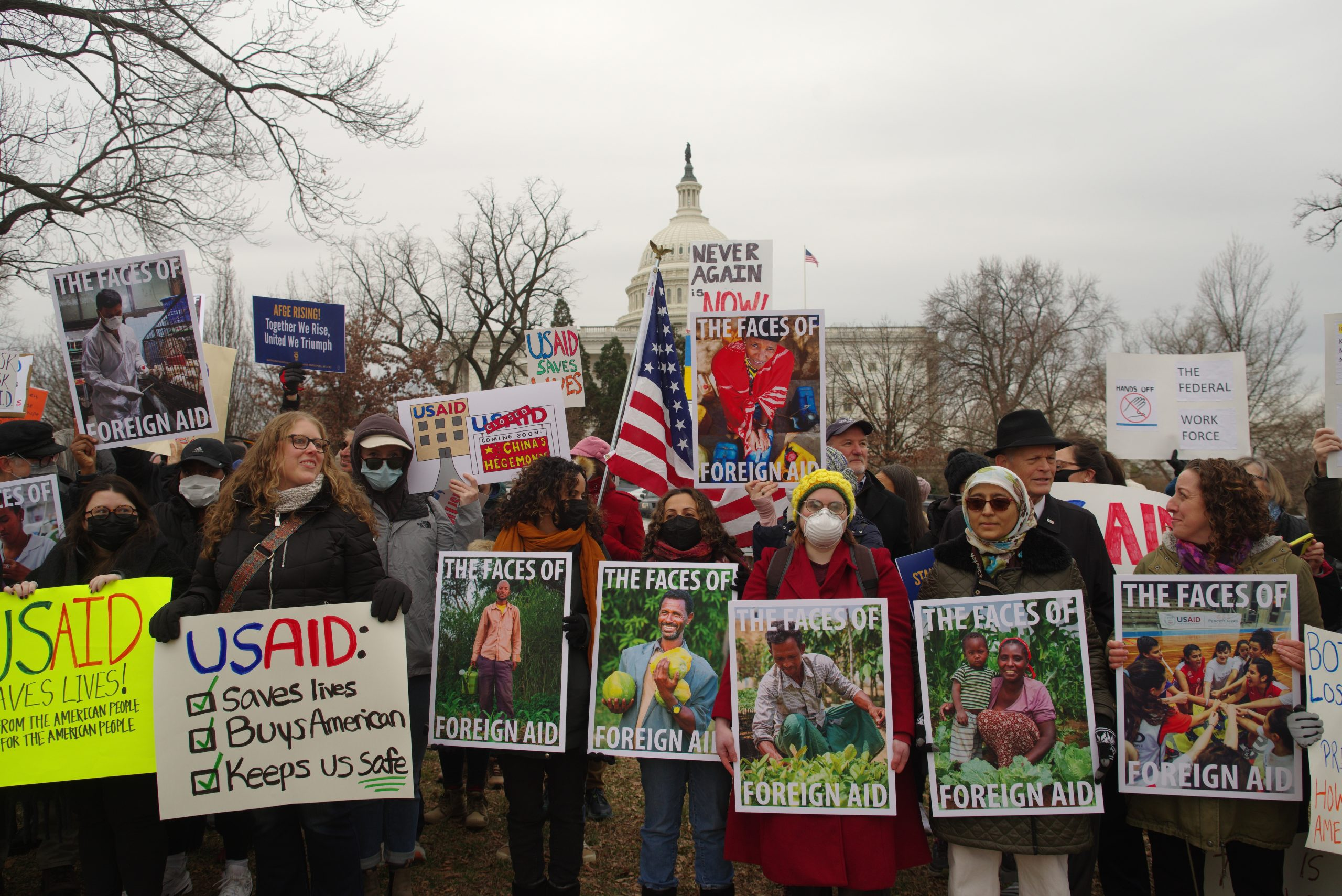
In the aftermath of President Donald Trump’s recent decision to dismantle USAID, liberal internationalists have rallied, galvanized by the attack to defend the value of their institutions. Established by President John F. Kennedy in 1961, USAID formalized US humanitarian relief efforts and diplomatic interventions in the Global South, especially—as I have written elsewhere—during the Congo Crisis, at a height in the transformative era of decolonization and the Cold War.
Trump’s plan has frozen more than 90 percent of USAID’s global operations as one of many perceived sites of state overspending and threatens unemployment for around 10,000 people. On February 21, 2,000 federal employees were put on immediate leave and given 15 minutes to pack their desk. Footage of these employees leaving the headquarters building has gone viral. Similarly, British Prime Minister Keir Starmer recently announced plans to cut the UK international aid budget from 0.5 percent to 0.3 percent in order to sustain an increase to defense spending over the next two years. Beyond compassion for individual ex-employees, this wave of cuts has provoked a defensive reaction from those in the international humanitarian sector: If one of us is under attack, we all are. [continue reading]
 Imperial & Global Forum
You must be logged in to post a comment.