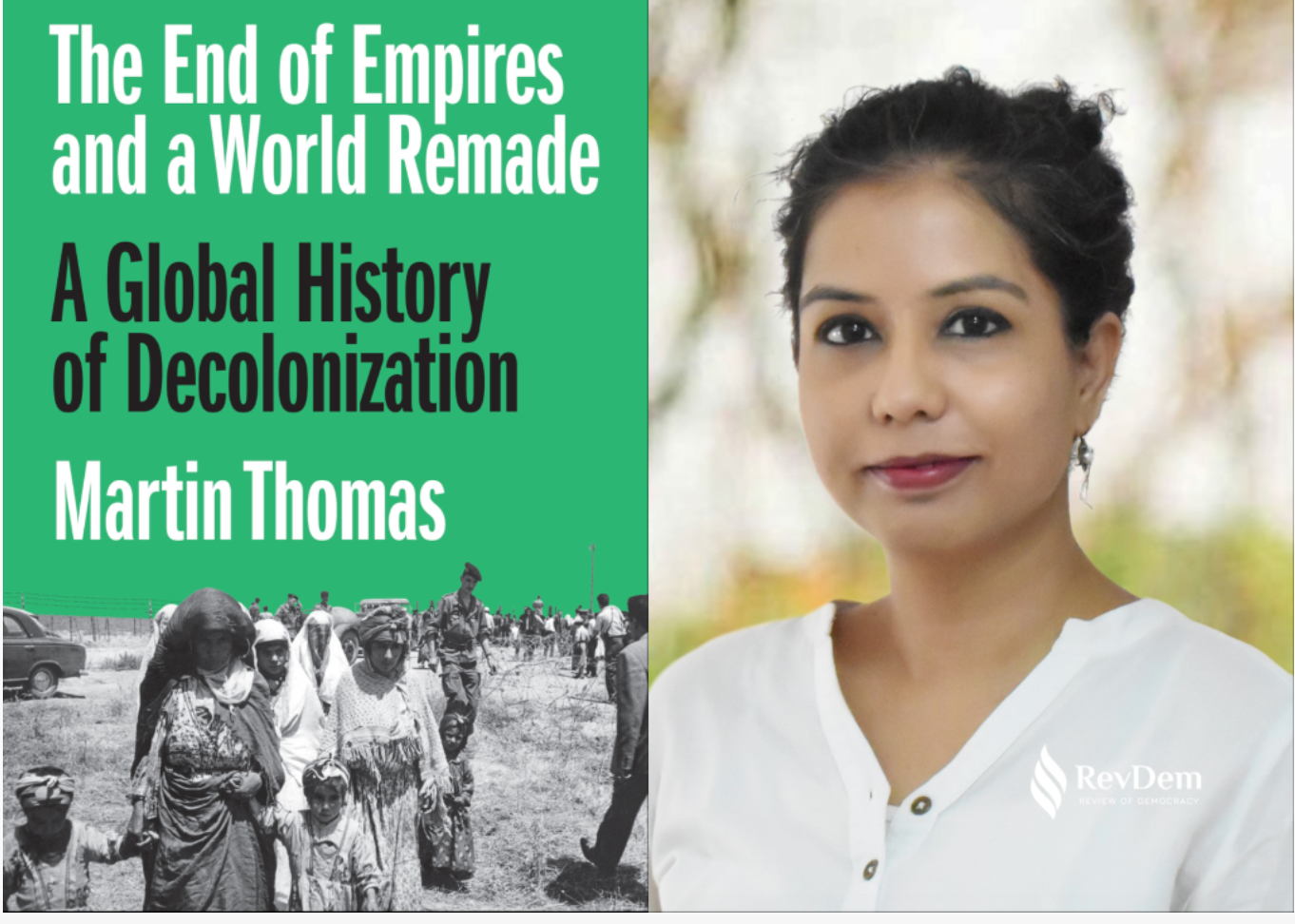
Dr. Anubha Anushree reviews Martin Thomas’s The End of Empires and the World Remade: A Global History of Decolonization, Princeton University Press, NJ, March 2024, 608 pages.
The title of Martin Thomas’s The End of Empires and a World Remade: A Global History of Decolonization signals the ambitious and unconventional nature of his now widely acclaimed project. From the outset, Thomas frames decolonization not simply as a linear dismantling of empires, but as a complex and often contradictory process—one that simultaneously disintegrated old hierarchies and gave rise to new, and sometimes equally exclusionary, national orders. His emphasis on decolonization as a reintegrative force highlights how the collapse of imperial structures often yielded unstable, improvised formations of authority and belonging. The process was deeply entangled with the rise of nationalism and the promise of democracy—two forces that could be emancipatory but also repressive, generative yet limiting. Offering a global history of decolonization is no small task—it requires navigating this terrain of ambivalence, where the struggle for freedom often reproduced new forms of domination, and where the language of democracy could both expand and foreclose political possibilities.
What distinguishes Thomas’s book is precisely this encyclopaedic ambition to capture decolonization in its mutating forms across various parts of the world. Spanning a vast geographical terrain and the turbulent decades between the 1940s and 1990s, the book begins with a striking anecdote: the celebration of Kenyan independence in Nairobi on December 11, 1963. Seen through the eyes of Labour MP Barbara Castle, a vocal advocate for Kenyan independence in the British Parliament, the scene encapsulates the contradictions of decolonization. A regimental band plays Auld Lang Syne, evoking the solemn grace of British ceremonial tradition, even as Castle herself arrives late, scrambling over a fence and tearing her dress in the process. This chaotic juxtaposition—the orchestrated rituals of empire alongside the messy reality of postcolonial transition—mirrors the broader argument of the book: decolonization was not simply the rejection of colonial rule but an unpredictable leap into nation-building, improvisation, and disorder.
Thomas’s study interrogates these contradictions by expanding the definition of decolonization. It is not merely, as he writes, “the concession of national self-determination to sovereign peoples” (13), but also a generative force that “energized different ideas of belonging and transnational connections” (4).
Delivered on Wednesday 14th May, 16:00-17:00, Building One, Constantine Leventis Room
Recent years have been characterised by a range of debates about the legacies of the settler colonial past and how they should inform the state’s relationship with indigenous peoples. With the recent rejection of an ‘indigenous voice to parliament’ in Australia and ongoing efforts to redefine the state’s relationship with the Treaty of Waitangi in New Zealand it may seem that established postcolonial settlements are under threat. David’s inaugural lecture reflects on how recent public debates offer new opportunities to reconsider the contested history of settler democracy. The lecture focuses on three examples from the turn of the 20th century, which challenged understandings of ‘British’ democracy: the craze for debating societies among the unenfranchised, the growth of Maori parliaments, and the pioneer Indian MPs at Westminster.
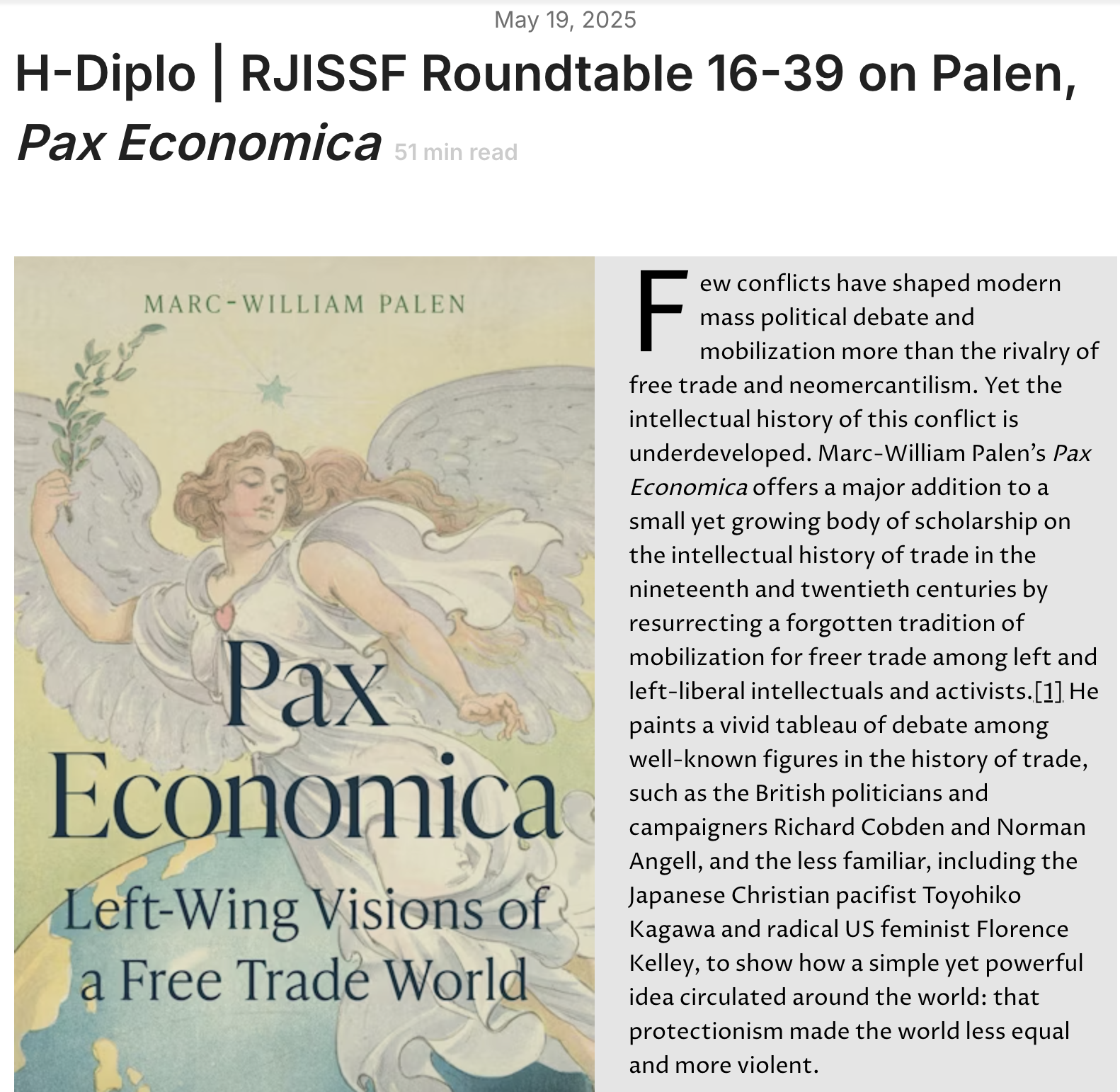
Few conflicts have shaped modern mass political debate and mobilization more than the rivalry of free trade and neomercantilism. Yet the intellectual history of this conflict is underdeveloped. Marc-William Palen’s Pax Economica offers a major addition to a small yet growing body of scholarship on the intellectual history of trade in the nineteenth and twentieth centuries by resurrecting a forgotten tradition of mobilization for freer trade among left and left-liberal intellectuals and activists.[1] He paints a vivid tableau of debate among well-known figures in the history of trade, such as the British politicians and campaigners Richard Cobden and Norman Angell, and the less familiar, including the Japanese Christian pacifist Toyohiko Kagawa andradical US feminist Florence Kelley, to show how a simple yet powerful idea circulated around the world: that protectionism made the world less equal and more violent.
Like any political concept, “free trade” is riddled with tensions. What did it mean, say, for a free trading imperialist in the British Empire, who praised its pacifying effects while defending its enforcement at gunpoint in places like India and China? And how could anticolonial visions of trade, which gained steam after the First World War, be squared with the ambitions of postcolonial states to jumpstart their development with protections? By focusing on debates like these, Palen unsettles common associations of free trade with the right or the neoliberal center, showing how, for example, it was an important socialist cause before the dawn of the Cold War. He even suggests the existence of a long-lost “Marx-Manchester” synthesis (93), which was once so tight that to be labeled a free trader, such as during the first US Red Scare in 1919–20, could be tantamount to being called a Bolshevik.
Palen’s book is full of bold arguments and unexpected details, from the tracts of anarchist free traders in Meiji Japan to Georgist designs for the boardgame that eventually became Monopoly.[2]It leaves the reader with the distinct feeling that the twenty-first century is weighed heavily by unresolved political questions from the nineteenth about the relationship of globalization and war, the effects of freer trade on domestic equality and distributional conflict, and the uses of tariffs for both developmentalist and reactionary political projects. The resurgence of old neomercantilist ideas in the 2020s, particularly on the right, Palen concludes, has left an opening for the return of equally old left visions of a “free trade world.” And so the conflict continues.
All four reviewers in this roundtable agree that Palen’s book is empirically rich and deeply researched, perspectival-shifting, and timely. David Ekbladh emphasizes the complexity and sophistication of the worldviews of the protagonists Palen uncovers, including pacifists who espoused deep understandings of the relationship of military power and economics. He also praises Palen for casting a staple figure of US mid-twentieth-century history, the Tennessee politician and Secretary of State Cordell Hull, in new light, which shows how Hull unexpectedly acquired a mass following, ultimately winning the Nobel Peace Prize. Palen argues that far from being a “contrivance to mask hegemony,” as Ekbladh puts it, US free traderism at the end of the Second World War had a deep well of support among a broad coalition of political activists and social movements.
Francine McKenzie similarly praises the diversity of voices in Palen’s work, its global reach, and the complexity of its depiction of the “sticky concept” of free trade. She also poses a series of queries for the book’s protagonists: how did they actually think lowering tariffs would, in practice, translate into emancipatory politics; and what made them optimistic about the prospects for a cause that had a relatively poor track record? She also emphasizes, as Palen agrees, that rediscovering the anti-imperialism of some free traders does not make free trade imperialism any less valid an analytic concept. McKenzie suggests a valuable point of departure for further research which involves an equivalently broad intellectual history of protectionism, which was not only a foil for free traders, but itself a cause that inspired many different movements and political actors. Here, the recent work of Eric Helleiner is key.[3]
Sandrine Kottsimilarly emphasizes the important contributions Pax Economica makes to the study of internationalisms and peace movements. She adds further complexity to the story by showing how the Soviet bloc’s Council for Mutual Economic Assistance (COMECON) adopted free trade ideas during the Cold War. A similar point has recently been made by Oscar Sanchez-Sibony, who argues that Soviet leaders mobilized market ideas against the protectionist and market-distorting policies of their Western rivals.[4] Kott also suggests that a study which draws on other European contexts (as well as on Catholic thinkers as much as Protestants) could offer an important complement to Palen’s story, which is largely rooted in Anglo-American ideas and their global dissemination.
Martin Conwayagrees that Palen’s work forces us to rethink assumptions about free trade ideas serving simply as a cloak for narrow economic or geopolitical interests, or as a “lost cause espoused by a fringe of naïve liberal groups.”At the same time, Conway also points to the challenges faced by globally-focused intellectual histories. He notes that as much as showing what united otherwise very different writers, it is equally important to consider the specific and context-bound nature of their political aims. The dissemination of free trade ideas, as Palen’s book shows, was itself driven by “Western globalization.” But these ideas took on lives of their own as they intersected with an array of political causes—from Indian independence to Chinese Nationalism to interwar US feminism.
These rich suggestions for future research and debate, and Palen’s response to his reviewers, all speak to the ambition and vision of Pax Economica—and to the importance of the story it tells for the politics of our own time.
Contributors:
Marc-William Palen is a historian at the University of Exeter. He is editor of The Imperial & Global Forum and co-director of History & Policy’s Global Economics and History Forum in London. His newest book, Pax Economica: Left-Wing Visions of a Free Trade World (Princeton University Press, 2024) was named one of Financial Times’ “best books of 2024” and made the New Yorker’s 2024 “best books” list. He is also author of The “Conspiracy” of Free Trade: The Anglo-American Struggle over Empire and Economic Globalisation, 1846–1896 (Cambridge University Press, 2016).
Jamie Martin is Assistant Professor of History and of Social Studies at Harvard University. He is a historian of international political economy, empire, and the world wars. His book, The Meddlers: Sovereignty, Empire, and the Birth of Global Economic Governance (Harvard, 2022), received the 2023 World History Association Connected Book Award and the 2023 Transatlantic Studies and Cambridge University Press Book Prize and was shortlisted for the 2023 Susan Strange Best Book Prize. He is now writing a history of the world economy during the First World War. His public writing has appeared in The New York Times, London Review of Books, The Guardian, The Nation, n+1, and Bookforum.
Martin Conway is Professor of Contemporary European History at the University of Oxford. He is the author of a number of works on different aspects of the history of twentieth-century Europe, including Western Europe’s Democratic Age, 1945–1968 (Princeton University Press, 2020), which has also appeared in an Italian translation: L’età della democrazia (Carocci, 2023).
David Ekbladh is Professor of History and core faculty in International Relations at Tufts University. His books include, Beyond 1917: The United States and the Global Legacies of the Great War (with Thomas Zeiler and Benjamin Montoya, Oxford University Press, 2017), TheGreat American Mission: Modernization and the Construction of an American World Order (Princeton University Press, 2010), which won the Stuart L. Bernath Prize of the Society of Historians of American Foreign Relations, and Plowshares into Swords: Weaponized Knowledge, Liberal Order, and the League of Nations (University of Chicago Press, 2022).
Sandrine Kott is a full Professor of Modern European History at the University of Geneva and Visiting Professor at New York University. She has studied History in Paris, the University of Bielefeld, (FRG), and Columbia University (New York). Her main fields of expertise are the history of social welfare and labor in France and Germany since the end of the nineteenth century and labor (and power) relations in those countries of real socialism, in particular in the German Democratic Republic. In Geneva she has developed the transnational and global dimensions of each of her fields of expertise by taking advantage of the archives and resources of international organizations and particularly of the International Labor Organization. She has initiated in 2009 the History of International Organizations Network, a collaborative online research platform and seminar series http://www.hion.ch/.
Francine McKenzie is a Professor of History at Western University in Ontario, Canada. She is the author of Rebuilding the Postwar Order: Peace, Security and the UN-System, 1941–1948 (Bloomsbury Academic, 2023), GATT and Global Order in the Postwar Era (Cambridge University Press, 2020) and co-editor of Dominion of Race: Rethinking Canada’s International History (University of British Columbia Press, 2017). She is in the early stages of two projects, one on the discourse of peace in the 1940s and another on tensions between the conception and practice of international trade and liberal theories.
Marc-William Palen History Department, University of Exeter
University of Exeter Professor Martin Thomas’s masterful book The End of Empires and a World Remade (Princeton University Press, 2024) continues to spark discussion, most recently for the New Books Network and H-Diplo.
New Books Network Interview
Martin recently sat down with Morteza Hajizadeh for the New Books Network for a wide-ranging exploration of the book’s key arguments, takeaways, and contemporary resonances. You can listen to the interview here.
H-Diplo Review
The End of Empires was also recently given an insightful review by Eva-Maria Muschik for H-Diplo, which is reposted below:
H-Diplo Review Essay 621
Martin Thomas. The End of Empires and a World Remade: A Global History of Decolonization. Princeton University Press, 2024. ISBN: 9780691190921.
Martin Thomas’s The End of Empires is a rich book. Drawing on a wide range of English-language scholarship and a broad base of European archival materials, Thomas puts the issue of violence front and center and reminds us that twentieth-century decolonization was a globally connected process, but not strictly speaking a post-1945 phenomenon. In his understanding, it is also not a finished process. The emphasis throughout the book is on politics, especially individual conflicts, but also transnational networking and international law, economic matters, and the sociology of violence. Readers interested in learning more about the people, ideas, and culture that animated the global history of decolonization may need to turn elsewhere.


 Imperial & Global Forum
You must be logged in to post a comment.