
Mitchel Stuffers
Assistant Editor at CIGH Exeter & PhD Candidate in History, University of Exeter
From the opening of historical archives in Europe to Argentina’s bailout and Tony Blair’s potential role in Gaza, here are this week’s top picks in imperial and global history.
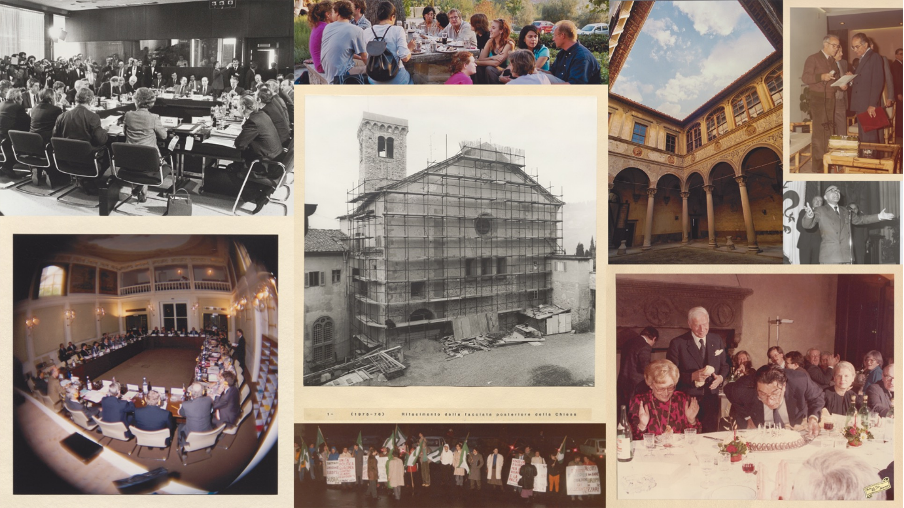
Over 50 years of the EUI’s visual history now available online
Editorial Team
European University Institute
More than 50 years of audiovisual files documenting the history of the European University Institute (EUI) are now available for online consultation at the Historical Archives of the European Union (HAEU). The opening of this collection coincides with the 50th anniversary of the EUI and offers a unique visual journey through half a century of academic, institutional, cultural and social life.
The collection, comprising more than 8200 photographs, posters, sound recordings, and videos in various formats (VHS, open-reel tapes, CDs, DVDs, and digital files), documents the evolution of the Institute from the negotiations for its creation in the 1970s to the present day. The files encompass a wide range of visual documentation, including images of academic ceremonies, conferences, institutional visits, and commemorative events, as well as the more informal moments that capture the everyday life and interactions of a university community. [Continue reading]
‘I have it in my blood and brain … I still haven’t been able to shake this nightmare off.’ How voices from a forgotten archive of Nazi horrors are reshaping perceptions of the Holocaust
Håkan Håkansson
The Conservation
“The witness – a tall, 16-year-old boy with a child-like face – recounts his sad story as if he were an old man”, she noted in her papers. “He speaks without becoming upset, only breaking down slightly when I ask about the fate of his parents and sister”. They were sitting in an old school building in Sweden, serving as a makeshift refugee camp. Taking her time to interview the Polish boy, the woman occasionally asked him to clarify or elaborate, gently urging him on while carefully taking notes.
His name was Genek Granek. He had been 12 when the Nazis closed the ghetto in his hometown Łódź in central Poland and initiated the week-long Sperre, clearing the ghetto of everyone unfit for work. He had seen the cars stop outside the hospital, where “patients were seized and thrown out the windows directly onto the cargo beds of the trucks,” Granek said, adding: “… among them were pregnant women, newborn infants, and people suffering from typhus, dysentery, and other diseases.” [Continue reading]
Trump’s Milei election warning fuels backlash and ‘colonialism’ accusations in Argentina
Leila Miller
Reuters
BUENOS AIRES, Oct 22 (Reuters) – When U.S. President Donald Trump last week conditioned a hefty financial bailout of Argentina on President Javier Milei triumphing in upcoming midterm elections, he handed the country’s opposition a new rallying cry.
On social media, #PatriaOColonia – motherland or colony – trended after Trump’s comments, which came during a press conference with Milei at the White House. Jorge Taiana, a former defense minister and leading Peronist opposition candidate in the province of Buenos Aires, demanded on X that Trump “stop extorting the Argentine people!” [Continue reading]
Beyond Bad Borders: How Nationalism, Imperialism, and Power Politics Shaped the Modern Middle East
Nicholas Danforth
The Century Foundation
In 2014, the Islamic State swept across large swaths of Iraq and Syria, soon emerging as the obligatory lede for every article about the Middle East and its history. Western commentators were quick to denounce the group’s radical theology and penchant for beheading. But they had little to say about its surprisingly mainstream take on the origin of modern Middle Eastern borders.
With the release of a propaganda video documenting the physical destruction of the Syrian–Iraqi border, then another titled “The End of Sykes–Picot,” the Islamic State added its voice to an ideologically diverse chorus placing the 1916 Sykes–Picot agreement at the root of all the region’s problems.1 The first video shows a bulldozer crashing through a sand berm, while a voiceover declares an end to the divisive and artificial national borders imposed by foreign oppressors. The second shows the demolition of a border checkpoint and promises more to come. [Continue reading]
Tony Blair ‘has a contribution to make’ to Trump’s Gaza peace deal, UK’s Middle East minister says
David Maddox
The Independent
Britain’s minister for the Middle East has pushed the case for Sir Tony Blair to be part of the board running Gaza after the second phase of the peace deal is agreed.
With concerns still high that the fragile ceasefire may not hold between Hamas and Israel, minister Hamish Falconer has hailed the qualities of the former prime minister in an exclusive interview with The Independent. The minister, whose portfolio also covers North Africa and plays a significant role in the migrant crisis, denied Keir Starmer’s decision to slash international aid has fuelled the illegal flow of people to Europe and the UK. [Continue reading]
 Imperial & Global Forum
You must be logged in to post a comment.