
Francine McKenzie
Western University
Like so many of America’s trading partners, President Trump’s announcement of Liberation Day in April 2025 and the introduction of new and higher tariffs rocked Canada. Since the initial jolt, officials from the two long-time trade partners and allies have met to resolve their trade dispute. An uneasy calm started to settle in. But now Canada-US trade relations are worse than ever. The reason: a dispute about Ronald Reagan’s views on trade.
Can the free-trade beliefs of Reagan, who was President of the United States from 1981-1989, cause a breakdown in the Canada-US trade relationship today?
From CUSFTA to trade wars
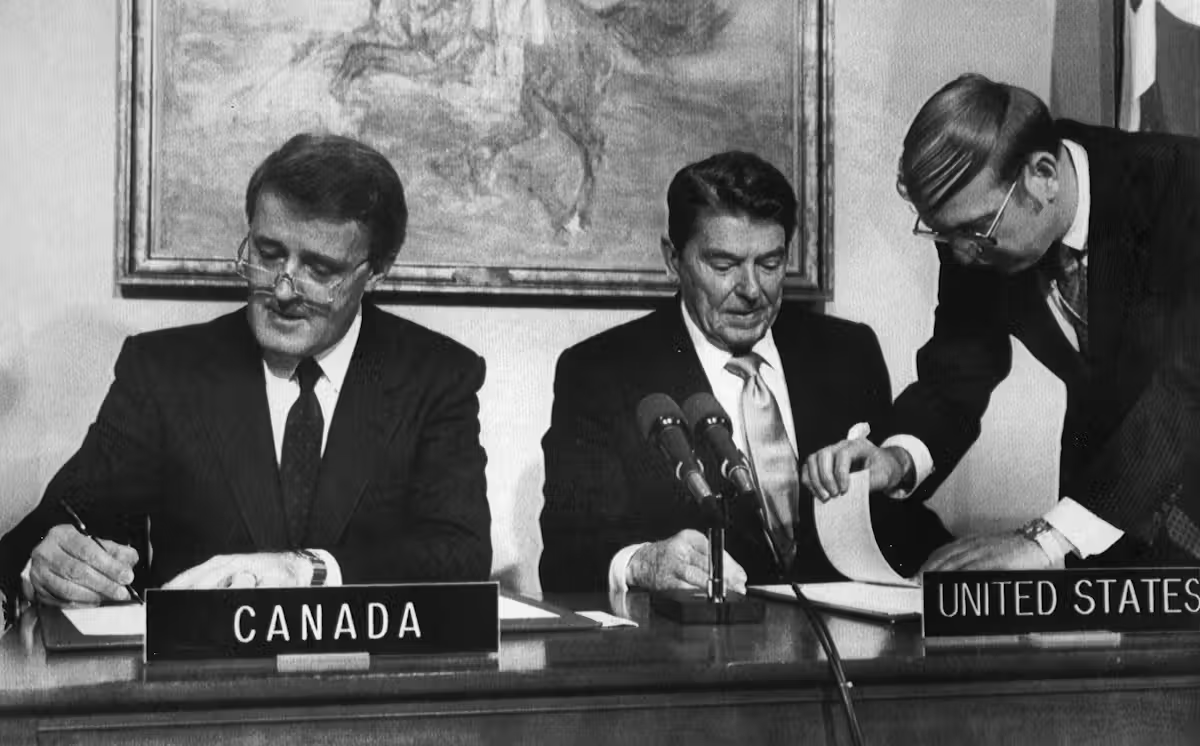
Trade is one of the oldest and most important parts of Canadian-American relations. Trade has often been a source of tension, but it has also been an engine of economic activity and development. Despite chronic concern in Canada about being overwhelmed by American economic and cultural power, trade between them increased in the 19th and 20th centuries until they became one another’s most important trade partner. They affirmed their conjoined economic futures when they concluded the Canada-US Free Trade Agreement (CUSFTA) in 1988, later broadened to the North American Free Trade Agreement (NAFTA) to include Mexico. Trade disputes continued, some for decades, but there was a comfortable certainty that Canada-US freer trade was here to stay.
Canada’s complacency came to an end this spring when the Trump administration, citing national security concerns surrounding immigration and fentanyl, imposed tariffs on Canadian exports, including steel, energy, critical minerals and cars, ranging from 10%-35%. The Canadian government retaliated, but also tried to de-escalate the conflict by signalling its willingness to negotiate.
The controversial ad
It seemed to be working until late October when the provincial government of Ontario launched a 60-second advertisement in which Reagan could be heard delivering an address from 1987 explaining the benefits of free trade and the harmful consequences of protectionism for American workers and consumers.
The ad first aired during the commercial break of the World Series between the Toronto Blue Jays and the Los Angeles Dodgers.
President Trump denounced the ad, calling it a “FRAUD” which misrepresented Reagan’s views on tariffs.[1] According to Trump, Reagan “LOVED TARIFFS FOR OUR COUNTRY.”[2] He insisted that the ad be withdrawn immediately. He wanted an apology. He imposed an additional 10% on all existing tariffs on Canadian exports. He ended trade talks and refused to meet with Liberal Prime Minister Mark Carney.
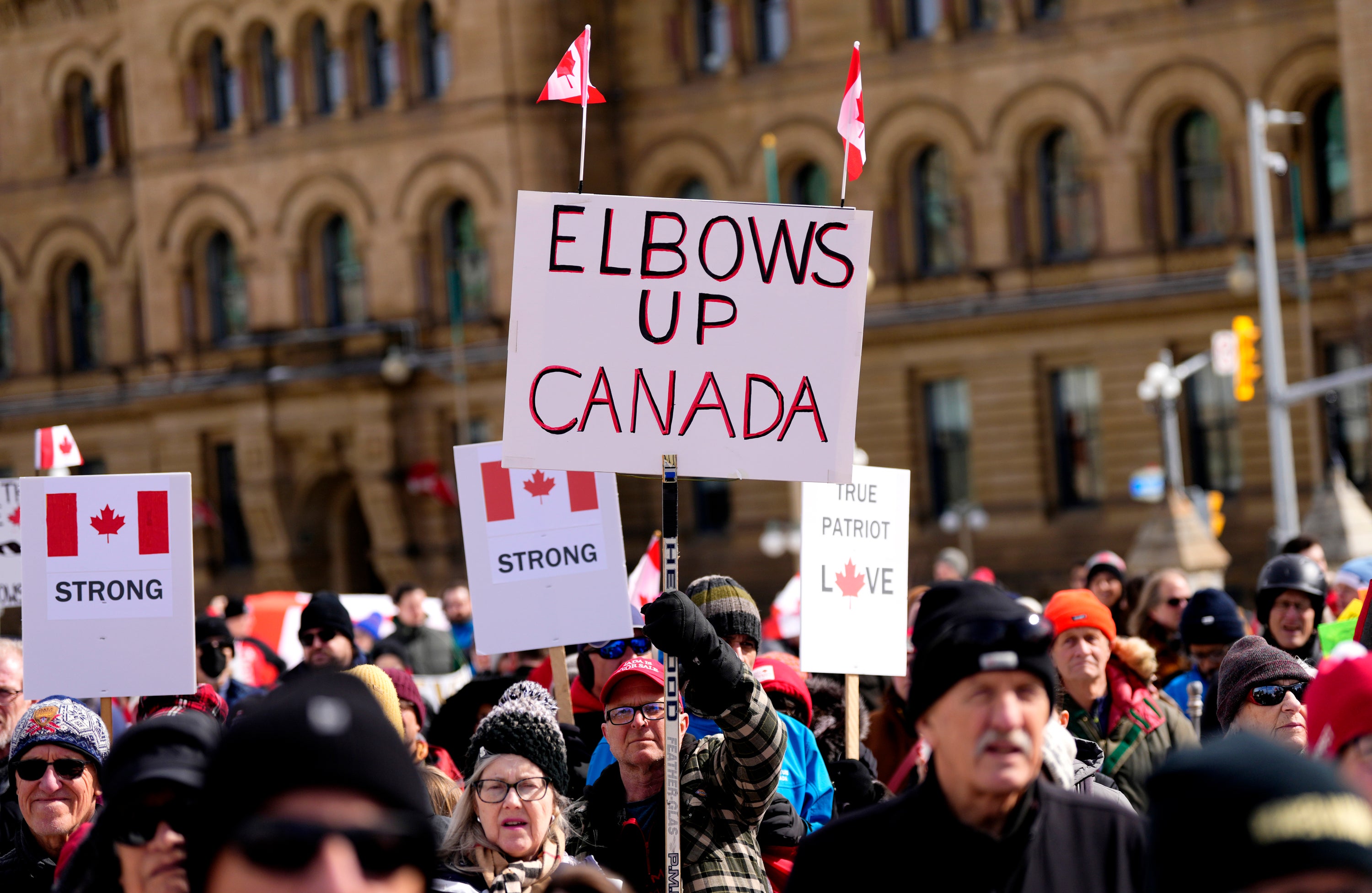
Most Canadians support the ad, despite Trump’s petulant and punitive response.[3] The Canadian reaction is consistent with the “elbows up” spirit that has fuelled Canadian nationalism and turned so many Canadians into trade warriors.
The government of Ontario has now withdrawn the advertisement and Prime Minister Carney has apologized.[4] The dust is settling although trade talks have not restarted.
Reagan: the most pro-free trade president in US history
Still, it’s important to recall the facts about Reagan’s views on trade: he was probably the most pro-free trade president in US history.
Over his two terms as president, he spoke often and positively about international trade, associating it with freedom, independence, prosperity, democracy, individual well-being, human progress, and American greatness. He once said that “the real story of human progress unfolds” through “the peaceful, everyday business of work and trade.”[5] He believed that trade was good for the United States and the world: “the way to promote worldwide prosperity is not to erect barriers, but to bring them down; not to decrease international trade, but to expand it.”[6]
Reagan was also a booster of the continental free-trade negotiations of the 1980s that resulted in the Canada-United States Free Trade Agreement. The negotiations were difficult, partly because US officials were less interested than their Canadian counterparts. But the President was keen. He insisted that US-Canada cross-border trade created jobs “by the millions,” expanded “opportunity for both our peoples,” and increased “the prosperity of both nations.” He praised the negotiations for “tearing down the walls, the tariffs, that block the flow of trade and eliminating the tangle of restrictions and regulations that bind our commerce and inhibit economic cooperation.”[7]
Reagan’s free-trade convictions were amplified by denunciations of protectionism and warnings about “the menace of trade barriers.”[8] In the 1980s, there was a lot of support for protectionism in the United States and around the world. But Reagan denounced the American Smoot-Hawley Tariff Act of 1930, introduced in response to the Great Depression and closing markets around the world. Reagan called these tariffs a “disaster” that proved that “protectionism doesn’t work.”[9] Reagan’s stand against protectionism at home put him at odds with Congress. He criticized members of Congress who supported protectionist bills for cozying up to special interests and he vetoed protectionist bills which he said would restrict trade and close the American market. He stuck to his views even as he approved some protectionist measures. To the President, it was straightforward: “protectionism is destructionism.”[10]
Reagan also acknowledged that there was domestic economic hardship in the United States, and, like many people, he connected these conditions to international trade. He repeated accusations that other countries (such as Japan, members of the European Community, and Canada) used unfair practices against the United States and promised to take action against them: “I will not stand by and watch American businesses fail because of unfair trading practices abroad. I will not stand by and watch American workers lose their jobs because other nations do not play by the rules.”[11]
However, he did not conclude that the United States should abandon free trade and open markets. According to Reagan, “free trade is, by definition, fair trade.”[12] He left the door open to America’s trading partners. As he explained, “We are always willing to be trade partners but never trade patsies.”[13] The goal of his administration was “to open the markets of other countries, not to close America’s markets.”[14] Closing the American market, he said, would harm the United States: “We remain opposed as ever to protectionism, because America’s growth and future depend on trade.”[15]
Conclusion
Claims that Reagan believed in protectionism wildly misrepresent his views on tariffs and trade. Claims that he endorsed free trade are much more accurate, although they gloss over his economic nationalist convictions and concerns about unfair trade.
Why does it matter today what the 40th American President, who left office almost forty years ago, said about free trade and protectionism?
It’s not because Reagan proved that free trade and open markets lead to peace and prosperity and that protectionism is always destructive. Rather, the current debate over the former president’s beliefs about trade show that history is alive in the present. In the current Canada-US trade dispute, history is a powerful political force because it legitimizes policies. This episode also makes clear why we need to uphold standards of integrity and rigour about the use of history. There might not be a single historical truth on which everyone can agree, but politicians cannot legitimize what they do today by invoking a false past.
Francine McKenzie teaches History at Western University in Canada. She studies the history of international trade, global governance, and peace. Her recent books are GATT and Global Order in the Postwar Era and Rebuilding the Postwar Order: Peace, Security and the UN System.
[1] “Trump threatens Canada with 10% extra import tax over anti-tariffs ad,” 25 October 2025, NPR, https://www.npr.org/2025/10/25/g-s1-95116/trump-canada-anti-tariffs-ad-import-tax
[2] Posting on Truth Social, https://truthsocial.com/@realDonaldTrump/posts/115428874684902595
[3] “The Ford Ad: Despite Trump’s tariff wrath, majority agree with ON government running TV spot featuring Reagan,” 30 October 2025, Angus Reid Institute, https://angusreid.org/doug-ford-trump-reagan-ad-carney-us-tariffs-trade/.
[4] “Trade talks with Trump ‘not yet revived’ since anti-tariff ad apology: Carney,” 5 November 2025, CBC, https://www.cbc.ca/news/politics/trump-trade-deal-carney-9.6967654.
[5] Ronald Reagan, “Remarks to Business Leaders at a White House Briefing on the Canada-United States Free Trade Agreement,” 4 November 1987, Ronald Reagan Library and Presidential Museum (RRLPM), https://www.reaganlibrary.gov/archives/speech/remarks-business-leaders-white-house-briefing-canada-united-states-free-trade.
[6] Ronald Reagan, “Remarks at a White House Ceremony for World Trade Week and the “E” and “E Star” Awards,” 19 May 1986, RRPLM, https://www.reaganlibrary.gov/archives/speech/remarks-white-house-ceremony-world-trade-week-and-e-and-e-star-awards.
[7] Reagan, “Remarks to Business Leaders,” 4 November 1987.
[8] Ronald Reagan, “Address to the 41st Session of the United Nations General Assembly in New York, New York,” 22 September 1986, RRPLM, https://www.reaganlibrary.gov/archives/speech/address-41st-session-united-nations-general-assembly-new-york-new-york.
[9] Reagan, Remarks at a White House Ceremony for World Trade Week, 19 May 1986.
[10] Ronald Reagan, “Address Before a Joint Session of Congress on the State of the Union,”
25 January1988, RRPLM, https://www.reaganlibrary.gov/archives/speech/address-joint-session-congress-state-union-1988, and “Address to the 41st Session of the United Nations General Assembly,” 22 September 1986.
[11] Ronald Reagan, “Announcement of the Establishment of the Trade Strike Force,” 2 October 1985, RRPLM, https://www.reaganlibrary.gov/archives/speech/announcement-establishment-trade-strike-force.
[12] Reagan, Remarks at a White House Ceremony for World Trade Week, 19 May 1986.
[13] Ronald Reagan, “Address Before a Joint Session of Congress on the State of the Union,”
27 January 1987, RRPLM, https://www.reaganlibrary.gov/archives/speech/address-joint-session-congress-state-union-1987.
[14] Ronald Reagan, “Remarks on Free and Fair Trade to Members of the United States Information Agency Volunteer International Council,” 17 June 1988, RRPLM, https://www.reaganlibrary.gov/archives/speech/remarks-free-and-fair-trade-members-united-states-information-agency-volunteer.
[15] Reagan, “Address Before a Joint Session of Congress on the State of the Union,” 27 January 1987.
 Imperial & Global Forum
You must be logged in to post a comment.