
Mitchel Stuffers
Assistant Editor at CIGH Exeter & PhD Candidate in History, University of Exeter
From US Intervention in Venezuela to Iran’s growing protests, here are this week’s top picks in imperial and global history.
How US intervention in Venezuela mirrors its actions in Panama in 1989
Adriana Marin
The Conversation
The US dramatically escalated its confrontation with Venezuela on January 3, moving from sanctions and targeted strikes on alleged drug-trafficking vessels to direct military action. In a pre-dawn operation, US forces captured the Venezuelan president, Nicolás Maduro, and his wife, Cilia Flores, and removed them from the country.
The operation has prompted historical comparisons with the US invasion of Panama in late 1989. Although separated by more than three decades and unfolding in different international contexts, the two episodes reveal a continuity in how the US approaches intervention, sovereignty and legality in the western hemisphere. [Continue reading]
Somaliland already operates as a de facto state. So why is Israel’s recognition of it so controversial?
Hannah Feuer
The Forward
Israel became the first nation in the world to recognize Somaliland as a country last week, prompting global outcry and an emergency meeting of the United Nations. The de facto state on the northern coast of the Horn of Africa has long operated independent of Somalia, but before Israel’s announcement, its sovereignty had not been officially recognized by any U.N. members.
After the collapse of Siad Barre’s regime in Somalia in 1991, Somaliland declared independence. The breakaway region has its own democratically elected government, military, currency, license plates and passports. It is often lauded for bringing relative stability to the region, with a record of peaceful transfers of power, though it is still only rated “partly free” by Freedom House amid crackdowns on journalists. [Continue reading]
Syria unveils new banknotes removing al-Assad images from currency
Editorial Team
Euronews
Syria’s interim President Ahmed al-Sharaa unveiled the country’s new banknotes at a ceremony in Damascus on Monday, removing images of ousted leader Bashar al-Assad and his father Hafez al-Assad in a symbolic break with the past. The new currency, which enters circulation on 1 January, features denominations of 10, 25, 50, 100, 200 and 500 Syrian pounds following the removal of two zeros from existing notes.
The redesigned bills display agricultural symbols including roses, wheat, olives, oranges and mulberries for which Syria is known, replacing political imagery. Al-Sharaa said the new currency marks “the end of a previous, unlamented phase and the beginning of a new phase that the Syrian people aspire to,” according to Syria’s official news agency SANA. [Continue reading]
Japanese association to Horizon Europe agreed
Sophie Hogan
Research Professional News
A deal has been agreed on Japan joining the 2021‑27 version of the EU’s research and innovation programme, Horizon Europe. Announced by the European Commission late last year, the deal is expected to be signed off in 2026 but is already effective through transitional arrangements. Association to Horizon Europe enables a country’s researchers to win funding from the programme and to lead collaborative projects, in exchange for a budget contribution.
The current version of the programme is the first to permit the association of countries far outside the European region. However, this participation is limited to Horizon’s second pillar, focused on collaborative R&I related to industrial competitiveness and societal challenges. [Continue reading]
What to know about the protests shaking Iran as government shuts down internet and phone networks
Jon Gambrell
AP News
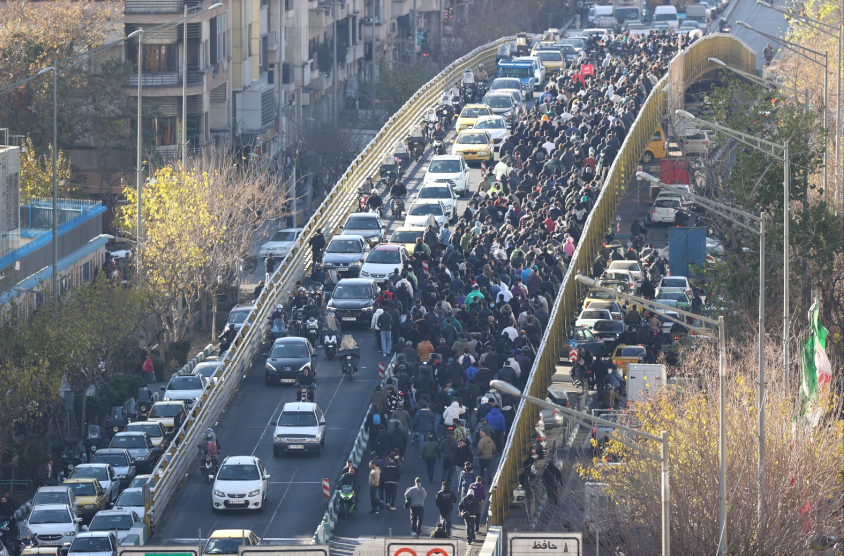
DUBAI, United Arab Emirates (AP) — Nationwide protests in Iran sparked by the Islamic Republic’s ailing economy are putting new pressure on its theocracy as it has shut down the internet and telephone networks.
Tehran is still reeling from a 12-day war launched by Israel in June that saw the United States bomb nuclear sites in Iran. Economic pressure, which has intensified since September when the United Nations reimposed sanctions on the country over its atomic program, has sent Iran’s rial currency into a free fall, now trading at over 1.4 million to $1. Meanwhile, Iran’s self-described “Axis of Resistance” — a coalition of countries and militant groups backed by Tehran — has been decimated since the start of the Israel-Hamas war in 2023. [Continue reading]
 Imperial & Global Forum
You must be logged in to post a comment.