
Mitchel Stuffers
Assistant Editor at CIGH Exeter & PhD Candidate in History, University of Exeter
From Ukraine’s elusive peace deal to India’s ‘colonial’ railway uniform, here are this week’s top picks in imperial and global history.
New year, new deal? Why peace still feels elusive for Ukraine
Shaun Walker
The Guardian
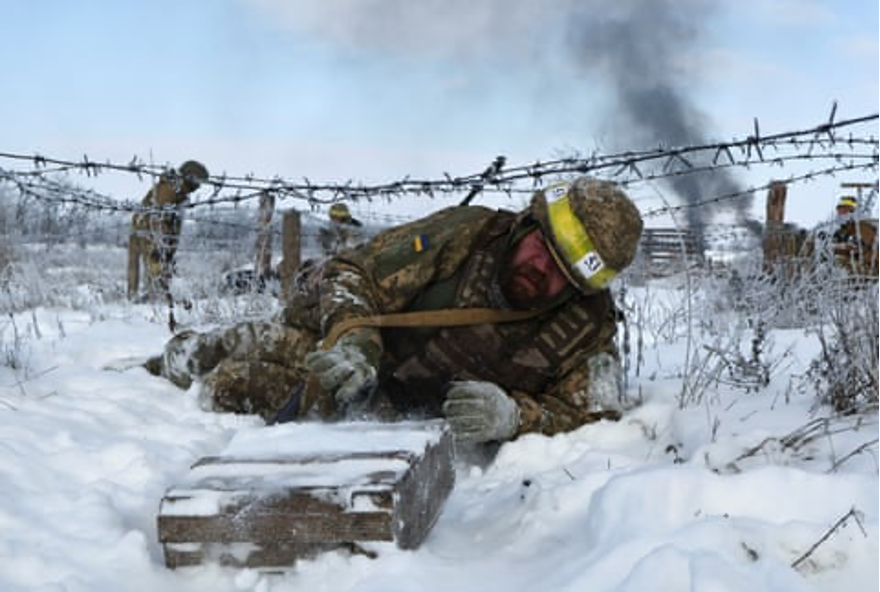
“I would give anything in the world if, in this address, I could say that peace will also come in just a few minutes,” Volodymyr Zelenskyy said in a message to the Ukrainian people released just before midnight on New Year’s Eve. “Unfortunately, I cannot say that yet.”Zelenskyy said a peace agreement was “90% ready”, but added something that subverted Donald Trump’s constant claims that a deal is just around the corner. “Those 10% contain, in fact, everything,” he said.
It is almost a year since Trump took office and promised to end Russia’s war on Ukraine within 24 hours. That never seemed possible, but as 2025 came to a close a new flurry of US diplomacy began, accompanied by more optimistic statements about peace. [Continue reading]
Iran warns of retaliation if Trump strikes, US withdraws some personnel from bases
Parisa Hafezi & Andrew Mills
Reuters
The United States is withdrawing some personnel from bases in the Middle East, a U.S. official said on Wednesday, after a senior Iranian official said Tehran had warned neighbours it would hit American bases if Washington strikes.
With Iran’s leadership trying to put down the worst domestic unrest the Islamic Republic has ever faced, Tehran is seeking to deter U.S. President Donald Trump’s repeated threats to intervene on behalf of anti-government protesters. A U.S. official, speaking on condition of anonymity, said the United States was withdrawing some personnel from key bases in the region as a precaution given heightened regional tensions. [Continue reading]
Nuremberg: A new kind of justice?
Editorial Team
Churchill Archives Centre
Germany’s surrender on May 7th, 1945 marked the conclusion of World War II in Europe. As Allied forces looked upon the destruction and devastation of the war, they were increasingly convinced that mechanisms must be put in place to hold Axis powers accountable for these atrocities and to provide a unified front to prevent similar violations from occurring again. Outlined in the London Conference, the International Military Tribunal (IMT) was organised to punish Nazi crimes during World War II. It consisted of judges and prosecutors from the United Kingdom, France, the United States, and the Soviet Union.
Over the course of the next year, these representatives would hold a trial in the German city of Nuremberg, symbolic due to its history as a site of Nazi rallies before the war. The trial, which ended in ten executions, established definitive evidence for Nazi crimes, and set a new precedent for international law and cooperation. Heavily publicized, the proceedings captured the attention of millions, as citizens engaged with ideas and controversy surrounding responsibility, retribution, and justice. This exhibition presents the 1945-1946 Nuremberg Trial from multiple viewpoints within the Churchill Archives Centre collections. [Continue reading]
Why the Taliban Wants to Talk with the US
James D. Durso
National Interest
Can the Donald Trump administration stomach the short-term political costs of engaging with Afghanistan for the long-term benefit of US influence in Central Asia?
Before Afghanistan in 2021, America was last defeated by a national liberation movement in Vietnam in 1975. After the fall of Saigon, the “domino theory” assured Americans that Asia would quickly fall to Communism. That didn’t happen, and the ensuing violence (Vietnam’s 1979 invasion of Cambodia and China’s attack on Vietnam) didn’t affect American security. But Eurasia in 2026 is another situation entirely. While Washington waited 19 years to establish diplomatic relations with the Socialist Republic of Vietnam, it shouldn’t delay diplomatic recognition of the new regime in Afghanistan. [Continue reading]
Railways discontinues ‘colonial uniform’: Evolution of the bandhgala, a ‘made in India’ fashion statement
Rinku Ghosh
The Indian Express
Often called the “prince suit” or the “prince cut” in common parlance, the bandhgala originated in the princely state of Jodhpur in Rajasthan. Take a look at its fascinating journey. When Union Railways Minister Ashwini Vaishnaw announced that railway staff would no longer have the bandhgala as their uniform, he termed it a colonial relic. The garment, however, was one of the first “Made in India” fashion statements to capture the global imagination. Often called the “prince suit” or the “prince cut” in common parlance, it originated in the princely state of Jodhpur in Rajasthan.
“The bandhgala jacket has always been a court garment of Indian provenance and has evolved from centuries of formal attire in royal India. The buttoned-up jacket with a stand-up collar, however, had varying colonial trappings and embellishments. There were fabric loops or epaulettes on the shoulders for embroidered insignia indicating the wearer’s rank. Sometimes the insignia was pinned on to the high, closed collar itself. The trims, cummerbunds and external paraphernalia may have been colonial but the jacket itself was wholly Indian in origin,” [Continue reading]
 Imperial & Global Forum
You must be logged in to post a comment.