
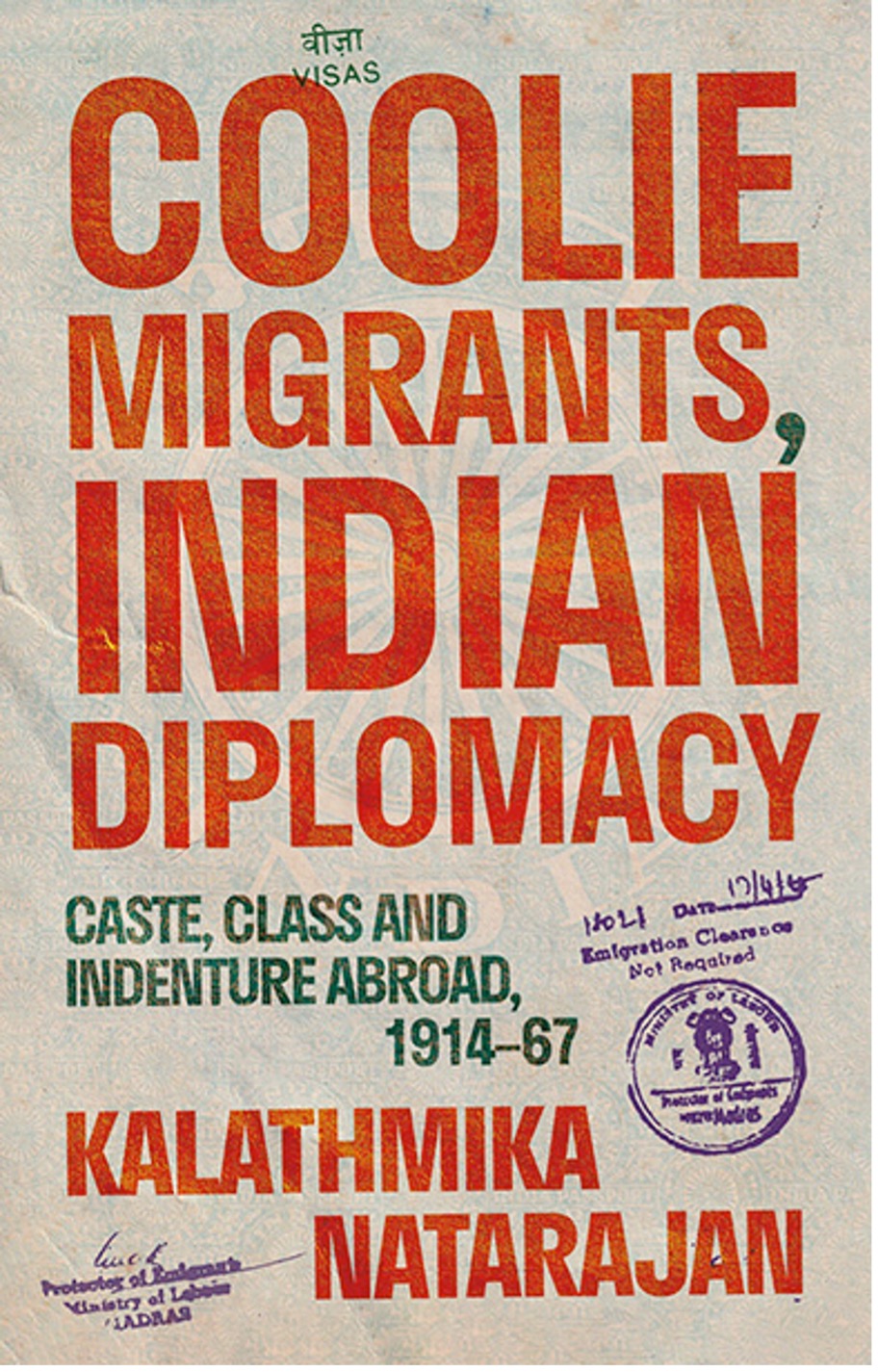

Dr Kalathmika Natarajan, a Lecturer in Modern South Asian History at the University of Exeter, recently sat down for a Forum interview to discuss her exciting new book, Coolie Migrants, Indian Diplomacy: Caste, Class, and Indenture Abroad, 1914-67 (London: Hurst, 2025 and New York: Oxford University Press, 2026). Dr Natarajan’s CIGH book launch is Wed. Jan. 28 from 3:30-5pm. Click here for further details of the book launch.
- Why did you write this book?
This book began as a PhD thesis at the University of Copenhagen in 2015 – it started off as a doctoral thesis focused on postcolonial ties between Britain and India but thankfully evolved into a larger project that explored the ways in which migration shaped Indian diplomatic history. I wanted to go beyond the overwhelming focus on high politics in this field by drawing on the critical, postcolonial turn in new diplomatic history. This took me to a whole host of archives that made it abundantly clear how Indian diplomacy was irrevocably shaped by the histories and legacies of indenture and labour migration – most evident in the anxieties of caste elites over the figure of the ‘coolie’ migrant. Such a framework helped centre caste as an essential category that shaped Indian imaginations of the international realm and those best suited to traverse it. This also enabled me to write a bottom-up history about how labour migrants shaped diplomacy, rather than simply being recipients and ‘problems’ of diplomacy.
- What do you hope it achieves?
My book is in conversation with the outstanding recent work of scholars of diplomatic history, migration and critical caste studies, such as Vineet Thakur, Gajendran Ayyathurai, Kalyani Ramnath, and Somak Biswas – I hope it emphasises the tremendous value of bringing these fields together and thinking through the intersections of caste, indenture, and labour migration as central to the emergence of postcolonial diplomacy. Instead of adopting a ‘diaspora diplomacy’ lens which is framed often as a study of how the state engages with a fairly homogenous diaspora, the book locates indenture and labour migration as pivotal to the making of Indian diplomacy itself.
Coolie Migrants, Indian Diplomacy helps dismantle assumptions of caste as a ‘domestic’ category that is of little concern to disciplines like diplomatic studies and international relations. Instead, my book shows how anti-caste leaders and migrants articulated their international status and directly engaged with and often articulated a stake in the making of Indian diplomacy. I hope it also demonstrates the value of a multilingual archive and a focus on the ‘unlikely’ sources and sites of diplomacy – from quarantine camps at Mandapam en-route to Ceylon, Labour Department activities spanning Madras to Malaya, pedagogic missions in the Caribbean, passport offices in India, and migrant homes in Birmingham.
- What do you consider to be your book’s most significant contribution(s) to imperial and global history?
The indentured labour system constituted by the colonial state in 1834 involved the migration of more than a million labourers from India to far-flung colonies ranging from British Guiana and Trinidad to East Africa and Fiji. Other histories of kangani/overseer-‘assisted’ migration intertwine the regions we now bound as South Asia and Southeast Asia. While scholars of imperial and global history have examined and increasingly stressed the connected and comparative aspects of these histories, there is a need for greater focus on how the afterlives of indenture and labour migration shaped the international order and world history at large. In this sense, my book contributes to a growing, expansive focus on indentureship and its legacies – see the work of Jonathan Connolly and Purba Hossain, for instance. While much has been written about the overwhelming presence of the term ‘coolie’ in the colonial archive, there has been little focus on how the term is inescapable in the archive of an emergent Indian diplomacy. My book draws attention to the fact that the term ‘coolie’ – a derogatory, racialised and gendered term with a complex legacy – was nevertheless also read through and embedded in narratives of caste, thereby reframing global histories of labour migration.
While a considerable scholarship has superbly traced the racialised migration and border policies emerging at the end of Empire, my book calls for a closer consideration of categories like caste to fully understand how these policies worked in the late colonial and early postcolonial period. Newly postcolonial nations like India adopted a discretionary passport policy and often collaborated with their former colonizer to delineate a mutually acceptable category of ‘undesirables’ who could be denied entry into Britain. Such policies were shaped by the long afterlife of indenture and anxieties over the so-called ‘coolie stain’ on India’s reputation.
- What were some of the challenges in writing this book?
Some of the main challenges were (ironically) both the sheer scale and scope of Indian migration (the Indian diaspora is today the largest in the world) and the limited ways in which this have been dealt with in diplomatic history/IR. This is even more true of categories like caste which have rarely been subject to sustained study in this field. Moving beyond the quintessential archives for diplomacy – and reorienting the perspective from Delhi to Madras, and London to Birmingham, helped tremendously. As did going beyond an overwhelming focus on the Nehrus and Menons to engage with anti-caste leaders like Rettamalai Srinivasan and organisations like the South Indian Suppressed Classes Society as highly relevant actors in an emergent diplomacy.
- What’s next?
I’m working on a second book tentatively titled Caste at Bay which examines how migration and mobility across the Bay of Bengal shaped different forms of anti-caste internationalism. Drawing on a range of literary, cinematic, and archival sources in Tamil and English and tracing the mobilities of performers, diplomats, journalists and activists, I intend to examine histories of caste, migration, and resistance that intertwine Madras, Ceylon, Malaya, and Burma.
I have also been working on an interdisciplinary project on the prolific histories of repatriation and ‘return’ to/from South Asia through the late colonial and early postcolonial periods. This project moves beyond the dominant focus on (e)migration to foreground repatriation instead and has been shaped in collaboration with Antara Datta (Royal Holloway) and other colleagues.
 Imperial & Global Forum
You must be logged in to post a comment.