
Mitchel Stuffers
Assistant Editor at CIGH Exeter & PhD Candidate in History, University of Exeter
From AI images distorting Holocaust memory to the new challenges faced by middle-power nations, here are this week’s top picks in imperial and global history.
Clickbait and ‘AI slop’ distort memory of Holocaust
Editorial Team
France24
An emaciated and apparently blind man stands in the snow at the Nazi concentration camp of Flossenbuerg: the image seems real at first but is part of a wave of AI-generated content about the Holocaust. As the world marks International Holocaust Remembrance Day on Tuesday, experts warn that such content — whether produced as clickbait for commercial gain, or for political motives — threatens efforts to preserve the memory of Nazi crimes. AFP’s Fact Check team has noted a surge of such imagery on social networks, distorting the history of Nazi Germany’s murder of six million European Jews during World War II.
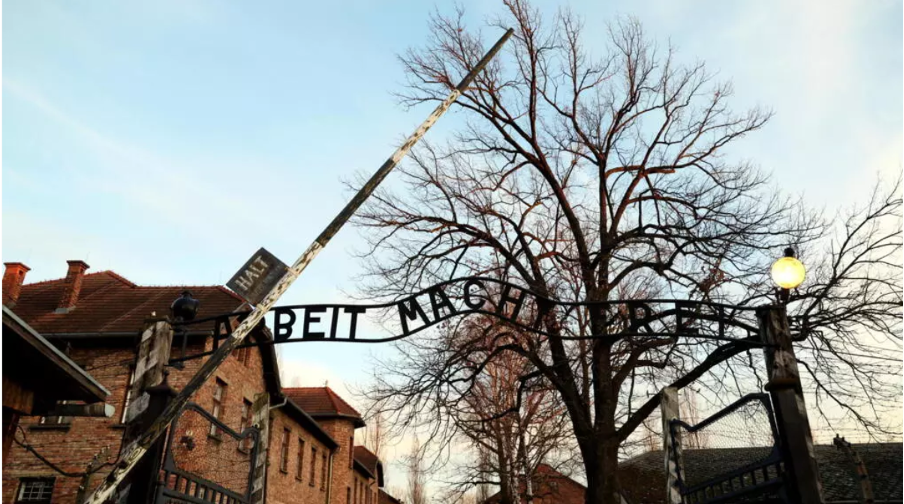
Among the AI-generated images that have gone viral is one of a little girl with curly hair on a tricycle. She is presented as Hannelore Kaufmann, a 13-year-old Berliner who purportedly died at the Auschwitz extermination camp, of which the 1945 liberation by Soviet troops is commemorated on Tuesday. However, there is no record of her ever having existed. [Continue reading]
‘Target mainland’: planned Troubles board game condemned in Northern Ireland
Rory Carroll
The Guardian
By turning conflict into entertainment US games company is ignoring its living legacy, says victims rights’ group It pits the IRA against the British army and the Royal Ulster Constabulary, it lets players plant bombs and make political deals and it promises to wrap up the conflict within six hours. Welcome to the Troubles – the provisional board game version. The brainchild of a US games company, The Troubles: Shadow War in Northern Ireland 1964-1998, is played with dice, tokens and a deck of 260 cards.
The game is not yet complete or available for purchase, but disclosure of its existence on Thursday prompted an outcry in Northern Ireland, where a victims’ rights group said it could retraumatise people. “They’re oversimplifying what is a very complex issue,” said Kenny Donaldson of the South East Fermanagh Foundation. Victims and survivors could feel “triggered” by the game, he said. “Many will feel that it has the effect of minimising their suffering.” [Continue reading]
How Reason Cultivated Abstraction: The Plantation Roots of Economic Modernity
Facundo Rocca
Journal of The History of Ideas Blog
The familiar landscape of economic modernity is typically drawn from the “Manchester model” and the British Industrial Revolution: a scenery of technical innovations and the purported discovery of economic rationality that gradually optimized productive practices. This archetypal account, however, leaves three fundamental points out of sight.
First, the simplification of labor was not merely the outcome of a technical or “scientific” change—an attunement of practice to rationality; it required a profound redefinition of what work is. A conceptual and ontological recasting—prefigured in theoretical discourse—was necessary for work to appear as an abstract, measurable, and universal activity. Second, as numerous scholars (discussed below) have shown, the decisive innovations in labor organization and the earliest inventions of scalability were not pioneered in European workshops, but in the colonial plantation. There, modular simplification, extraction-oriented rationality, and mass coordination of effort were first systematized and inserted in global circuits of exchange. Third, the emergence of the modern economy was inseparable from more-than-human ecologies. Abstract labor and value were grounded in material operations that transformed not only human practice—or the way humans manipulate natural goods—but the lands, bodies and non-human worlds themselves. [Continue reading]
The Colonial Takeover of Venezuela Begins with Corporate Investment
Hope Dancy
The Nation
Accusations of neocolonialism against the United States following Operation Absolute Resolve in Venezuela are not wrong—but they are focused on the wrong thing. The spectacle of Nicolás Maduro’s capture has drawn attention away from the quieter installation of systems and power networks that constitute colonial rule. If we ignore those systems now, Venezuela could slide into a colonial state that US policymakers and citizens will hardly be able to see, let alone contest.
Colonialism is not defined by spectacle but by the imposition of infrastructures of power, and history shows that private companies have been at the forefront of constructing this influence. The imperial 19th century offers a warning: Some of the most exploitative power imbalances of the colonial world began not with conquest but with private corporate investment. [Continue reading]
As the world inches back to a pre-WW2 order, the ‘middle powers’ face a grave new challenge
Allan Little
BBC
I had been asked to give a keynote speech at a conference at Columbia University’s Journalism School. It was January 2002. Two planes had been flown into the twin towers of the World Trade Center months earlier and you could still feel how wounded the city felt. You could read it in the faces of New Yorkers you spoke to. In my speech I made a few opening remarks about what the United States had meant to me. “I was born 15 years after the Second World War,” I said, “in a world America made. The peace and security and increasing prosperity of the Western Europe that I was born into was in large part an American achievement.”
American military might had won the war in the West, I continued. It had stopped the further westward expansion of Soviet power. I talked briefly about the transformational effect of the Marshall Plan, through which the US had given Europe the means to rebuild its shattered economies, and to re-establish the institutions of democracy. [Continue reading]
 Imperial & Global Forum
You must be logged in to post a comment.