
Mitchel Stuffers
Assistant Editor at CIGH Exeter & PhD Candidate in History, University of Exeter
From Nigerian stories archived in the Arctic to historical methods and GenAI, here are this week’s top picks in imperial and global history.
‘The world’s memory’: why Nigeria is burying its history under a mountain in Svalbard
Gabriella Opara
Guardian
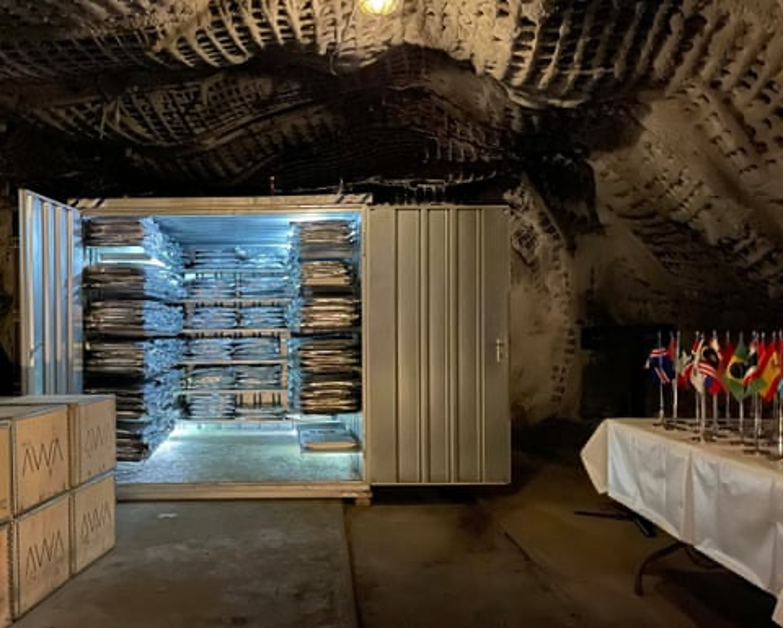
A decommissioned coalmine near the north pole is the last place you’d expect to find Indigenous stories from rural Nigeria, but deep below the Arctic permafrost of Svalbard a storage unit contains a cache of cultural and literary records from the West African country.
The Arctic World Archive (AWA) is a data storage unit where organisations and individuals can deposit records kept on specialist digitised film called Piql that lasts up to 2,000 years. On 27 February, Nigeria became the first African country to place archives at the facility 300 metres beneath a mountain where the cold, dark, dry conditions are perfect for preservation. [Continue reading]
Botswana, South Africa and DRC on standby as reports show US has only two months’ worth of rare earths left
Olamilekan Okebiorun
Business Insider Africa
Africa is emerging as a potential source of rare earth minerals for the United States, which reportedly has only about two months’ worth of the critical materials left in its defence stockpile as the war with Iran intensifies, making access to new supply sources increasingly urgent. Reporting by the South China Morning Post indicates that U.S. defence reserves of rare earth elements may be dangerously limited, according to sources familiar with the matter.
The minerals are essential components in advanced weapons technologies, including missile guidance systems, fighter aircraft, radar platforms and secure communications infrastructure. The vulnerability has become more pronounced as military tensions between Washington and Iran have escalated. U.S. strikes that began on February 28 reportedly consumed about $5.6 billion worth of munitions within days, according to Pentagon estimates. [Continue reading]
Ivory Coast welcomes ‘talking drum’, first artifact sent back from France
Loucoumane Coulibaly
Reuters
Traditional chiefs wearing crowns and gold chains gathered at Ivory Coast’s main airport on Friday to welcome the return of a “talking drum” looted more than a century ago, the first artifact returned to the West African country by former colonial power France. The drum – known as “Djidji Ayokwè”, meaning Panther-Lion in the Atchan language – is more than three metres long and weighs nearly 400 kg, according to Ivory Coast’s culture ministry.
It was used by the Atchan people, native to southern Ivory Coast, to alert locals to forced labour operations being carried out by colonizers and to mobilize fighters. The Ivorian culture ministry is seeking the restitution of 148 artifacts from France, and the talking drum, previously displayed at the Quai Branly Museum in Paris, is the first to make the return journey. [Continue reading]
Iran’s cultural heritage in the crossfire – expert explains what has been damaged and what could be lost
Katayoun Shahandeh
Conversation
Following joint attacks by the United States and Israel on Iran on February 28, the country has come under repeated strikes. These attacks, which were ostensibly supposed to target Iran’s nuclear and missile capabilities, have also caused civilian casualties and damage to cultural sites.
Airstrikes near historic districts in Tehran and Isfahan have damaged monuments that have survived for centuries. The losses highlight how war can endanger not only lives but also the historical memory embedded in cities and landscapes. As an Iranian art historian, watching these events unfold in my country is deeply and doubly painful. Iran contains one of the world’s richest concentrations of historic architecture and urban heritage. The country has 29 Unesco world heritage sites, spanning more than two millennia, from ancient imperial capitals to Islamic urban ensembles and desert cities. [Continue reading]
Back to Basics? Historical Methods and the Rise of AI
Chris Campbell
North American Conference on British Studies
If you ask ChatGPT a medical question it will stress, repeatedly, that it is not capable of diagnosis. Although it may offer some general answers, it will ask first for further clarification, and then ultimately advise you to consult a trained professional. It appears that it has, in fact, been programmed to state explicitly that it can’t provide definitive answers to medically-related queries; lawsuits would abound were it to make a mistake. For questions about history, though, ChatGPT makes no such disclaimer. Ask it – as I did – a broad question like “What caused the British Empire’s growth?”, and it will not ask for further clarification or put caveats on its knowledge.
[…] Clearly, the stakes are higher if ChatGPT were to misdiagnose an illness, rather than misrepresent history. And yet, in recent years, certain historical subjects (particularly as they relate to issues such as slavery, empire, and race) have been co-opted by a resurgent populism, inflamed public opinion, and reshaped our political discourses. [Continue reading]
 Imperial & Global Forum
You must be logged in to post a comment.