
Dr Lori Lee Oates
Memorial University
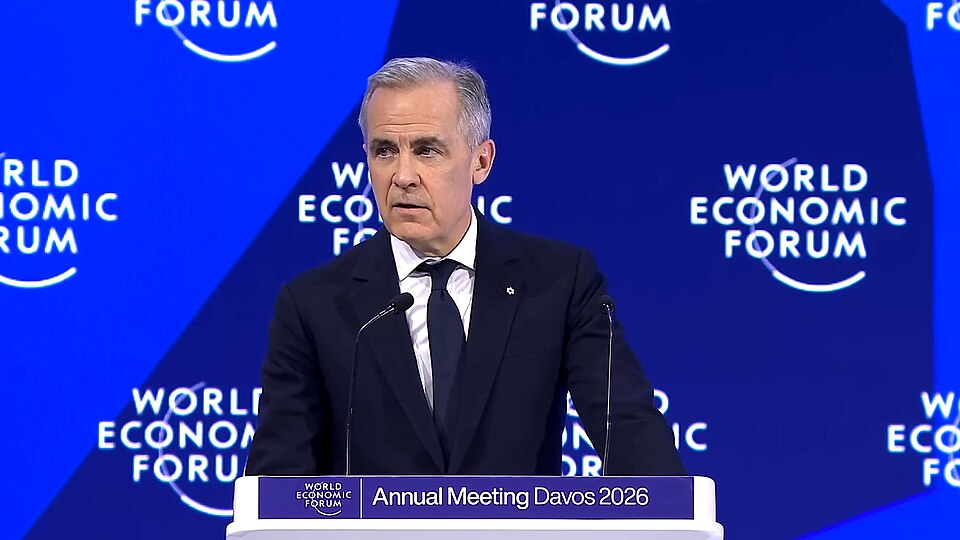
On January 20 of this year, Canadian Prime Minister Mark Carney gave a speech at the World Economic Forum in Davos, in which he claimed that, “we are in the midst of a rupture. Not a transition.” This speech is said to have “sent shockwaves through the international community” by New York Times journalist and podcaster Ezra Klein. Carney was arguably the first member of the western alliance to seriously acknowledge the current problems with the hegemony of the United States in present day geopolitics. However, what Carney calls a rupture is arguably just the latest stage in a larger transition that scholars have been warning about for at least the last decade.[1]
This transition, scholars would argue, is rooted in weaknesses that have long existed in the geopolitical order. Some of these problems were embedded in the systems that emerged at the end of the Second World War, and some are part of the colonial systems that built the modern world. For example, historian Jamie Martin has effectively argued in The Meddlers (2022) that the international financial systems such as the World Bank and International Monetary Fund have infringed on the sovereignty of many states that have required their services, and that this is rooted in approaches that were developed in the early twentieth century. The problems with these systems have become more obvious and exacerbated in recent decades. Furthermore, this geopolitical order has become ever more dysfunctional, and the problems are far broader than the increasingly dangerous U.S. hegemony that Carney described in Davos.
In the now-famous speech Carney argued that “we knew that the story of the rules-based international order was partially false. That the strongest would exempt themselves when convenient.” He maintained that states have been going along to ensure their safety, as integration becomes an increasing threat in the contemporary period. He called on middle powers to act in concert so that together we can build an order that is once again based on values, rather than bowing to U.S. hegemony. Certainly, Carney has pursued new transnational relationships since the Davos speech with European powers, China, and now India. However, his short time as Canadian Prime Minister has also been marked by ignoring breaks with international law on the part of the U.S. He has even actively supported them at times.
Since coming to office on March 14, 2025, Carney’s foreign policy seems quite at odds with the values-based order of middle powers he proposed. He has notably been silent about, and even at times supported, U.S. imperial actions. His government said nothing as the U.S. bombed speed boats in international waters. When the U.S. kidnapped the president of Venezuela, Carney called this “welcome news” on January 6, 2026, at a media availability in Paris. Carney was again silent as the United States sanctioned a Canadian judge of the International Criminal Court over an investigation into Israel’s war against Gaza. Most recently, he offered Canadian support for the U.S. attack on Iran. However, his Foreign Affairs Minister Anita Anaud has since said that Canada “will not be participating in the war.”
Commentators, including some scholars, often make the mistake of focusing on Donald Trump and Carney, as the powerful national leaders who are driving geopolitics. However, as global and imperial historians we should be aware that the forces of geopolitics do not change direction overnight and events that seem like ruptures are often decades in the making. Such occurrences are moved forward by the ever-changing structures of globalization and the shifts in both local and global relationships that are often driven by technological change. There are many smaller transitions that lead up a truly global shift.
Geopolitics is now in the era of big tech and an alignment between the “broligarchy” and defence spending. New York Times journalist Sheera Fenkel has argued that there has been a “Militarization of Silicon Valley.” Similarly, watchers at Brown University and the University of Toronto have documented the expanding links between Silicon Valley and the American military industrial complex. It is also noteworthy that employees of both Google and OpenAI have signed petitions opposing military use of AI. OpenAI picked up a Pentagon contract that Anthropic walked away from, citing ethical concerns in relation using their technology being used for mass surveillance and for weapons systems that kill people without human input.
As infrastructure for globalization goes, the tech companies of today are arguably far more impactful than the steamships, telegraphs, printing presses, and Suez Canal that historically enabled imperialism and globalization. Technology in the twenty-first century shifts digital information and products further and faster, in milliseconds around the world. This has been noticed by those who seek to control our behaviour. Warfare has changed as our data is now sold to the highest bidder seeking to influence the outcomes of elections, as with Cambridge Analytica. Elon Musk was quoted in the recently released Epstein emails as saying that Brexit was “just the beginning.”
Did you hear Carney talk about election interference, regulation of social media, or the dangers of Artificial Intelligence at Davos as he increases defence spending in Canada? Notably, his Minister of Artificial Intelligence and Digital Innovation, Evan Solomon, has met with Israel. Israel’s war on Gaza was actively supported by big tech companies that are headquartered in the U.S. Carney has also rescinded on implementing a Canadian Digital Services Tax, at the request of tech companies that were putting pressure on the Trump administration.
The links between big tech, oligarchs, and expanding transnational fascism are more obvious by the day. After purchasing Twitter in the leadup to the last American presidential election and openly supporting Donald Trump, Musk shifted the algorithms in ways that supported right wing politics. He did not buy Twitter to make money off Twitter. Musk bought it to gain power with the oligarchy that drives American politics and ultimately he made more money off Trump’s victory across his business interests.
Musk is best thought of as a defence contractor, relying on American government contracts and subsidies. He led the U.S. Department of Government Efficiency (DOGE) for a time, and recruited staff from Silicon Valley to work there. Concerns were raised about the transmission of personal data from government to the private sector. DOGE also oversaw the dismantling of United States Agency for International Development (USAID), which pursued the elimination of poverty and disease across the globe. This represented a significant shift in American foreign policy.
Undoing these global shifts would require far more than a speech at Davos or even new agreements between middle powers. There has been a fundamental economic shift during the last five decades that has facilitated the rise of this transnational oligarchy and Carney, an Oxford educated economist, is not talking about undoing those shifts. He is talking about living with them, through “pragmatic realism” which pursues whatever will work in the moment. This is not the same as pursuing a values-based international order. However, historians and world leaders have long known the importance of Securing the World Economy (2013) in order to achieve stability in geopolitics. When we have failed to achieve economic stability in the twentieth century, geopolitical instability followed.
Rather than seeing Trump, Carney, and Musk as event-making men, the current geopolitical environment is most accurately viewed as driven by a web of powerful actors across nations who are tied to the existing order. These men are inside of those webs, with little power to change them if they want to continue to hold power. The central banker that facilitated Brexit is no more likely to be our saviour from the failing rules-based international order than a real estate mogul and television star from Manhattan is.
At McMaster University in Ontario, Canada, in 2017, political economist Mark Blyth discussed the emergence of what he called “Global Trumpism.” He argued that financial systems are like computers. They work for approximately 30 years, Blyth maintained, at which point you must replace the hardware. The system set up at the end of World War II worked until the 1970s, when stagflation was driving the need for change. The policies implemented in the early 1970s led to an expansion in neoliberalism that continues to haunt us today. This neoliberal world order was showing its age by 2008, Blyth argued. At that time, global financial systems needed a change in hardware that wasn’t provided.
The 2008 financial crisis spurred the beginning of the Occupy Wall Street movement as governments “bailed out Wall Street instead of Mainstreet.” Blyth argues that by 2016 the world was “waking up to 30 years of stored trouble” because they hadn’t dealt with the economic and political problems caused by the shift to neoliberalism, starting with Nixon’s move off the gold standard. Political polarization and the move to the right, across many nations, was a response to the failure of wages to keep up with the cost of living since the 1970s. This enabled the rise of far-right politicians like Trump but also left-wing politicians like Bernie Saunders. Centrists like Hillary Clinton would not survive in this environment, and certainly we’ve seen many of them fall across the world since 2016. As fascism thrives in an era of desperation and instability, it was now rearing its head again.
By 2016, tech companies were mining our data for the purposes of election interference, in support of Trump and the Leave campaign. Concepts like “post-truth” and “alternative facts” arrived with little attention paid to the reality that these were anti-Enlightenment approaches. In retrospect, these words designed to destroy progress made as far back as the middle of the seventeenth century. The Enlightenment led the world to the French, American, and Hattian Revolutions, and the various fights for human rights that followed. However flawed those shifts were, they put humanity on the road to establishing what we have come to know as liberal democracy. Post-2016, concepts such as free elections, a free press, free speech, separation of powers, and the rule of law are up for debate as to whether they provide a public good and being rebranded as the problem by those who abhor checks on their power. We’re supposed to be confused about which side wants these things, as Musk claimed to buy Twitter to preserve free speech.
The solutions needed at present are far bigger than anything Carney is acknowledging. In The Atlantic in June of 2025, Blyth argued that: “The global economy is getting a hardware refit and trying out a new operating system – in effect, a full reboot, the likes of which we have not seen in nearly a century.” He maintained that: “The governing ideas about the economy are in flux. We have to decide what the new economic order looks like and whose interests it will serve.” There is no guarantee that it will be the working or even the middle classes. Voters are now being targeted to manipulate election outcomes in what is essentially transnational class warfare. It is unlikely that what happens next will benefit anyone but the oligarchs that control the algorithms – and I don’t hear Carney calling to address this situation.
In 2020, Steven Levitsky and Lucian Way coined the term “competitive authoritarianism” to describe countries with seemingly strong democratic institutions yet a lack of democratic options. In such a system, voters choose between a variety of corrupt actors, while the institutions of democracy seems to still be alive. It would be a mistake to think this is only an issue in the U.S. or driven by Trump alone. Other spaces where competitive authoritarianism has been rising include Turkey, Hungary, India, and the Philippians. The book How Democracies Die argued as far back as 2018 that the U.S. had already passed some important gateposts on the way to authoritarianism. Far right ideas have notably been making their way into Canadian politics as Carney realigns the policies of the Canadian party system. Canadians, like many voters across the world, now face a choice between right and further right.
In 2024, journalist Anne Applebaum published Autocracy Inc. which argued that autocratic states are now working together, with kleptocrats cooperating across international lines. This is the infrastructure of the global anti-democratic project. During the first Trump administration in 2018, Republican operative Steve Bannon discussed the need for a Europe-wide right-wing supergroup. He spoke in terms of the Brexit vote and the election of Trump as the U.S. president in 2016 as the start of this project.
The broader role of the U.S. in building a global system of money laundering has been described by Casey Michael in American Kleptocracy (2021), which demonstrated the extent of the infiltration of American financial systems by corrupt regimes across the globe. In Offshore: Stealth Wealth and the New Colonialism (2025) Brooke Harrington explained the system for offshoring money works and maintains that the system benefits oligarchs on a transnational basis, rather than any single nation. These systems were not built overnight but they are determining what kind of future we can have, as oligarchs work together transnationally to enrich themselves, at the expense of the rest of us.
Carney has long worked within these transnational systems, and he is very much a part of them now. He is not a bringer enlightenment, even though he clothes himself (badly) in the language of scholars. After all, if you wanted to destroy Canadian universities, you’d do exactly what Carney is doing, as he bragged in his Davos speech about the educated Canadian labour force. At home, he engages in massive increases in defence spending, cuts to public services, nationalism, corporatism, and building a majority through political defections rather than at the ballot box. Carney is, however, right about one thing. The old order is not coming back.
The kind of system that emerges next remains to be seen, but it is not looking great for democracy and enlightenment right now. If the world wishes to preserve these principles, more is needed than a pragmatic realist challenge to U.S. geopolitical hegemony as proposed by Carney. In many ways, Carney’s speech was a massive oversimplification, full of platitudes that sounded like standing up to Donald Trump. However, to date Carney has not shown a real willingness to deal with the question of how to secure the global economy for political stability. Until he’s willing to get serious about ensuring that this hardware upgrade serves the working and middle class, and defending a true value-based international order, the Davos speech should not be viewed as a credible call to action.
Lori Lee Oates is a Teaching Assistant Professor in the Department of Sociology and Criminology at Memorial University in St. John’s Canada where she is also project coordinator for the SSHRC Insight Development Grant Funded project Cursed: How the Resource Curse Manifests in Newfoundland and Labrador. Lori Lee’s research and teaching focuses on intersections between colonialism, resource development, and political economy.
[1] Steve Livitsky and Daniel Zablatt, How Democracies Die, New York, NY: Crown, 2018; Thomas Piketty, Capital in the Twenty-First Century (Arthur Goldhammer trans.), (Cambridge: Harvard University Press, 2014), Marci Shore, The Taste of Ashes: The Afterlife of Totalitarianism in Eastern Europe, (New York: NY: Crown, 2014); Timothy Snyder, The Road to Unfreedom: Russia, Europe, and Asia, (New York, NY: Crown, 2019); Jason Stanley, How Fascism Works: The Politics of Us and Them, (New York, NY: Random House, 2018); and Adam Tooze, Crashed: How a Decade of Financial Crisis Changed the World (New York, NY: Viking, 2018).
 Imperial & Global Forum
You must be logged in to post a comment.