Brexit, Free Trade, and the Perils of History

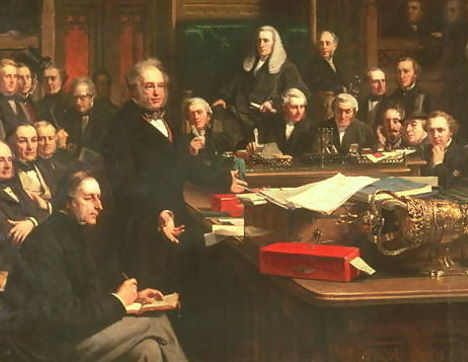
Lord Palmerston Addressing the House of Commons During the Debates on the Cobden–Chevalier Treaty in February 1860, as painted by John Phillip (1863).
Palmerston before the House of Commons amid the Debates on the Cobden–Chevalier Treaty in February 1860. Painting by John Phillip (1863).

Anthony Howe
University of East Anglia

Amid much discussion of alternatives to Britain’s current relationship with Europe, the Canadian, Norwegian, and Swiss models have featured widely. But surprisingly little attention has been paid to the closest historical model of what Brexiteers might hail as ‘a free trade Europe’.[1]

The first version of a ‘common market’ based on free trade treaties was created in Europe in the 1860s. Following the signing of the 1860 Anglo-French (Cobden-Chevalier) commercial treaty, a further 50-60 interlocking trade treaties were negotiated between European states, in effect creating a free trade area, the closest Europe got to a single market before the 1970s.

The economic benefits of this first common market are still contested by economic historians, but, as a model of a loose institutional framework it successfully lowered tariffs between participating states (only Russia of major European states remained outside it).

And at first glance this treaty network appears remarkably similar to the goals of those wishing to avoid a European super state in favour of simpler trade-based relationships. However, the fate of this model should be less than encouraging for the Leave campaign. Continue reading “Brexit, Free Trade, and the Perils of History”

This Week’s Top Picks in Imperial & Global History

Anthony Russo
Anthony Russo

Marc-William Palen
History Department, University of Exeter
Follow on Twitter @MWPalen

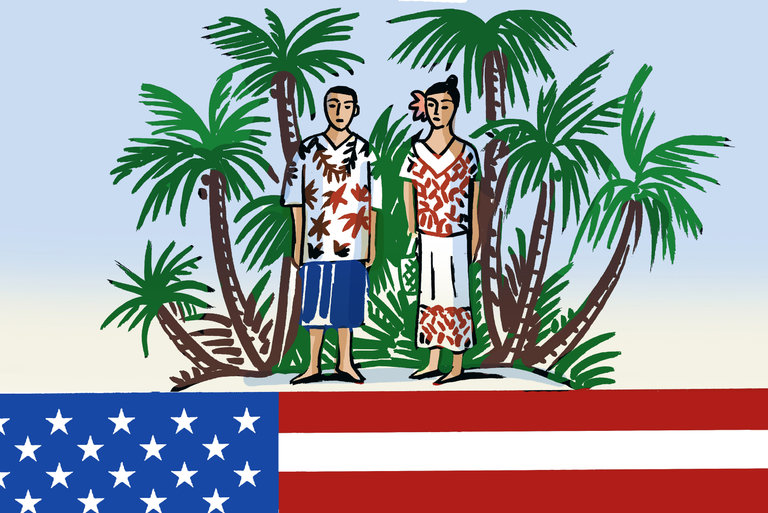
From how Muhammad Ali helped globalize Black Power to whether American Samoans are American citizens, a special ‘American Empire’ edition of this week’s top picks in imperial and global history.

Continue reading “This Week’s Top Picks in Imperial & Global History”

“Playing Indian”: Exeter Rugby in a Postcolonial Age

Exeter chiefs3

Rachel Herrmann
University of Southampton
Follow on Twitter at @Raherrmann

On any given weekend, you might find yourself on a train platform, surrounded by sports fans wearing “Native American” headdresses and “war paint,” and waving inflatable tomahawks. They’ll be wearing apparel purchased from the team’s online store (the “Trading Post”), where you can also buy a “Little Big Chief” mascot. During the event, supporters will chant the Tomahawk Chop to get into the spirit of things, and afterward, perhaps they’ll rehash the game on the team’s message boards (“The Tribe”).

No, this isn’t the Atlanta Braves. It’s not the Washington Redskins. This is a rugby match for the Exeter Chiefs. And it evokes Britain’s forgotten imperial American past. Continue reading ““Playing Indian”: Exeter Rugby in a Postcolonial Age”

Selective Memory: The Brexit Campaign and Historical Nostalgia

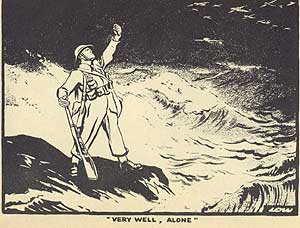
Printed the day after France requested armistice terms from Germany, a celebration of Britain's 'lonely' wartime defiance.  Evening Standard (18 June 1940).
Printed the day after France requested armistice terms from Germany, a celebration of Britain’s ‘lonely’ wartime defiance. Evening Standard (18 June 1940).

Rachel Chin
University of Exeter
Follow on Twitter @chinra4

Billionaire stockbroker Peter Hargreaves recently claimed that leaving the EU could be likened to the British evacuation from Dunkirk in late May 1940. This withdrawal signalled the British retreat from the continent and immediately preceded the French capitulation to German forces two weeks later. Hargreaves declared, “We will get out there and we will become incredibly successful because we will be insecure again.”[1]

As a scholar of rhetoric and the Second World War, I have become particularly attuned to how conflict is used and abused by politicians as a means to convince the British public of the value of a particular issue. Most recently, Tory politicians and campaigners like Hargreaves have mobilised Britain’s role in the Second World War as a justification to vote either for or against staying in the European Union (EU). This type of rhetoric is, at its core, emotive and nostalgic. It’s also deeply troubling because such oversimplified ideas of national identity and wartime patriotism are circumventing any chance of having a meaningful discussion about how Brexit would or would not change life on this island nation. It also ignores the fact that the Second World War was a global conflict, however much that might challenge ingrained nationalistic nostalgia. Continue reading “Selective Memory: The Brexit Campaign and Historical Nostalgia”

This Week’s Top Picks in Imperial & Global History

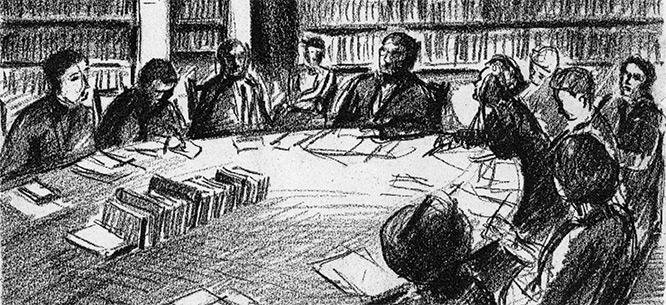
Karl Polanyi teaching at the Workers’ Educational Association, c. 1939. Sketch by William Townsend.

Marc-William Palen
History Department, University of Exeter
Follow on Twitter @MWPalen

From Karl Polanyi for president to European refugee camps in the Middle East, here are this week’s top picks in imperial and global history. Continue reading “This Week’s Top Picks in Imperial & Global History”

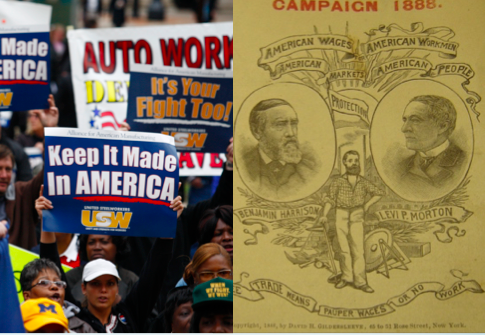
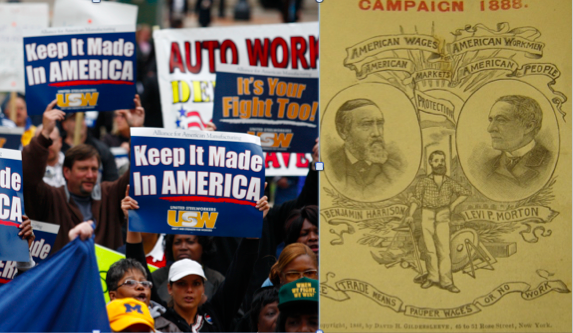
Donald Trump and the History of American Protectionism: A New Documentary


Screen Shot 2016-05-30 at 21.44.02

Featuring Marc-William Palen (Exeter), Helen Milner (Princeton), Bill Galston (Brookings Institution), Carla Hills (former US trade representative), David Auter (MIT), David Taylor (Pennsylvania Manufacturers’ Association), Bruce Springsteen, and Ferris Bueller, Edward Stourton examines America’s long history of resistance to free trade, and asks why it has again become such a potent political force in a new documentary for BBC Radio 4. Continue reading “Donald Trump and the History of American Protectionism: A New Documentary”

This Week’s Top Picks in Imperial & Global History

Pamphlet with analysis of the Cairo conference, by Homer A. Jack, 1958.

Marc-William Palen
History Department, University of Exeter
Follow on Twitter @MWPalen

From historians against Brexit to the ‘other’ Bandung, here are this week’s top picks in imperial and global history. Continue reading “This Week’s Top Picks in Imperial & Global History”

Global Radicals: The Transnational Imagination of Australian Sixties Activists

Third World Bookshop. ©Russ Grayson, pacific-edge.info

Jon Piccini
University of Queensland
Follow on Twitter @JonPiccini

Ever since 2009, when the so called ‘Green Revolution’ in Iran mobilised disenchantment over rigged electoral processes via social media websites such as Twitter and Facebook, pundits have marveled at the ‘hashtag revolutionaries’ of the 21st century. Hashtags such as #BlackLivesMatter and #RhodesMustFall have come to define movements for African American dignity and the decolonisation of higher education, while the media have awarded popular ‘tweeters’ such as Deray Mckesson spokesperson positions in these otherwise leaderless movements.

However, some dispute the level to which these websites and social media celebrities were central to protest organisation, and broader questions of temporality are equally posed. The marvelling in Twitter’s spontaneous and instantaneous communication leaves little allowance for previous forms of transnational communication that, while perhaps not as quick or easily mediatised, created global movements long before the internet.

My book, Transnational Protest, Australia and the 1960s, published by Palgrave MacMillan shines a light on the processes of global political engagement that made the 1960s a transnational decade. It explores how Australian activists sought out, engaged with, experienced, and translated global ideas – from anti-colonial struggle in Vietnam to the Black Power movement in America and student-worker politics in France. Continue reading “Global Radicals: The Transnational Imagination of Australian Sixties Activists”

Reminder to Register for Tomorrow’s Talk by H. W. Brands – on Reagan, FDR, and US Foreign Policy

What FDR and Reagan Had in Common

And What Might be Disappearing from American Foreign Policy

a Talk by

Professor H. W. Brands

Brands, Bill 2009

When: 24 May, 2.00-3.30

Where: Laver LT6, University of Exeter

RSVP online at Eventbrite

Abstract: Franklin Roosevelt epitomized liberalism in America in the 20th century, and Ronald Reagan conservatism. Yet while they disagreed on nearly everything in domestic affairs, they agreed on the need for the United States to play the leading role in world affairs. This consensus among liberals and conservatives is at risk from the mediocre performance of the U.S. economy since 2008 and from a questioning at both ends of the political spectrum of the value to the United States of trying to solve the world’s problems. Continue reading “Reminder to Register for Tomorrow’s Talk by H. W. Brands – on Reagan, FDR, and US Foreign Policy”

This Week’s Top Picks in Imperial & Global History

2_2000
Government of Bahrain Annual Report for Year 1358 (February 1939 – February 1940). British Library, IOR/R/15/1/750/4

Marc-William Palen
History Department, University of Exeter
Follow on Twitter @MWPalen

From the CIA’s role in Mandela’s 1962 arrest to forgetting the Cultural Revolution, here are this week’s top picks in imperial and global history. Continue reading “This Week’s Top Picks in Imperial & Global History”

Air Power and the Modern World

Air Power Black

Jeremy Black
University of Exeter

“We were very young in those days” is the most weighty phrase near the beginning of The Case of the Constant Suicides, a novel by the Anglo-American detective writer John Dickson Carr. Published in 1941, this novel begins in London on September 1 1940, just before the heavy German air attacks on the city had started: “An air-raid alert meant merely inconvenience, with perhaps one lone raider droning somewhere.” By 1941, as today, the experience of bombing was very different, although not as different as it was to be by the end of the war in 1945. Bombing by 1945 had become a key experience of urban life, both in Europe and in East Asia. Refracted through the media and the arts, the civilian experience has to be remembered as a human backdrop to the discussions about effectiveness and practicality.

Air power has played a key role in the military history of the last century, both independently and within land and sea conflicts. Air power has been particularly important at the tactical and operational levels. It has also been seen as a strategic tool, even if bringing this element to fruition has proved very difficult; and difficult, moreover, for the range of states that have sought to pursue this means. The debates about what air power can provide have taken considerably different directions based on whether the army was the dominant service and the degree to which the air force was independent. These issues raise questions not only about how best to present the history of air power, but also concerning its past and present rationale and relevance. Continue reading “Air Power and the Modern World”

This Week’s Top Picks in Imperial & Global History

A woman in a traditional hoop skirt walked past graves adorned with Confederate battle flags in Santa Bárbara d’Oeste, Brazil. An annual celebration of the area’s many Confederate settlers was held in the cemetery last month. CreditMario Tama/Getty Images

Marc-William Palen
History Department, University of Exeter
Follow on Twitter @MWPalen

From Confederates in Brazil to Jacobins in India, here are this week’s top picks in imperial and global history. Continue reading “This Week’s Top Picks in Imperial & Global History”

James Belich to Give Inaugural @ExeterCIGH Annual Lecture – ‘Globalization and Divergence over Five Millennia’

Prof.James-Belich-e1398596928140The inaugural Centre for Imperial & Global History Annual Lecture, will take place on 25 May (full details and abstract below). Professor James Belich (Beit Professor of Imperial and Commonwealth History, University of Oxford) will be speaking on Globalization and Divergence over five millennia. The lecture should be of wide interest. Attendance is open to Exeter staff and students. The lecture will be followed by a drinks reception.

Continue reading “James Belich to Give Inaugural @ExeterCIGH Annual Lecture – ‘Globalization and Divergence over Five Millennia’”

Britain’s ‘Return East of Suez’: A Historical Perspective

A parade of the Trucial Oman Scouts in the early 1960s. The Trucial Oman Scouts were a security force under direct British control designed to preserve law and order in the Trucial shaikhdoms (today’s United Arab Emirates)
A parade of the Trucial Oman Scouts in the early 1960s. The Trucial Oman Scouts were a security force under direct British control designed to preserve law and order in the Trucial shaikhdoms (today’s United Arab Emirates).

Helene von Bismarck

In March 2016, Defence Secretary Michael Fallon confirmed during a trip to Oman that the British Government was considering the establishment of a permanent army training base there. It is the latest in a series of announcements indicating that Britain is extending and consolidating its military presence in the Persian Gulf.

This development started in 2010, when incoming Conservative Prime Minister David Cameron announced the ‘Gulf Initiative’, by which he meant a coordinated attempt to rekindle Britain’s formerly close relationships with the Gulf States. The implementation of this policy was delayed by the advent of the Arab Spring, but was kickstarted again in December 2014 when Foreign Secretary Philip Hammond confirmed that Britain would build a Royal Navy base in Bahrain. In November 2015, the Strategic Defence Review published by the British Government called for a ‘new Gulf strategy’ and ‘a permanent and more substantial UK military presence’ in the area.

Nor has the British Government shied away from invoking Britain’s imperial past in this context. The Strategic Defence Review stressed Britain’s ‘historic relationships’ with Bahrain, Qatar, Oman, Kuwait and the United Arab Emirates, and Mr. Hammond went as far as calling the project to build a base in Bahrain Britain’s ‘return East of Suez’.[1] Continue reading “Britain’s ‘Return East of Suez’: A Historical Perspective”

This Week’s Top Picks in Imperial & Global History

1930 US advert for canal

An advert for the canal, for the US market, c. 1930, from the Manchester Libraries, Information and Archives, Manchester City Council

Marc-William Palen
History Department, University of Exeter
Follow on Twitter @MWPalen

From empire by collaboration to the rise of the global citizen, here are this week’s top picks in imperial and global history. Continue reading “This Week’s Top Picks in Imperial & Global History”