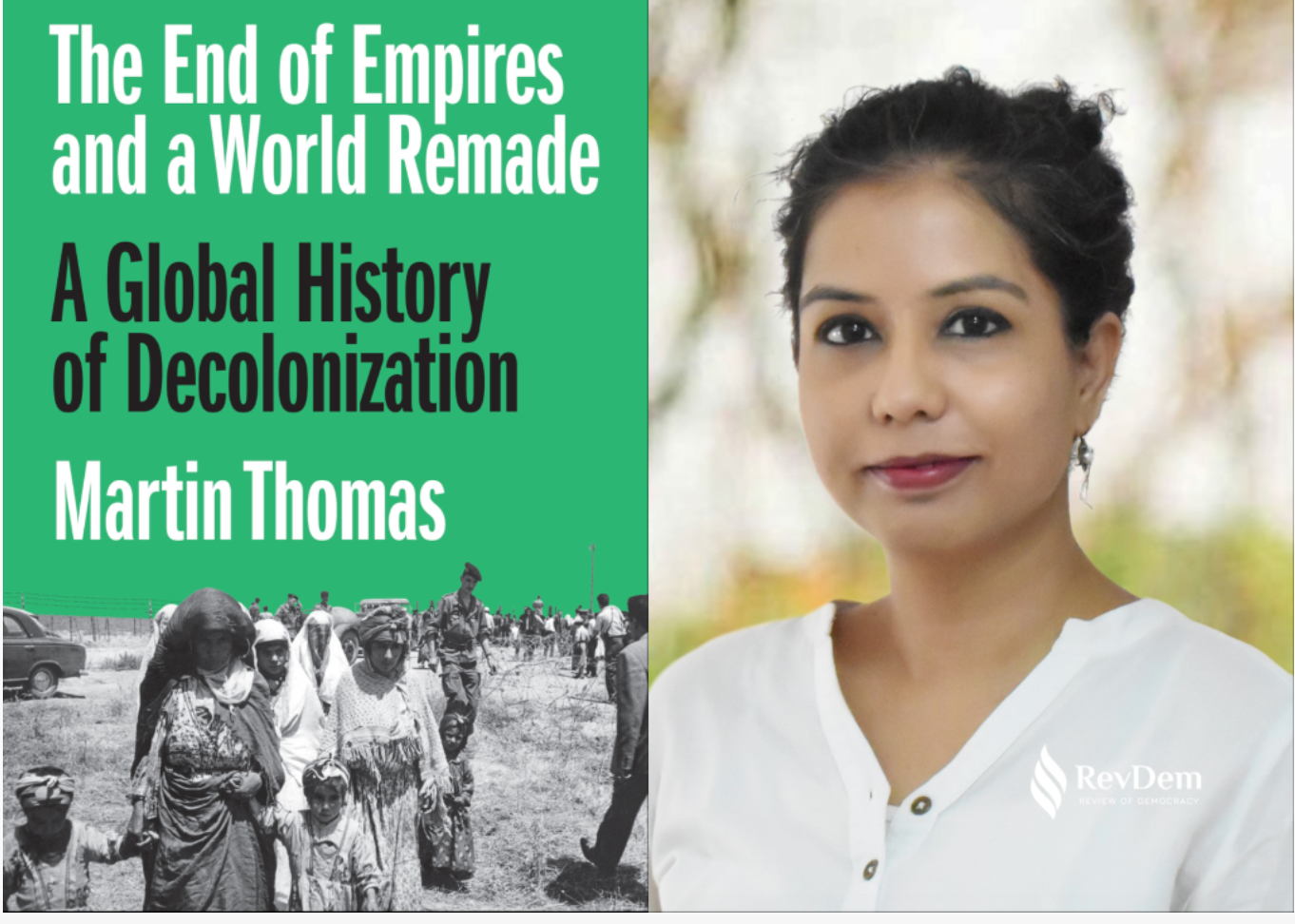
Did European colonialism truly end in the 20th century, as we often assume? In this episode Anne van Mourik (NIOD) speaks with Martin Thomas (Exeter University) about his book The End of Empires and a World Remade: A Global History of Decolonization (Princeton University Press). He argues that decolonization was not just the transfer of power from colonizers to the colonized, but a global, often violent process that forged new alliances, reshaped international connections, and left behind enduring colonial legacies. In this episode we ask: How to rethink decolonization? If empires were so powerful, military, politically, economically, why and how did they collapse? And how is colonial violence different than violence in non-imperial spaces?
Dr. Anubha Anushree reviews Martin Thomas’s The End of Empires and the World Remade: A Global History of Decolonization, Princeton University Press, NJ, March 2024, 608 pages.
The title of Martin Thomas’s The End of Empires and a World Remade: A Global History of Decolonization signals the ambitious and unconventional nature of his now widely acclaimed project. From the outset, Thomas frames decolonization not simply as a linear dismantling of empires, but as a complex and often contradictory process—one that simultaneously disintegrated old hierarchies and gave rise to new, and sometimes equally exclusionary, national orders. His emphasis on decolonization as a reintegrative force highlights how the collapse of imperial structures often yielded unstable, improvised formations of authority and belonging. The process was deeply entangled with the rise of nationalism and the promise of democracy—two forces that could be emancipatory but also repressive, generative yet limiting. Offering a global history of decolonization is no small task—it requires navigating this terrain of ambivalence, where the struggle for freedom often reproduced new forms of domination, and where the language of democracy could both expand and foreclose political possibilities.
What distinguishes Thomas’s book is precisely this encyclopaedic ambition to capture decolonization in its mutating forms across various parts of the world. Spanning a vast geographical terrain and the turbulent decades between the 1940s and 1990s, the book begins with a striking anecdote: the celebration of Kenyan independence in Nairobi on December 11, 1963. Seen through the eyes of Labour MP Barbara Castle, a vocal advocate for Kenyan independence in the British Parliament, the scene encapsulates the contradictions of decolonization. A regimental band plays Auld Lang Syne, evoking the solemn grace of British ceremonial tradition, even as Castle herself arrives late, scrambling over a fence and tearing her dress in the process. This chaotic juxtaposition—the orchestrated rituals of empire alongside the messy reality of postcolonial transition—mirrors the broader argument of the book: decolonization was not simply the rejection of colonial rule but an unpredictable leap into nation-building, improvisation, and disorder.
Thomas’s study interrogates these contradictions by expanding the definition of decolonization. It is not merely, as he writes, “the concession of national self-determination to sovereign peoples” (13), but also a generative force that “energized different ideas of belonging and transnational connections” (4).
Marc-William Palen History Department, University of Exeter
University of Exeter Professor Martin Thomas’s masterful book The End of Empires and a World Remade (Princeton University Press, 2024) continues to spark discussion, most recently for the New Books Network and H-Diplo.
New Books Network Interview
Martin recently sat down with Morteza Hajizadeh for the New Books Network for a wide-ranging exploration of the book’s key arguments, takeaways, and contemporary resonances. You can listen to the interview here.
H-Diplo Review
The End of Empires was also recently given an insightful review by Eva-Maria Muschik for H-Diplo, which is reposted below:
H-Diplo Review Essay 621
Martin Thomas. The End of Empires and a World Remade: A Global History of Decolonization. Princeton University Press, 2024. ISBN: 9780691190921.
Martin Thomas’s The End of Empires is a rich book. Drawing on a wide range of English-language scholarship and a broad base of European archival materials, Thomas puts the issue of violence front and center and reminds us that twentieth-century decolonization was a globally connected process, but not strictly speaking a post-1945 phenomenon. In his understanding, it is also not a finished process. The emphasis throughout the book is on politics, especially individual conflicts, but also transnational networking and international law, economic matters, and the sociology of violence. Readers interested in learning more about the people, ideas, and culture that animated the global history of decolonization may need to turn elsewhere.
Empires, until recently, were everywhere. They shaped borders, stirred conflicts, and set the terms of international politics. With the collapse of empire came a fundamental reorganization of our world. Decolonization unfolded across territories as well as within them. Its struggles became internationalized and transnational, as much global campaigns of moral disarmament against colonial injustice as local contests of arms. In The End of Empires and a World Remade, Martin Thomas tells the story of decolonization and its intrinsic link to globalization. He traces the connections between these two transformative processes: the end of formal empire and the acceleration of global integration, market reorganization, cultural exchange, and migration.
A book launch & conversation with Martin Thomas, author of ‘The End of Empires and a World Remade’. Hosted by Lars Cornelissen.
Was the twentieth-century collapse of European colonialism as definitive as it is often portrayed? How can we do justice to the historical complexity of decolonization while maintaining a broad global perspective?
In The End of Empires and World Remade: A Global History of Decolonization, Professor Martin Thomas [University of Exeter] brings together perspectives from global history, comparative politics, and international relations to re-evaluate decolonization in all of its historical messiness.
The Japanese Cruiser Kongo in Istanbul, 1891 by Luigi Acquarone 1800–1896
THURSDAY 12 MAY 2022 – SATURDAY 14 MAY 2022
Graduate Institute of International and Development Studies Maison de la paix, chemin Eugène-Rigot 2, 1202 Genève
The Annual Pierre du Bois Conference, organized by the Graduate Institute in partnership with the Pierre du Bois Foundation, will take place at Maison de la Paix in Geneva from 12-14 May 2022. Professor Cyrus Schayegh is organizing the conference.
The scholarly context for the Pierre du Bois Annual Conference 2022 is a fascinating development in the discipline of history in the last decade: the rising interest in trans- and interimperial histories. These build on studies showing that a single empire’s metropole and colonies need to be empirically and conceptually integrated. In the first decade of the 21st century, such more contextualized and decentered histories of empire started evolving into trans- and interimperial histories proper. Inspired by an earlier turn to transnational and global histories, respective historians have been critiquing a deeply rooted and ultimately nationally-biased tendency, by many historians of empire, to focus empirical research and even conceptual conclusions on one single empire. The rise of trans- and interimperial histories crystallized by the 2010s—though it was, one may say, predated by older studies of nonEuropean modern empires. While methodologically dissimilar to present trans- and interimperial studies, these studies quasi by necessity paid considerable attention to (often unequal) relationships especially with modern European and American empires.
We will be running our next Decolonization Workshop here at the Institute of Commonwealth Studies in Senate House, London, on Monday 16 March 2020. The day will run from 11.00am to 6.00pm.
As on previous occasions, we aim to have a series panel discussions over the course of the day. Each panel will consist of three papers lasting for 15-20 minutes. We are particularly appealing for proposals for presentations from research students and early-career researchers, although we welcome the participation of more established scholars. The workshop will provide an informal and supportive forum in which to discuss work in progress. Continue reading “CFP: Decolonization Workshop @ICwS_SAS, Monday 16 March 2020”→
Development and Securitisation, and (Counter)-Insurgency
Joint research workshop:
Understanding Insurgencies network and The worlds of (under)development: processes and legacies of the Portuguese colonial empire in a comparative perspective (1945-1975)
Lisbon, Portugal, 14-15 March 2019
Call for Papers
Proposals for papers are invited from members of the Understanding Insurgencies network and others for a two-day research workshop exploring the connections between development initiatives and counter-insurgent efforts to restore, impose, or otherwise establish forms of social control.
Enmeshed in rhetoric of poverty reduction and enhanced social opportunity, colonial development is increasingly viewed by scholars more sceptically: less as evidence of imperial goodwill than as an instrument of social and geo-political control in the face of mounting anti-colonial opposition. Sometimes described as integral to colonial claims to modernization, development policies could be highly coercive. At one level, technical aid and financial support was expected to diminish the appeal of anti-colonial alternatives, thereby stabilizing imperial order. At another, more tangible level, the instruments of development were often directives requiring forced relocation, the abandonment of customary practices, or the fulfillment of obligations that rendered individuals legible to – and controllable by – colonial authority. Arguments over development thus encapsulated the tension intrinsic to colonial authority: limited interventionism and purported respect for local ‘tradition’ or the pursuit of heightened social control characteristic of development projects. Continue reading “Call for papers: Development and Securitisation, and (Counter)-Insurgency”→
Martin Thomas, Richard Toye.Arguing about Empire: Imperial Rhetoric in Britain and France, 1882-1956. Oxford: Oxford University Press, 2017. 320 pp. $55.00 (cloth), ISBN 978-0-19-874919-6.Reviewed by Warren Dockter (Aberystwyth University) Published on H-Diplo (November, 2017) Commissioned by Seth OffenbachPrintable Version: http://www.h-net.org/reviews/showpdf.php?id=49706“A Silent, Rankling Grudge”
In the autumn issue of Nineteenth Century Review in 1877, W. E. Gladstone wrote an article on legacy of the British Empire and the Eastern Question entitled, “Aggression on Egypt and Freedom in the East.” In addition to supporting notions of self-rule in Egypt, Gladstone warned of the perils of imperial interventions, arguing, “My belief is that the day which witnesses our occupation of Egypt will bid a long farewell to all cordiality of political relations between France and England. There might be no immediate quarrel, no exterior manifestation, but a silent, rankling grudge” (p. 19). These words proved so prophetic that political radical Wilfred Scawen Blunt employed Gladstone’s rhetoric against him in his work The Secret History of the English Occupation of Egypt (1907), writing that “this article is so remarkable and so wonderfully prescient of evils he was himself destined to inflict upon Egypt that it deserves quoting” (p. 57). This exchange serves to illustrate the fluid nature of imperial rhetoric and the discursive relationship which formed between the British and French Empires.
Martin Thomas and Richard Toye have written a remarkably ambitious and excellent study which examines the intersections of imperial rhetoric between the French and British Empires during the late nineteenth and twentieth centuries. The book is based on seven case studies that focus on moments of imperial intervention in which both the French and Britain played an equal part, ranging from Tunisia and Egypt in the early 1880s through to Suez in 1956. This breadth allows the reader to see the evolution of imperial rhetoric in Britain and France while illustrating how policymakers in their respective metropoles became intrinsically linked, forcing them toward “co-imperialism.” This is particularly true regarding the Middle East and North Africa, where the British and French Empires remained in concert from nineteenth century until the realities of full-scale decolonization became apparent in latter half of the twentieth century. Continue reading “Dockter on Thomas and Toye, ‘Arguing about Empire: Imperial Rhetoric in Britain and France, 1882-1956’”→
We are delighted to announce a new online collaboration with our colleagues in the Department of History at the University of Texas at Austin. Not Even Pastand theImperial & Global Forum will be cross-posting articles, sharing podcasts, and sponsoring discussions of historical publications and events. We are launching our joint initiative this month with a blog, cross-posted from Not Even Past, based on a new book by Exeter’s own Martin Thomas and Richard Toye, Arguing About Empire: Imperial Rhetoric in Britain and France.
“At the present moment it is impossible to open a newspaper without finding an account of war, disturbance, the fear of war, diplomatic changes achieved or in prospect, in every quarter of the world,” noted an advertisement in The Times on May 20, 1898. “Under these circumstances it is absolutely essential for anyone who desires to follow the course of events to possess a thoroughly good atlas.” One of the selling points of the atlas in question – that published by The Times itself – was that it would allow its owner to follow “most minute details of the campaign on the Atbara, Fashoda, Uganda, the Italian-Abyssinian conflict &c.” The name Atbara would already have been quite familiar to readers, as the British had recently had a battle triumph there as part of the ongoing reconquest of the Sudan. Continue reading “Arguing about Empire: The Dreyfus Affair and the Fashoda Crisis, 1898”→
GLOBAL COMPARISONS FROM THE COLONIAL CONTEXT, 1920-2000
Workshop
Global History & Culture Centre, University of Warwick
14-15 June 2018
This workshop is part of a Leverhulme Trust Research Network on Understanding Insurgencies: Resonances from the Colonial Past. Led by the University of Exeter’s Centre for War, State and Society, other collaborators in this international network are the University of Warwick, University of Oxford, the Centre National de la Recherche Scientifique (CNRS) Paris, University of Glasgow, Universite de Québec à Montréal, and KITLV Institute Leiden.The network is funded by the Leverhulme Trust to stage a series of workshops and conferences over a three-year period, (commencing June 2016), and leading to publications.
The theme of this sixth workshop in the Understanding Insurgencies series is ‘Amnesty to Counter Insurgency’. The intention is to examine the manner in which amnesties have been used to bring about temporary cease-fires during counter-insurgency campaigns, to induce surrenders or the ending of hostilities that will bring conflict to an end, or as a means of engaging political discourse in order to generate a negotiated peace. We invite presentations that give detailed consideration to individual case studies during the twentieth century, but would also welcome papers which take a comparative approach and those that look at the principles and pit-falls that lie behind amnesty settlements, including papers that consider the political consequences of amnesties – where these may be contested as well as where they are accepted. Continue reading “CFP: Understanding Insurgencies (1920-2000)”→
Martin Thomas and Richard Toye University of Exeter
‘The struggle of races and of peoples has from now on the whole globe as its theatre; each advances towards the conquest of unoccupied territories.’ Tempting as it might be to ascribe such inflated rhetoric to Friedrich Nietzsche or Adolf Hitler, its originator was Gabriel Charmes, a disciple of leading late nineteenth-century French republican, Léon Gambetta.
In September 1882, Charmes was trying to persuade his fellow parliamentarians that France’s recent seizure of Tunisia was ethically imperative. Similar rhetoric could be found across the political spectrum, in Britain as well as in France. In 1888, the Conservative Prime Minister Lord Salisbury described small imperial wars as ‘merely the surf that marks the edge of the advancing wave of civilisation’. But if Britain and France both claimed to be the spearhead of civilizing influences, what happened when their interests clashed, and what new arguments emerged to rationalize the struggle for power between rival ‘civilized’ nations?
That is one theme of our new book, Arguing About Empire, but in order to answer the question we need equally to ask what happened when Anglo-French interests appeared to coincide. How did the two countries’ respective elites justify their mutual collaboration in the face of challenges from other powers and, increasingly as time went on, from domestic anti-colonial critics and local nationalist opponents too? Continue reading “France and Britain – colonial rivals, or co-imperialists?”→
This one-day conference will combine academic papers with a seminar session at which serving and former Embassy staff will be invited to present their testimonies and perspectives. The intention is to present a summary of the conference findings to the FCO to help inform future thinking in this area. The event will be held at the British Academy, 9 June 2016.
Embassies have long been integral to international diplomacy, their staff instrumental to inter-governmental dialogue, strategic partnerships, trading relationships and cultural exchange. But Embassies are also discrete political spaces. Notionally sovereign territory ‘immune’ from local jurisdiction, in moments of crisis Embassies have often been targets of protest and sites of confrontation. Embassies in Crisis will revisit flashpoints in the lives of Embassies overseas. Approaching Embassies as distinct communities with their own micro-histories, this conference seeks to explore each of these aspects in the lives of Embassies and the people who run them. Papers are welcomed that discuss instances of international confrontation or mass demonstration, past and present, that placed particular Embassies in the global spotlight. Continue reading “Call For Papers: Embassies in Crisis”→
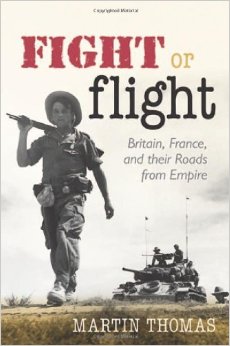
Martin Thomas’s path-breaking book Fight or Flight: Britain, France, and their Roads from Empire tells how the world’s two largest colonial empires disintegrated dramatically after the Second World War. Although shattered by war, in 1945 Britain and France still controlled the world’s two largest colonial empires, with imperial territories stretched over four continents. And they appeared determined to keep them: the roll-call of British and French politicians, soldiers, settlers and writers who promised in word and print at this time to defend their colonial possessions at all costs is a long one. Yet, within twenty years both empires had almost completely disappeared.
The collapse was cataclysmic. Peaceable ‘transfers of power’ were eclipsed by episodes of territorial partition and mass violence whose bitter aftermath still lingers. Hundreds of millions across four continents were caught up in the biggest reconfiguration of the international system ever seen.
In this new Talking Empire podcast Professor Thomas talks about the book with Professor Richard Toye.






 Imperial & Global Forum
You must be logged in to post a comment.