Introducing Dr. Rebecca Williams, Co-Director of the Centre for Imperial and Global History at Exeter

Rebecca Williams
Co-Director, CIGH, University of Exeter

Hello, I’m Dr. Rebecca Williams, Co-Director of the Centre for Imperial and Global History here at Exeter. I’m delighted to connect with scholars who are passionate about exploring the complex histories of medicine, health, and international development. My research focuses primarily on the history of health and medicine, particularly surrounding population, reproduction, and women’s health in modern South Asia, as well as the broader historical frameworks of international development that touch upon health, environmental concerns, and democracy.

Currently, I’m engaged in two significant research projects that shed light on these themes. My first project, which will result in a monograph tentatively titled Controlling Population, examines how India became the world’s test-case for state-led population control after independence. Through the Khanna Study—a pivotal family planning experiment in 1950s-60s Punjab—I explore why India became a laboratory for both transnational organizations and the Indian government’s ambitions in population control.

Continue reading “Introducing Dr. Rebecca Williams, Co-Director of the Centre for Imperial and Global History at Exeter”

No dogs, no Indians: 70 years after partition, the legacy of British colonialism endures

File 20170815 28964 1kf0u6k

Gajendra Singh, University of Exeter

The 70th anniversary of the end of Britain’s Empire in India and the birth of the post-colonial states of India and Pakistan have led to a renewed interest in the portrayal of this distant and under-explored past in British arts and the media.

It does not always make for good history. In the stories told on film, radio and television – from the film Viceroy’s House, to BBC One’s My Family, Partition and Me: India 1947 and Radio 4’s Partition Voices – complexity and context are downplayed in favour of “British” stories of colonialism, anti-colonial movements and partition violence.

Signs like this could be found all over colonial India.
Gautam Trivedi, CC BY-SA

History is to be communicated through genealogies of the great and the good – of news correspondents, movie directors and radio presenters introducing the audience to their unknown and often unremarkable forebears. The social histories touched upon are never fully communicable because of the desire to avoid reflecting upon the wider political and cultural contexts in which these individuals lived and breathed. Continue reading “No dogs, no Indians: 70 years after partition, the legacy of British colonialism endures”

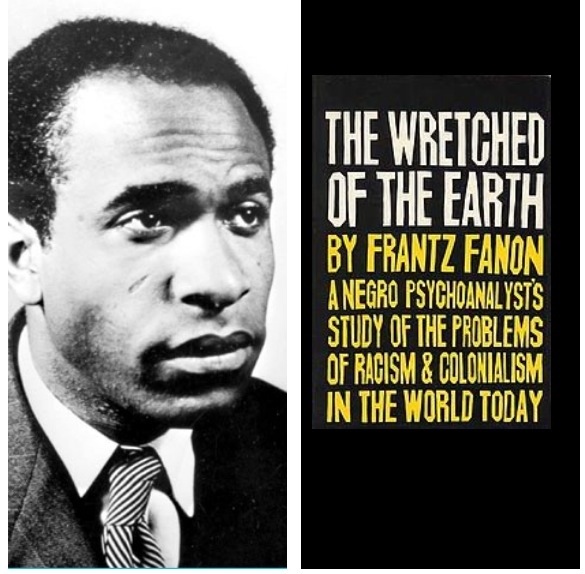
What’s So Shocking about the Wretched of the Earth?

fanon wretched of the earth

Richard Toye
History Department, University of Exeter

Follow on Twitter @RichardToye

Frantz Fanon (1925-1961) was a psychiatrist, intellectual and revolutionary. Born in the French Caribbean colony of Martinique, Fanon spent significant periods of his life in France and, crucially, Algeria. There he became an active member of the Front de Libération Nationale that fought, with ultimate success, against French rule. His most famous work The Wretched of the Earth, published shortly before his death from leukaemia, is a classic of decolonization literature. As Jean-Paul Sartre put it in his preface:  Continue reading “What’s So Shocking about the Wretched of the Earth?”