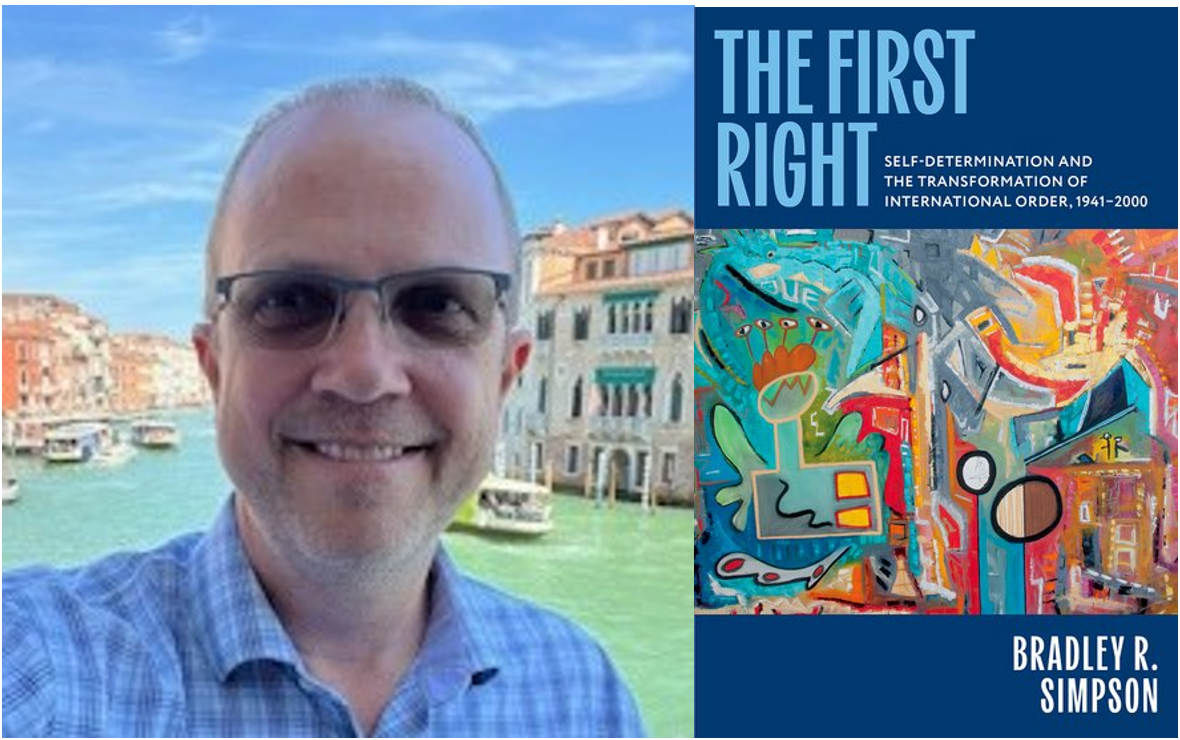
The First Right: Self-Determination and the Transformation of International Order, 1941–2000 – A CIGH Seminar with Brad Simpson (19 Nov.)

We are delighted to welcome Professor Bradley Simpson (University of Connecticut). He will be discussing his new book The First Right: Self-Determination and the Transformation of International Order, 1941–2000 (Oxford University Press, Oct. 2025). His talk is jointly convened by the Centre for Histories of Violence and Conflict and the Centre for Imperial and Global History.

Wednesday 19 November 2025, 2:30pm-4pm

Amory B310 and on Teams

Abstract: The idea of self-determination is one of the most significant in modern international politics. For more than a century, diplomats, lawyers, scholars, activists, and ordinary people in every part of the globe have wrestled with its meaning and implications for decolonization, human rights, sovereignty, and international order. This talk will examine self-determination as a century-long contest between contending visions of sovereignty and rights whose meaning has often emerged not just from the United Nations and great power diplomacy but from the claims of peoples, places, and movements on the margins of international society.

Click here to read the book’s introduction for free until 1 December.

Bio: Brad Simpson is Professor of History at the University of Connecticut. He teaches and researches twentieth century U.S. foreign relations and international history, and has an interest in US-southeast relations, political economy, human rights and development. His first book, Economists with Guns: Authoritarian Development and U.S.-Indonesian Relations, 1960-1968 (Stanford 2008) explores the intersection of anti-Communism and development thinking in shaping U.S. Indonesian relations. He is also founder and director of a project at the non-profit National Security Archive to declassify U.S. government documents concerning Indonesia and East Timor during the reign of General Suharto (1966-1998). This project will serve as the basis for a study of U.S.-Indonesian-international relations from 1965 to 1999, exploring how the international community’s embrace of an authoritarian regime in Indonesia shaped development, civil-military relations, human rights and Islamic politics.
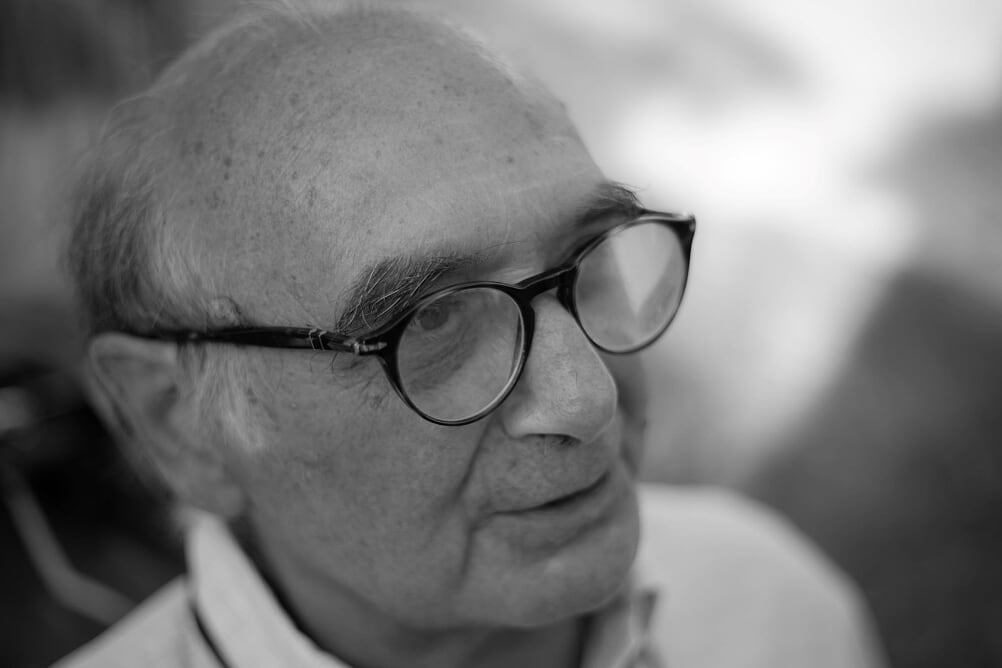
Alessandro Portelli Lecture and Interview – ‘The Fosse Ardeatine: History and Meaning of a Nazi Massacre in Rome’

Iona Ramsay and Maria Teresa Marangoni
University of Exeter

The following lecture was given by Professor Alessandro Portelli during his recent trip to Exeter to take part in a PGR workshop on oral history. He was also interviewed by Professor Kate Fisher about his experiences of doing oral history.

Alessandro Portelli has taught American Literature at the University of Rome “La Sapienza”. He is the founder and president of the Circolo Gianni Bosio for the critical study of people’s cultures. He has served as advisor on historical memory to the Mayor of Rome (2005-2008). Among his books are The Order Has Been Carried Out. History, Memory and Meaning of a Nazi Massacre in Rome (2003); They Say in Harlan County: An Oral History (2011); Hard Rain. Bob Dylan, Oral Cultures and the Meaning of History (2017); and most recently, Dal rosso al nero. La svolta a destra di una città operaria (From Red to Black. The right-wing turn of a working-class town, 2022).

Continue reading “Alessandro Portelli Lecture and Interview – ‘The Fosse Ardeatine: History and Meaning of a Nazi Massacre in Rome’”

Autumn Term @ExeterCIGH Virtual Seminar Schedule

The Autumn Term is now upon us, and so please find the Centre for Imperial and Global History virtual seminar schedule below for your calendars.

Please direct any inquiries about attending to the seminar convenor, Dr Lyubi Spaskovska. 

Date (Term 1)

Speakers 

Paper Title 

23rd September 2020 (Week 1), 15:30h

Nandini Chatterjee (University of Exeter), in conversation with Gajendra Singh (University of Exeter)

Book launch: Negotiating Mughal Law a Family of Landlords Across Three Indian Empires (CUP, 2020)

7th October 2020 (Week 3), 15:30h

Rachel Lin (University of Exeter) &

Iacopo Adda (University of Geneva)

Historical Memory in Sino-Russian Border Museums

21st October 2020 (Week 5), 15:30h

Joint event with Violence

Margot Tudor (University of Manchester) 

Emily Bridger (University of Exeter)


Beer, Boxing, and Belly-dancers: Gendering Peacekeepers in Egypt 1956-1967

‘All Township Love-making is Rough’: Rape as a Contested Concept in Apartheid-era Soweto, South Africa

4th November 2020 (Week 7), 15:30h

Crispin Bates (University of Edinburgh)

Policing Intimacy and Queering the History of South Asian Overseas Migration in the Colonial Era

18th November 2020 (Week 9), 15:30h

Beth Rebisz (University of Reading) 

Gavin Davies (University of Exeter)

Gendered Geographies of State Coercion in the Late-Colonial Period: Kenya, 1954-1960

‘The Eye’s Great Feast’: Food and Civility in William Darton Jr’s Games of Travelling in Asia and Europe

2nd December 2020 (Week 11), 15:30h

Nicholas Grant (University of East Anglia)

Task Force Africa: The NAACP and Black Internationalism in the 1970s

Connecting Empires – A Centre Talk by Richard Drayton This Wednesday

ExeterRobert Fletcher
University of Exeter
Follow on Twitter @rsgfletcher

Identifying the differences between empires can improve our understanding of the phenomenon of imperialism, and shed new light on respective experiences of empire. But the emergent similarities are no less compelling, and prompt us to re-examine familiar notions of competition, conflict and ‘Scrambles’ between hostile imperial powers.

One of the issues of great interest to us at the Exeter Centre for Imperial and Global history is how far imperial culture should be seen as inherently transnational, permeating not only the border between ‘metropole’ and ‘periphery’, but also the boundaries between empire-builders themselves. Where and why were practices and ideas formed in dialogue between imperial actors, and what do we stand to gain by considering this a form of ‘co-imperialism’?

draytonThis Wednesday we’re excited to welcome Professor Richard Drayton (King’s College London) to Exeter to talk on the subject of ‘Masked Condominia: Pan-European Collaboration in the History of Imperialism, c. 1500 to the present’. Richard sets out the problem as follows: Continue reading “Connecting Empires – A Centre Talk by Richard Drayton This Wednesday”