Did European colonialism truly end in the 20th century, as we often assume? In this episode Anne van Mourik (NIOD) speaks with Martin Thomas (Exeter University) about his book The End of Empires and a World Remade: A Global History of Decolonization (Princeton University Press). He argues that decolonization was not just the transfer of power from colonizers to the colonized, but a global, often violent process that forged new alliances, reshaped international connections, and left behind enduring colonial legacies. In this episode we ask: How to rethink decolonization? If empires were so powerful, military, politically, economically, why and how did they collapse? And how is colonial violence different than violence in non-imperial spaces?
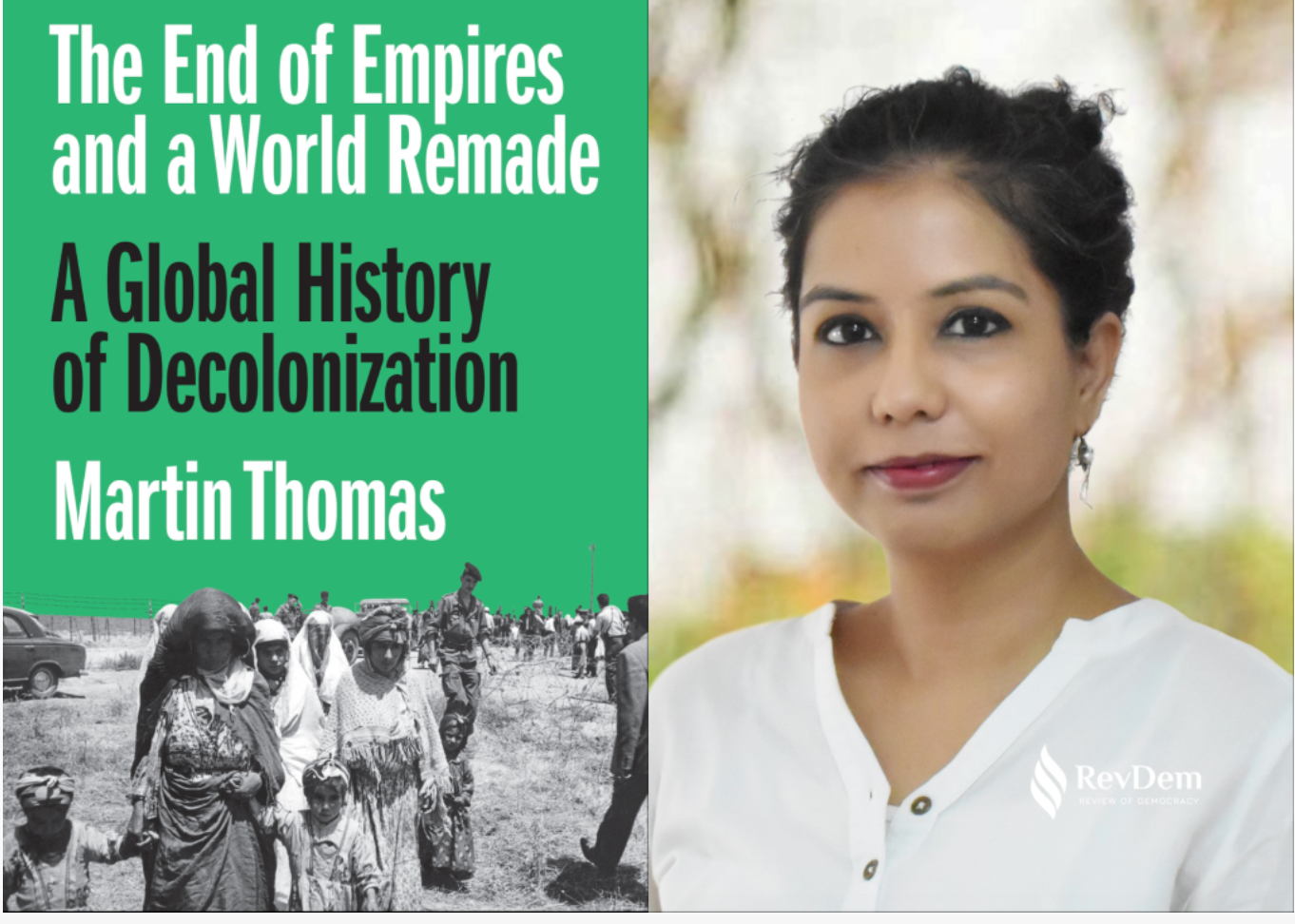
Dr. Anubha Anushree reviews Martin Thomas’s The End of Empires and the World Remade: A Global History of Decolonization, Princeton University Press, NJ, March 2024, 608 pages.
The title of Martin Thomas’s The End of Empires and a World Remade: A Global History of Decolonization signals the ambitious and unconventional nature of his now widely acclaimed project. From the outset, Thomas frames decolonization not simply as a linear dismantling of empires, but as a complex and often contradictory process—one that simultaneously disintegrated old hierarchies and gave rise to new, and sometimes equally exclusionary, national orders. His emphasis on decolonization as a reintegrative force highlights how the collapse of imperial structures often yielded unstable, improvised formations of authority and belonging. The process was deeply entangled with the rise of nationalism and the promise of democracy—two forces that could be emancipatory but also repressive, generative yet limiting. Offering a global history of decolonization is no small task—it requires navigating this terrain of ambivalence, where the struggle for freedom often reproduced new forms of domination, and where the language of democracy could both expand and foreclose political possibilities.
What distinguishes Thomas’s book is precisely this encyclopaedic ambition to capture decolonization in its mutating forms across various parts of the world. Spanning a vast geographical terrain and the turbulent decades between the 1940s and 1990s, the book begins with a striking anecdote: the celebration of Kenyan independence in Nairobi on December 11, 1963. Seen through the eyes of Labour MP Barbara Castle, a vocal advocate for Kenyan independence in the British Parliament, the scene encapsulates the contradictions of decolonization. A regimental band plays Auld Lang Syne, evoking the solemn grace of British ceremonial tradition, even as Castle herself arrives late, scrambling over a fence and tearing her dress in the process. This chaotic juxtaposition—the orchestrated rituals of empire alongside the messy reality of postcolonial transition—mirrors the broader argument of the book: decolonization was not simply the rejection of colonial rule but an unpredictable leap into nation-building, improvisation, and disorder.
Thomas’s study interrogates these contradictions by expanding the definition of decolonization. It is not merely, as he writes, “the concession of national self-determination to sovereign peoples” (13), but also a generative force that “energized different ideas of belonging and transnational connections” (4).
Marc-William Palen History Department, University of Exeter
University of Exeter Professor Martin Thomas’s masterful book The End of Empires and a World Remade (Princeton University Press, 2024) continues to spark discussion, most recently for the New Books Network and H-Diplo.
New Books Network Interview
Martin recently sat down with Morteza Hajizadeh for the New Books Network for a wide-ranging exploration of the book’s key arguments, takeaways, and contemporary resonances. You can listen to the interview here.
H-Diplo Review
The End of Empires was also recently given an insightful review by Eva-Maria Muschik for H-Diplo, which is reposted below:
H-Diplo Review Essay 621
Martin Thomas. The End of Empires and a World Remade: A Global History of Decolonization. Princeton University Press, 2024. ISBN: 9780691190921.
Martin Thomas’s The End of Empires is a rich book. Drawing on a wide range of English-language scholarship and a broad base of European archival materials, Thomas puts the issue of violence front and center and reminds us that twentieth-century decolonization was a globally connected process, but not strictly speaking a post-1945 phenomenon. In his understanding, it is also not a finished process. The emphasis throughout the book is on politics, especially individual conflicts, but also transnational networking and international law, economic matters, and the sociology of violence. Readers interested in learning more about the people, ideas, and culture that animated the global history of decolonization may need to turn elsewhere.
Empires, until recently, were everywhere. They shaped borders, stirred conflicts, and set the terms of international politics. With the collapse of empire came a fundamental reorganization of our world. Decolonization unfolded across territories as well as within them. Its struggles became internationalized and transnational, as much global campaigns of moral disarmament against colonial injustice as local contests of arms. In The End of Empires and a World Remade, Martin Thomas tells the story of decolonization and its intrinsic link to globalization. He traces the connections between these two transformative processes: the end of formal empire and the acceleration of global integration, market reorganization, cultural exchange, and migration.
A book launch & conversation with Martin Thomas, author of ‘The End of Empires and a World Remade’. Hosted by Lars Cornelissen.
Was the twentieth-century collapse of European colonialism as definitive as it is often portrayed? How can we do justice to the historical complexity of decolonization while maintaining a broad global perspective?
In The End of Empires and World Remade: A Global History of Decolonization, Professor Martin Thomas [University of Exeter] brings together perspectives from global history, comparative politics, and international relations to re-evaluate decolonization in all of its historical messiness.



 Imperial & Global Forum
You must be logged in to post a comment.