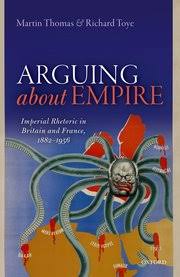
Martin Thomas, Richard Toye. Arguing about Empire: Imperial Rhetoric in Britain and France, 1882-1956. Oxford: Oxford University Press, 2017. 320 pp. $55.00 (cloth), ISBN 978-0-19-874919-6.
Reviewed by Warren Dockter (Aberystwyth University)
Published on H-Diplo (November, 2017)
Commissioned by Seth Offenbach
Printable Version: http://www.h-net.org/reviews/showpdf.php?id=49706“A Silent, Rankling Grudge”
In the autumn issue of Nineteenth Century Review in 1877, W. E. Gladstone wrote an article on legacy of the British Empire and the Eastern Question entitled, “Aggression on Egypt and Freedom in the East.” In addition to supporting notions of self-rule in Egypt, Gladstone warned of the perils of imperial interventions, arguing, “My belief is that the day which witnesses our occupation of Egypt will bid a long farewell to all cordiality of political relations between France and England. There might be no immediate quarrel, no exterior manifestation, but a silent, rankling grudge” (p. 19). These words proved so prophetic that political radical Wilfred Scawen Blunt employed Gladstone’s rhetoric against him in his work The Secret History of the English Occupation of Egypt (1907), writing that “this article is so remarkable and so wonderfully prescient of evils he was himself destined to inflict upon Egypt that it deserves quoting” (p. 57). This exchange serves to illustrate the fluid nature of imperial rhetoric and the discursive relationship which formed between the British and French Empires.
Martin Thomas and Richard Toye have written a remarkably ambitious and excellent study which examines the intersections of imperial rhetoric between the French and British Empires during the late nineteenth and twentieth centuries. The book is based on seven case studies that focus on moments of imperial intervention in which both the French and Britain played an equal part, ranging from Tunisia and Egypt in the early 1880s through to Suez in 1956. This breadth allows the reader to see the evolution of imperial rhetoric in Britain and France while illustrating how policymakers in their respective metropoles became intrinsically linked, forcing them toward “co-imperialism.” This is particularly true regarding the Middle East and North Africa, where the British and French Empires remained in concert from nineteenth century until the realities of full-scale decolonization became apparent in latter half of the twentieth century. Continue reading “Dockter on Thomas and Toye, ‘Arguing about Empire: Imperial Rhetoric in Britain and France, 1882-1956’” →

 Imperial & Global Forum
You must be logged in to post a comment.