
Beatrice Gervasi, Katarzyna Jonkisz, Meng Hao, Sabeth Malfliet, and George Ellis
Students of ‘Linguistic Landscapes‘, Venice International University Summer School 2025
Faculty: Kurt Feyaerts, KU Leuven (Coordinator); Richard Toye, University of Exeter (Coordinator); Matteo Basso, Iuav University of Venice; Geert Brône, KU Leuven; Claire Holleran, University of Exeter; Eliana Maestri, University of Exeter; Michela Maguolo, Iuav, University of Venice; Paul Sambre, KU Leuven
Our case study of Venice for the ‘Linguistic landscapes: signs and symbols’ summer school was centred around the storied neighbourhood of Santa Maria Formosa. This area boasts a historic Basilica, the Fondazione Querini Stampalia library and a new art installation of 2 lions and 2 lionesses which is intended to promote public interaction with art and celebrate Venetian pride. In short, this area offers a lot culturally and historically. This is strongly evident when walking down the side streets. During our first excursion, our group got the immediate sense that this was a residential area that had developed a strong tourist population due to its historical significance and geographic location (en route to the Rialta bridge).
We were fortunate in the sense that this region of Venice was not a particularly large one, being measured at 0.0072km^2. However, this did not mean that our investigations were without challenge. The geography of this area (a seeming thoroughfare for tourist populations) led to difficulties in photo collation. This combined with the high-content-per-area (a total of 73 relevant primary photos) and the labyrinthine streets led to our group having an abundance of data and difficulties delimiting our data set and research question. To overcome this, we adopted a thematic approach which split our data set into three relevant points for discussion: action flows, multilingualism and polyfunctionality. We then used relevant semiotic and anthropological studies (for example Landry and Bourhis 1997, Scollon and Scollon, 2003) to dissect the data set and apply a linguistic landscapes lens with the end goal of finding out whether Santa Maria Formosa is a healthily functioning neighbourhood or another victim of the increasing globalization faced all over the western world.
Multilingualism in Santa Maria Formosa
During our exploration of Santa Maria Formosa, we found our attention drawn to the church, formally the Church of the Purification of Mary, which was located in the centre of the plaza – a testament to its historical and cultural role, and a potential factor in the high tourist flow in the area (Urry, 1990).
Naturally, during our first visit we approached the church at the main entrance. The main doors boasted a stark juxtaposition – this entrance gave us a chance to see the culturally rich, baroque interior but it contrasted sharply with a set of multilingual signs which indicate that the locals of Santa Maria Formosa have their own social norms and expectations.
It seemed apparent to us that these multilingual signs were aimed at the tourist population as they displayed international languages such as English, German, Spanish, and French. These signs which display instances of multilingualism generally involve commands or requests which are intended to uphold the respect of this sacred place. This indicates a clear accommodation of the tourist presence and it is a clear representation of local rules and norms to a global and diverse audience. This instance reflects a desire to preserve and protect heritage whilst also being pragmatic towards tourist flows – an act of hospitality management but also of boundary setting (Landry and Bourhis).
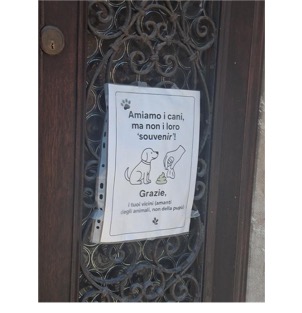
The front entrance and its seemingly imperative multilingual signage were contrasted starkly with the back façade of the Santa Maria Formosa church. The monolingual signage, hinting at a sense of linguistic exclusion and a private social script, and the more playful message (see Figure 1) indicates that the back façade was intended for the local population of Santa Maria Formosa – it was reserved for those who were part of an inner circle of linguistic knowledge and for those who didn’t need a reminder of the local rules.
As a team, our biggest take-away from the Santa Maria Formosa church ties in neatly with Jan Blommaerts’ theory (Blommaerts, 2013) of the order of indexicality – the same spaces hold differing meanings for different groups – and we got an immediate idea that this space, which seemingly served as a thoroughfare for tourists, had a lot more to it than met the eye.
Biblioteca Querini Stampalia – multi-use spaces
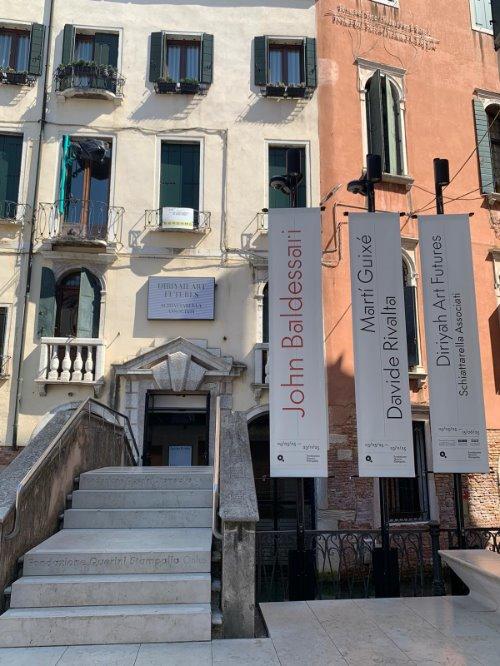
During our fieldwork we were quickly drawn to an area emblematic of Blommaert’s paradigm: La Biblioteca Querini Stampalia. For over 150 years, this library has been regarded as “the library of the Venetians,” as its official website proudly proclaims. Nestled on one side of the lively Campo Santa Maria Formosa, the library houses an extensive collection of volumes and remains open even on holidays—a testament to its role as a cornerstone of intellectual and civic life in Venice.
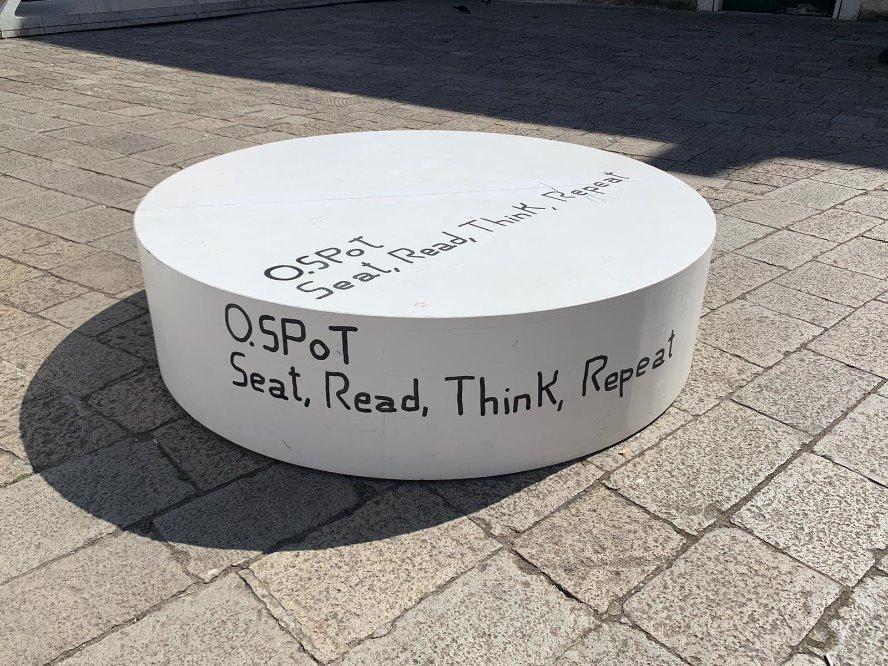
Yet, as one approaches the library, it is not the flow of residents or the prominent Italian signage that commands attention. Instead, the eye is drawn to a trio of large lion statues dominating the space adjacent to the entrance. Two white circular benches stand in front of them, bearing a message not in Italian, but in English: “Seat, Read, Think, Repeat.”
This subtle yet striking linguistic choice reveals another dimension of the space. It’s not just a library—it is also home to the Fondazione Querini Stampalia, which regularly hosts contemporary art exhibitions.
During our fieldwork, we observed how these lion sculptures—created by artist Davide Rivalta—serve as both public art and interactive installations. At first glance, they appear to enhance the public realm and invite community engagement. However, there is a striking irony here. The lion of Venice, long associated with Saint Mark the Evangelist, has deep historical and political roots as a symbol of Venetian identity and pride. And yet, here in Campo Santa Maria Formosa, these lions seem to have taken on a different role: tourist photo opportunities. Rather than sparking reflective engagement with art or history, they often function as aesthetic backdrops for quick snapshots. What was intended as a site for thoughtful interaction has, in practice, become part of the city’s expanding tourist infrastructure—a symbolic detour on the way to more “authentic” landmarks.
This shift is a vivid example of what theorists like John Urry (1990) has described: the transformation of cultural symbols into consumable tourist images. The lion retains its literal (denotative) identity—an animal, a sculpture, a landmark—but its connotative significance has evolved. Besides representing a link to an important cultural past, it also functions as a brand—one that is a symbol of the globalization of their city (Blommaert, 2013).
Bookshop Acqua Alta + shop with indirect tourism
The Acqua Alta bookshop is another interesting example that offers insight into the connotations associated with tourists and residents, based on the choice of language in certain signs.
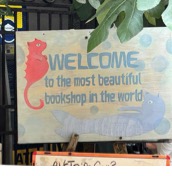
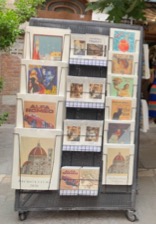
This photo (Figure 5) is a key example of MacCannell (1999) and his ‘The tourist: a new theory of the leisure class’. The sale of posters littered with stereotypical Italian connotations, such as Alpha Romeo, Mamma mia, Aperol spritz, etc., show that parts of Santa Maria Formosa deliberately try to appeal tourists by offering a supposedly ‘authentic’ Italian experience. In a broader sense, this shows that the area and the locals themselves are leveraging the tourist trade and, in some cases, maybe even commodifying their own culture. This indicates a split within the neighbourhood itself – some residents cater to the other residents, whilst others use multilingualism and cliches to attract the tourists. The explicit touristic character of the bookshop is also supported by the welcome sign (Figure 4): an exclusively English sign, using the hyperbole “most beautiful bookshop in the world” to directly appeal to tourists travelling from all over the world.
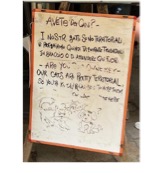
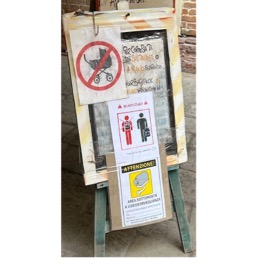
Figure 6 & 7, on the other hand, show an interaction between Italian and English signs, usually as an indication of the intended target audience. The signs near this bookshop are particularly interesting because the spatial overlay of certain signs can teach us more about the chronological evolutions of the multilingual aspect of the signs and the perceived hierarchy of languages here. The fully written out signs (warning to watch out for the cats if you brought your dog, and an instruction to be careful not to swing your backpack into something) have both evolved from bilingual to monolingual signs. As we can safely assume that tourists are less likely to have brought their pets compared to locals, it makes sense that the English part of Figure 3 has faded and/or been wiped out over time, without it majorly impacting the effectiveness of the sign. Contrarily, the other instruction has been re-imagined as a less complex, solely English sign. We could interpret this to mean that locals usually do not carry big backpacks, and that tourists are more likely to recklessly stumble into things in the shop. Moreover, most of the signs have been simplified and turned into non-verbal ones by working with pictograms. This could either be a way to avoid tourists not reading the fully written out signs, or a way to circumvent having to choose a specific language.
Lastly, the sign notifying visitors of camera surveillance is only in Italian. Perhaps the bookshop owners count on the camera pictogram to accurately convey the message, or maybe they have learnt from experience that tourist focus less on the general informative signs, as opposed to the direct warnings or the ‘authentic’ aesthetic signs.
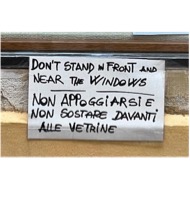
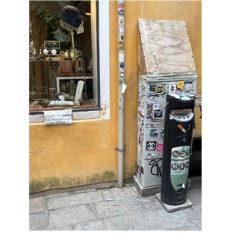
The shop right next to the bookshop naturally has to deal with a lot of indirect tourism, which is evidenced by the bilingual sign/instruction (Figure 8) attached to the windows. While the sign is written out in Italian and English, the choice to put English first could indicate that this is mostly meant as an instruction for tourists. However, as Figure 6 shows, the abundance of stickers and notes on the electricity box right next to the window suggest that the warning has often gone ignored.
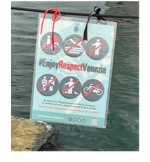
Finally, it is interesting to note that the city of Venice seems to take the imbalance between touristic and residential spots into account as well. In Figures 9 & 10, one taken next to the bookshop and the other taken near a take-off spot for gondola tours on the Santa Maria Formosa campo, the city chose to include a sign with its slogan meant to raise awareness: “#EnjoyRESPECTVenezia”. The choice to use an English slogan and to highlight the “Respect” in the slogan clearly signifies that the city hoped to combat the increase in (disrespectful) tourists in Venice. By choosing to put these slogans near predominantly touristic spots such as the bookshop and the gondola services, they offer further evidence to support our division of Santa Maria Formosa into touristic, residential and mixed areas.
Fruit and vegetable stall: a “healthy” campo?
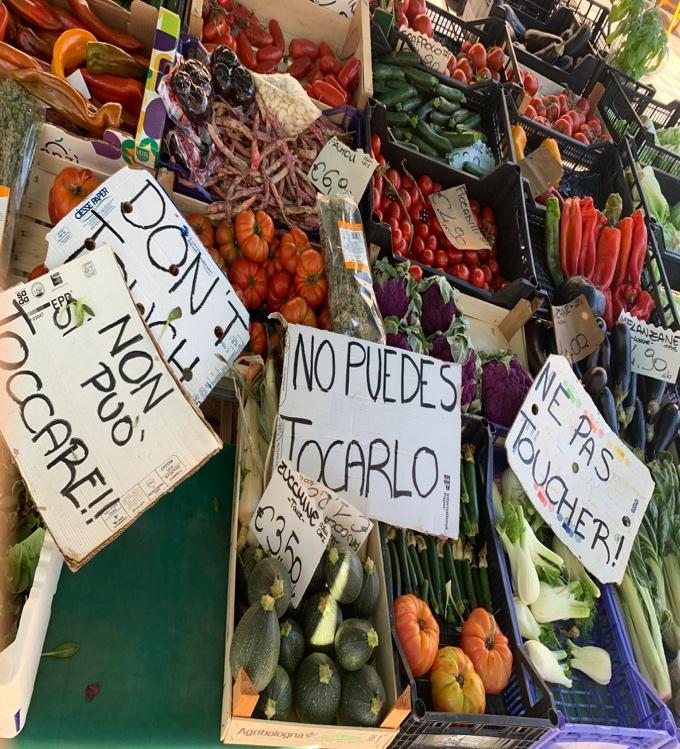
At first glance, the presence of a fruit and vegetable stall in the middle of Campo Santa Maria Formosa might suggest a vibrant, healthy neighbourhood. In many urban contexts, such stalls are often seen as signs of strong local life—a kind of informal social infrastructure that signals stability, community, and a resident-based economy.
But a closer look complicates this cheerful image. The signs displayed on the stall read “Do not touch”—and are all in different languages. These multilingual signs instantly disrupt the assumption that the stall serves primarily local residents. Would Venetians really need to be reminded not to touch the products for sale?
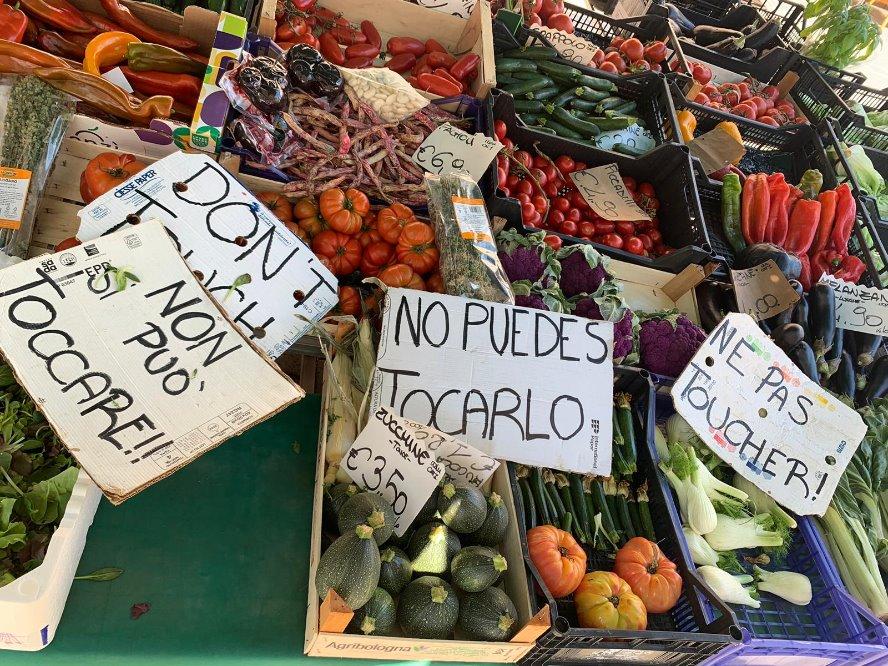
We decided to speak directly with the vendor to better understand the dynamics at play. Below is an excerpt from our interview:
“Not all tourists are the same. There are the ones that come here, touch everything, disturb others-the ones we call scoasse. But then there are the good ones: they stay here longer, maybe they have a house here, and they come here often, because they came once and liked the food. They are good people. The signs are not for all tourists…” (Campo S.M. Formosa, July 2025)
We learn that the stall has two main users, divided into two moments of the day: the morning for the residents, and the afternoon for tourists. And even with the latter, the definition is not straightforward: the signs are not displayed for the “good” tourists, who go there habitually, know the vendor, have learnt the ritualised practices governing that specific social infrastructure. The signs are there for the bad ones, the scoasse in Venetian dialect—literally, the “trash”.
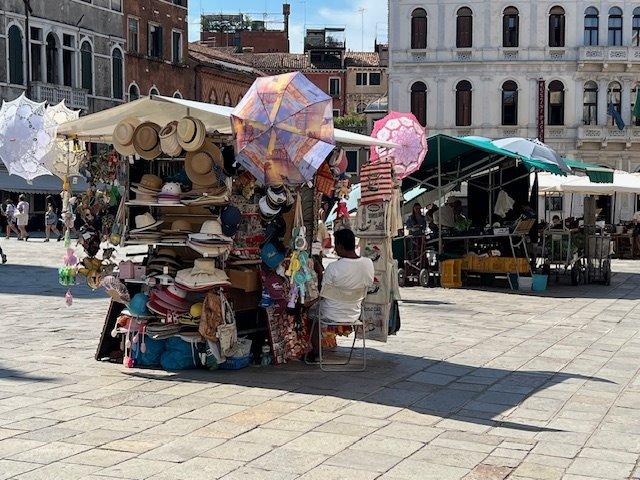
Looking around, we noticed that the fruit and vegetable stall is located between two kiosks selling tourist merchandise—likely frequented by the “bad tourists” the vendor referred to during our interview. The juxtaposition is striking: a symbol of local life and the unmistakable signs of mass tourism.
As we moved across the square, heading in the opposite direction from the church, we gradually entered what felt like a more residential part of the campo. Several elements of the linguistic landscape signalled this shift.
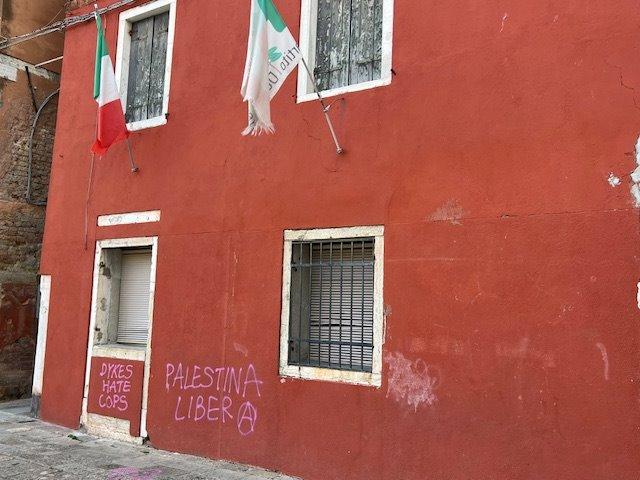
We spotted the local headquarters of a political party, a shaded space beneath which children played while grandparents and parents watched over them—a scene that speaks to a slower, everyday rhythm of life. On the walls of the party’s building, we noticed various forms of political and social contestation, some of them written in Italian. These signs suggest ongoing civic engagement and resistance—messages clearly intended for a local audience, rather than passing tourists. “Palestina Libera” (Free Palestine), in Italian, next to “Dykes Hate Cops” in English, as well as “Queers for Palestine”. One of our unanswered question concerns precisely the multilingualism displayed in these graffiti: given the style and colour, they are apparently made by the same people. Is the English language used because of international movements and political slogans, or is it like that strategically to reach as many people? After all, the English slogans have their corresponding Italian version.
Funeral homes and picnic gatherings – contradiction or contestation?
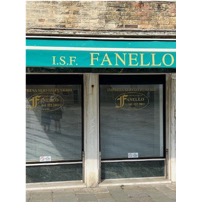
At a certain point during our walk, we came across a funeral home—a typically local service, intended primarily for residents, not just in Venice, but anywhere.
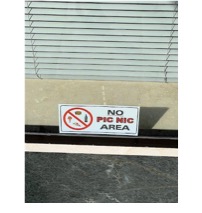
What caught our attention, however, was something quite unexpected. Just below the funeral home’s sign, another message appeared—this one in English: “No Picnic Area.”
Once again, the juxtaposition was striking. On the one hand, the funeral home conveys dignity, restraint, and locality. On the other, the “No Picnic Area” sign seems almost absurd in this context—who would consider picnicking in front of a funeral service?
And yet, this small, almost comical clash between signs reveals something much deeper: a state of incommunicability within the linguistic landscape itself. The older, local signage speaks to a certain intended use of space—a space of mourning, of everyday life. The newer, tourist-oriented signage responds not to residents, but to behaviours observed in an increasingly transient public.
A sense of inappropriateness is conveyed by the clash of these two signs—by the collision of symbolic orders.
Commodification vs local resistance – the multilingual landscape of conflict in Santa Maria Formosa
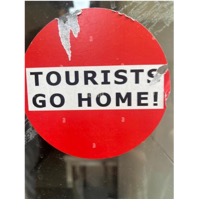
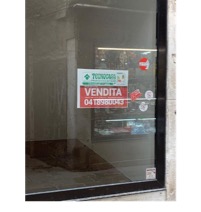
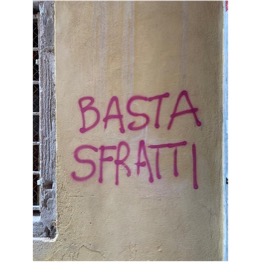
In Santa Maria Formosa, the interplay of multilingual and monolingual signage shows us the nuanced relationship between residents and tourists. In residential alleys, signs like “immo” (immobilaria) — written solely in Italian — mark housing communications clearly directed at locals, reinforcing a sense of community ownership and exclusion from the tourist economy. In contrast, on busier streets frequented by tourists, Italian “for sale” signs appear alongside protest stickers in English, such as “tourists go home” — messages that speak directly to outsiders and signal conflict around gentrification and globalization. The Italian slogan “basta sfratti” (“stop evictions”) appears in areas marked by political graffiti and local aesthetics, linking housing activism to broader socio-ideological movements. Particularly revealing is the condition of many protest stickers: partially torn, defaced, or removed. With these findings unresolved questions come to light — who is censoring these messages? Tourists? Disapproving locals? Property owners protecting market value? These signs, and their erasure, show that the public spaces in Santa Maria Formosa are contested and meaning is constantly changing. Ultimately, the linguistic landscape here reflects a delicate balance: while tourists are accommodated through polite multilingual signage, residents assert resistance through local language and protest. What emerges is not open conflict, but a carefully managed, and at times fragile, coexistence akin to a tug of war.
Hidden signs of contestation
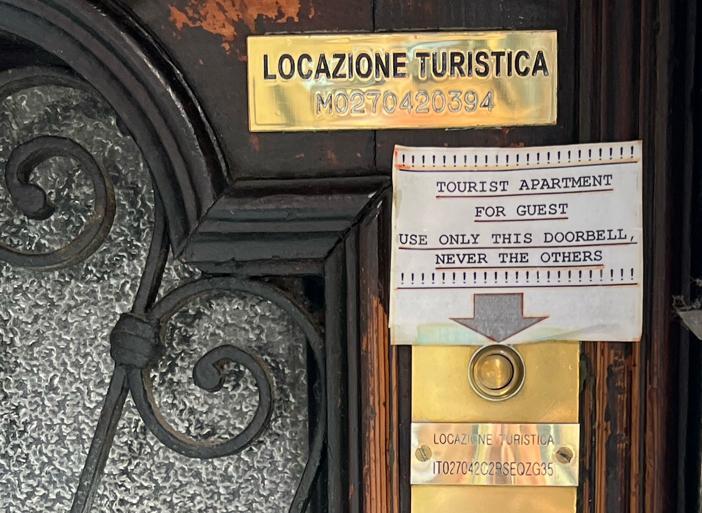
Placing instructions in English may have different purposes and may show contrasting attitudes of their authors toward tourists. If we compare those located on doorbells of residential buildings and those placed on shop entrances, we can notice two approaches towards English speaking tourists. In residential buildings where both tourist accommodations and apartments with permanent residents are located, we can find several notices asking tourists to ring the correct bell (photo 1). Those instructions are mostly in English and may have two main roles. On one hand, they help tourists in navigating a new place and finding their apartment easier. On the other hand, they keep residents from being disturbed by tourists constantly ringing their doorbell by mistake. In a certain way, they “protect” locals from tourists. English signs at the entrances of shops suggest alternative attitudes.
That type of sign is much more welcoming and joyful. Shop owners invite English speaking customers to enter and, if needed, provide them with further instructions (figure 19). This difference in the residents’ and shop owners’ attitudes may be determined by a level of a potential profitability of a tourist presence in the area. In the case of shop owners, tourists are potential customers who can generate an income. When it comes to the residents, they do not directly profit financially from living next to a tourist accommodation, yet they struggle with different types of inconvenience, for instance aforementioned unwanted doorbell ringing.
Santa Maria Formosa – thoroughfare or neighbourhood?
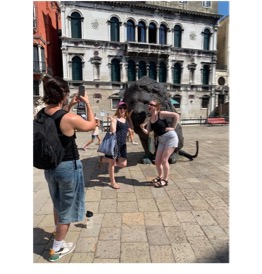
Santa Maria Formosa offers a microcosmic view of how Venice negotiates its identity in the face of tourism, and how multilingual and semiotic signs both reflect and shape that negotiation. One of the starkest examples lies in the aforementioned lion statues. Symbols of Venetian pride, sovereignty, and civic identity, tied to St Mark the Evangelist. While artist Davide Rivalta intended the lions in this campo to foster interaction between the public and contemporary art, they have instead become emblematic of the city’s semiotic shift under tourism pressure. These statues are now ‘photo pit-stops’, frequently climbed, sat upon, or staged around by the tourist population. In semiotic terms, their denotative meaning — a lion, an art object — remains unchanged, but their connotative meaning, as Barthes (1964) would suggest, has been sequestered: they now stand not for Venetian resilience but for a touristic, globalized image of the city. For locals, they may still carry historical gravity, but for tourists, they function as commodified icons — Venice reduced to snapshot and spectacle. The city trivialized through excessive commodification. This aligns with MacCannell’s (1976) notion of staged authenticity, where symbols meant to illustrate heritage are stripped of context and recycled to serve the tourist gaze (Urry, 1990). As Blommaert (2013) argues, signs acquire new meanings in global flows, often disconnected from their original sociocultural grounding. The lion statues thus represent the broader tensions between preserving heritage and adapting to economic changes — this is where the linguistic landscape becomes central.
As a team we found that tourist flows around Santa Maria Formosa illustrated these shifts not only visually but also linguistically. Gondola signage along the borders of the campo, for instance, often appears in multiple languages — Italian, English, German — which, in line with Landry and Bourhis (1997), shows the high ethnolinguistic vitality of the tourist population. Multilingualism here is expedient: it welcomes, directs, and facilitates tourist movement in areas like gondola stations. However, this same linguistic openness can signal a double-edged process: while outwardly inclusive, it can also mark a space as no longer primarily for locals. Where signage is monolingual Italian — such as the more mundane or community-facing notices like “Immo” on residential doors or “Basta sfratti” (stop evictions) graffiti — it becomes clear the intended audience is internal. These monolingual signs not only preserve a ‘local only discourse’ but also assert ownership over space, resisting the dilution of local presence in the symbolic environment (with further examination, this use of monolingualism could be linked in with wider sociological debates around community with scholars such as Benedict Anderson). Writ large, the layering of multilingual and monolingual signage reveals nuanced geosemiotic divisions (Scollon & Scollon, 2003), in which different areas speak to different groups, reflecting an ongoing negotiation between welcome and resistance.
This negotiation is just as evident in social behaviours and movement patterns. The Biblioteca Querini Stampalia serves as a pivotal dual-use space. At its main entrance, tourists are greeted with multilingual signage and curated exhibition paths, inviting them to participate in the cultural, historical narrative of the city. But deeper within the building, the language use shifts back to monolingual Italian — a linguistic reminder of local purpose, aimed at long-term users of the library, not temporary guests. The difference in movement through the space was fundamental in our fieldwork: tourists pass quickly through front areas, engaging with the architecture and displays, while residents settle into reading rooms and community areas. Urry’s (1990) tourist gaze is contrasted with what Scollon and Scollon (2003) call resident discourses in place — slower, habitual, often invisible forms of interaction that claim the space without spectacle or fanfare. This linguistic layering mirrors the social layering of use and shows how local life quietly but deliberately persists.
Even more subtle markers of residential flow appear in the embodied use of space — for instance, a child playing in the plaza. Though easily overlooked, this activity signals that Santa Maria Formosa is not only a transit site but a living neighbourhood. Children’s play indicates safety, routine, and communal knowledge — elements that do not align with the fleeting tourist experience. As Scollon and Scollon’s geosemiotics reminds us, meaning is not only in signs but in how bodies move and inhabit space. This act of play reclaims the square as a ‘lived in environment’, not just a site for photography or passage. Such small, habitual practices underscore that the local population has not entirely ceded public space — they remain physically and symbolically present, even if their signs are more subtle.
This being said, the linguistic landscape of Santa Maria Formosa showed us signs of its internal struggle in less subtle ways: Protest stickers — often in English — stating “Tourists go home,” or graffiti like “Basta sfratti,” signal direct resistance to the tourist economy. Their strategic placement near real estate signs or tourist pathways shows how the linguistic landscapes can become battlegrounds. The partial removal of these protest stickers complicates their meaning further: who removes them? Tourists who feel accused? Residents who disapprove of the tone? Property owners protecting economic interests? This ambiguity reflects Blommaert’s (2013) insight into indexical instability — signs do not carry fixed meanings, especially in spaces of social tension. The tearing down of protest signs is itself a semiotic act and an interaction with the space. This revealed to us the conflict and negotiation over who controls the symbolic order of the space.
In sum, the linguistic and semiotic environment of Santa Maria Formosa reveals a highly layered and nuanced urban dynamic. Tourist flows are accommodated — through multilingual signage, symbolic landmarks, and curated pathways — but local flows persist beneath or beside them, in monolingual signs, embodied practices, and moments of subtle or overt resistance. The landscape speaks in many tongues, literally and metaphorically, and through these voices we hear the competing desires to preserve, to adapt, and to belong. What emerges is not simply a binary of conflict or harmony, but a negotiated coexistence: one in which language, space, and movement are constantly redefined in response to global pressure and local persistence.
Conclusions
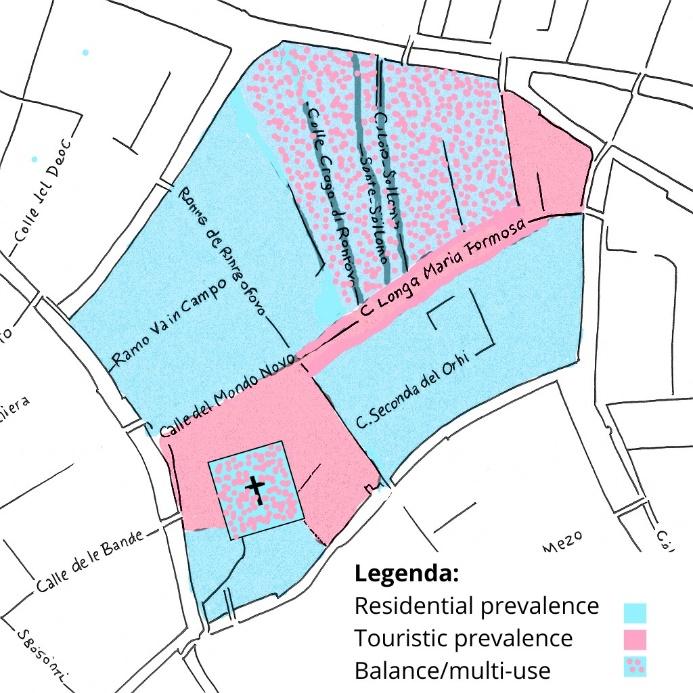
To illustrate this precarious balance and interaction between touristic and residential prevalence in Santa Maria Formosa, we created a map (Figure 23) in which we tried to discern which of the two was most present in a certain part of our neighbourhood. This is the culmination of the specific Linguistic Landscape elements and signs discussed in this blog. In particular, we wanted to draw attention to the alternating uses of the campo, brought together by the centrally positioned church. The church itself can be considered a place of mixed use, as it is adorned with signs specifically catered to both tourists – the warnings and general instructions in English and other languages –, and to locals – the exclusively Italian signs listing the timestamps for mass –. The only other spots we considered truly mixed are the houses surrounding the residential alleys. While these alleys were mostly devoid of elaborate signs directed at tourists, we did notice that a large amount of the houses in these alleys served as touristic residences as well. One could therefore deduce that the houses next to the alleys are occupied by a mix of tourists and residents. Overall, the spaces with notable touristic prevalence, aside from the campo, are the main shopping street and the bookshop Acqua Alta at the other end of the map.
Our fieldwork revealed a space that, while physically unified, can be socially fragmented. Through the lens of the Linguistic Landscape (LL), we identified a latent conflict between residents and tourists. This tension does not always erupt into open confrontation—both groups coexist and share the same urban infrastructure—but it is inscribed in the symbolic and linguistic fabric of the city.
Take, for example, signs like “Do Not Touch” posted at local market stalls, clearly aimed at tourists, or graffiti such as “Tourists Go Home” and “Basta Sfratti” (Stop Evictions) scrawled near real estate listings. These signs don’t just communicate practical messages; they express deeper anxieties about space ownership, access, and identity.
This tension is part of a broader negotiation of public space—a process that plays out through multilingual signage and spatial practices. Multilingualism, in this context, doesn’t only facilitate communication. It encodes different roles, audiences, and functions: English for tourist management; Italian for political resistance; sometimes both, in hybrid or overlapping uses of space.
What emerged was a relatively clear—but not rigid—division of urban zones. Certain parts of the campo leaned toward residential use, marked by local services, political party headquarters, and spaces where children played and elderly residents gathered. Other areas skewed toward tourism, featuring souvenir stands, signage in multiple languages, and art installations repurposed as photo ops. Despite this spatial division, we also observed polyfunctional spaces, such as churches used simultaneously for worship and sightseeing, with signage reflecting their dual roles in multiple languages and registers.
This dynamic complexity echoes Kevin Lynch’s concepts of legibility and imageability (1960). The city, in his view, is readable not just through its physical layout, but through the symbols and behaviours that shape how people move through and understand it. In this light, the LL becomes a map of situated interactions—or at times, their absence—which speak volumes about how urban space is claimed, contested, and shared.
Ultimately, these signs are more than just texts—they are artifacts of negotiation between different urban actors, mediating how space is used and by whom. By mapping these interactions, we gain a deeper understanding of how the built environment both reflects and shapes social life, offering valuable insights for more responsive, inclusive urban planning.
Bibliography
Barbera, F. (2024). Material and “providential” social infrastructures: a foundational economy perspective. Handbook of Social Infrastructure, 350-363. (maybe on the blog post)
Barthes, Roland. 1957. Mythologies. New York: The Noonday Press.
––––––––. 1964. Elements of Semiology. New York: Hill And Wang.
Blommaert, Jan. 2013. Ethnography, Superdiversity and Linguistic Landscapes Chronicles of Complexity. Multilingual Matters.
Gorter, Durk. 2006. Linguistic Landscape: A New Approach to Multilingualism. Clevedon England; Buffalo: Multilingual Matters.
Gunther Kress, and Theo Van Leeuwen. 2000. Reading Images: The Grammar of Visual Design. London: Routledge.
Landry, Rodrigue. Linguistic Landscape and Ethnolinguistic Vitality.
Maccannell, Dean. 1999. The Tourist: A New Theory of the Leisure Class. Berkeley, Calif.: University of California Press.
Scollon, Ron, Suzie Wong Scollon, and Suzie Wong. 2003. Discourses in Place: Language in the Material World. London: Routledge.
Urry, John. 1990. The Tourist Gaze. Sage Publications Limited.


You must be logged in to post a comment.