
Mitchel Stuffers, PhD Candidate in History, University of Exeter & Assistant Editor at CIGH Exeter
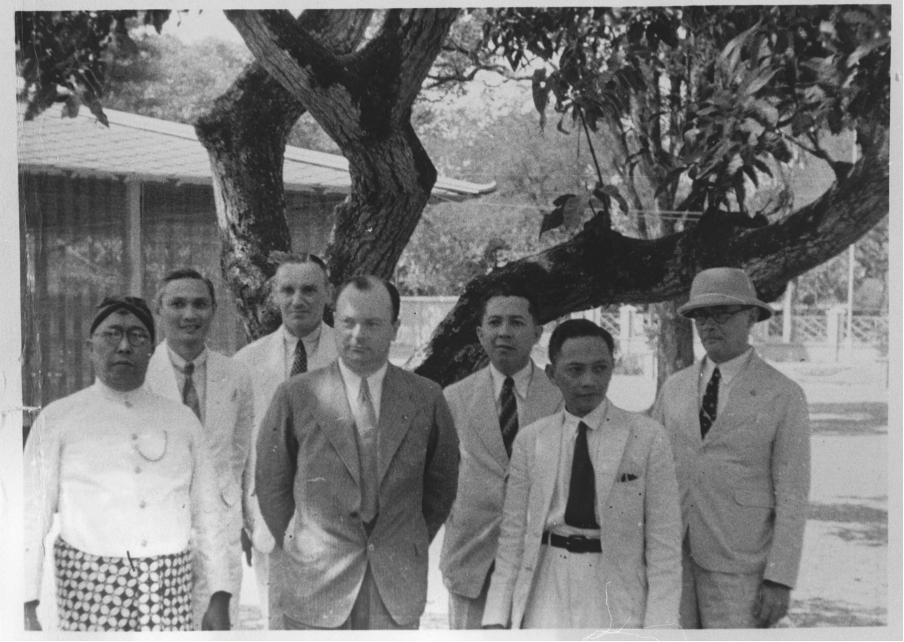
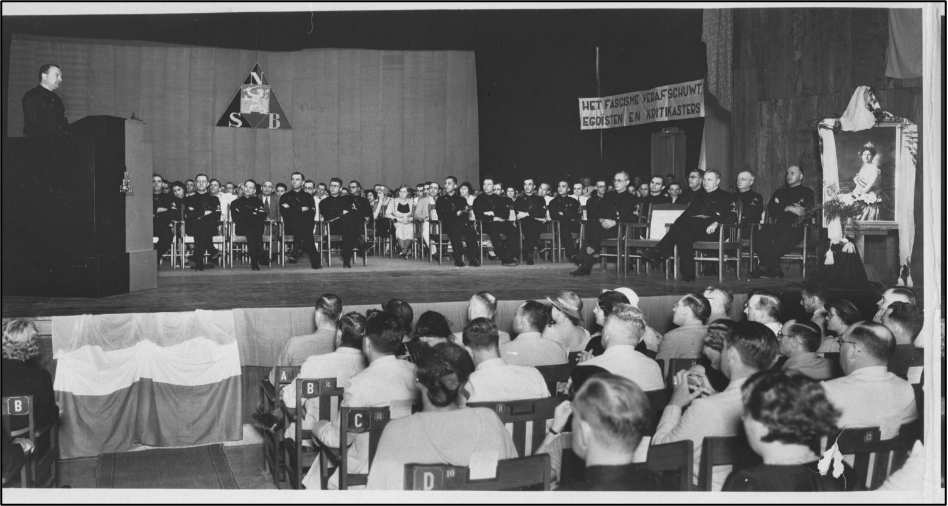
Anton Adriaan Mussert, the leader of the Dutch fascist National Socialist Movement(Nationaal-Socialistische Beweging, NSB), took a 2-month trip to the Dutch East Indies (now Indonesia) in 1935. While there, he agreed to an interview by the colony’s nationalist newspaper Pemandangan, wherein Mussert, remarkably, sought to sell the empire to its anticolonial-leaning readership.
I uncovered the interview while researching my PhD, which integrates imperial & colonial studies and comparative fascist studies by examining how organisations like the Dutch National Socialist Movement(NSB) built, justified, and executed their visions of fascist international worldbuilding. It also draws on Holocaust & Genocide Studies and Intellectual History to gain a more holistic overview of its origins and aims.
Over the last year and a half, I engaged with materials not only from the Netherlands but also pieces from some of its former colonies, like Indonesia, to engage with those inquiries.
Dutch colonial rule over Indonesia, especially before the outbreak of World War Two, was of enough interest to the NSB that its leader had decided to visit it and create an inter-imperial branch to operate from it. The NSB’s efforts to establish a foothold in the colony have led to various arguments among historians. Some claim that Mussert sought to use the Dutch East Indies as a steady stream of funds, and that the Indonesian NSB operated as a mere extension of the motherland’s metropolitan interests.[1] Another scholar reasoned that the NSB had held an “inclusive culturalist notion” of pan-imperial cooperation in its outlook on the colonies, whereby the organisation at large was genuinely impacted, until ethnonationalist chauvinism eventually ended it.[2] The existence of an interview wherein Anton Mussert was transcribed into Indonesian, rather than Dutch, thereby sways us to lean towards the latter hypothesis and examine its peculiarities, wherein an appeal to the colony may reveal its pre-war PR strategies.
Examinations on the NSB more broadly start with insightful works such as those by Edwin Klijn and Robin te Slaa, which, when discussing the NSB’s colonial & imperial aspects, argue that the urge for Lebensraum (Living space) was essentially nullified for the Dutch fascists due to the presence of the colonies before World War Two.[3] More recent historiography includes Tessel Pollman,[4] Jennifer Foray,[5] Geraldien von Frijtag Drabbe Künzel,[6] and Nathaniël Kunkeler.[7] However, it was a note in an older work, from 1968, that led to this short article. Simon L van der Wal briefly mentioned the existence of an interview with the NSB’s Leader, Anton Adriaan Mussert, by a leading Indonesian newspaper;[8] one with anti-colonial, pro-independence leanings.[9] The existence of this interview thereby challenges the way we understand the outreach of ultranationalist groupings to their non-white audiences. It moves us to ask how inter-imperial organisations like the NSB appealed to the wider sphere of colonised subjects, beyond the organisation’s perceived exclusivist dimensions, as has widely been the case in popular memory in the Netherlands following the NSB’s downfall.
The interview has now been recovered, translated from Indonesian, and brought under examination. It contains aspects that I believe are worth reflecting on. The Indonesian National Library archivists’ kind help in locating the interview among its vast collections, coupled with the willingness of a friend of mine, Amriza Basyari, to be the document’s translator, reveals a rare glimpse into Mussert’s double-sided appeal; now targeted at Indonesian audiences, recorded during his trip there in July & August 1935, years before the outbreak of the Second World War wherein the NSB collaborated with Nazi Germany.
Analysis: Anton Mussert in The Pemandangan newspaper[10]
When examining the interview contents, two main elements jump out. The first is that Mussert’s paternal narrative of imperialism aligns with that of other NSB propaganda, which serves to reinforce prior perceptions on how Mussert sought to keep the colony in line. However, the second half of his interview appears to deviate from what one may otherwise expect from the NSB Leader; democracy and bottom-up representation were seemingly discussed positively.
He was interviewed from the comfort of his hotel room, joined by a Pemandangan journalist and a local NSB representative.
Opening the interview, Mussert combatted the idea of Indonesian separatism by highlighting the longer history between the Dutch and the East Indies. He equated the continuation of the empire with sustained order and stability for both parties, stating:
With over 300 years of relations, Holland and the Indies have become one. Separation means chaos for both parties. Holland still needs to lead this country; without it, the Indies will suffer. Holland and the Indies have to become one imperium. Many groups in this country believe the Indies cannot be separated from top leadership, Holland, as it can cause chaos within its own populations or fall into the hands of other empires. (Appendix I)
Thereby, as with other NSB propaganda about Indonesia, including domestic outlets like their (Dutch language) Indië – Hou Zee magazine, Mussert used a paternalist narrative to justify the continuation of Dutch colonial rule. Particularly relevant to the Indonesian audience, of course, would be that he warned them against civil unrest and outside threats. Expanding on this, the newspaper noted Mussert’s call for closer cooperation:
Mr. Mussert does not see any separation between the people in the Netherlands and in this country. The Dutch people are Hollandsche Nederlanders, and the people here are Indische Nederlanders. How can the people in Holland and here be one? Because one empire must work together, not only Hollandsche or Indische Nederlanders [but together] for the progress of Holland and Indie. (Appendix II)
Thus, the first half of Mussert’s interview promotes a paternalist imperial dynamic, which connects to broader (early) NSB appeals to locals in the colonies, whereby they proclaimed not to judge by skin colour or place of birth, but by everyone’s devotion to the imperium.[11] Combined with the otherwise recorded scornful speech on indigenes by another scholar,[12] these comments appear to reflect an attempt at appeasing various audiences, customising the language to make the NSB universally appealing.
More curious is the second half of the interview, which featured a noticeably more positive tone on democracy and transparent governance than otherwise expected from the autocratic NSB’s fascist leader. Pemandangan recorded Mussert’s seemingly positive outlook on grassroots representatives, wherein he expressed:
[The current] body of representatives are only present in Holland, [but there is] the need for adequate representation from Indonesian Dutchmen from Indonesians, [and] it has to be chosen by the people and not like the system now, by those in Holland [under communist influence.] The people of Holland now are bored of scheming politicians, and there must be a representative for the people by the people. (Appendix III)
In addition to this call for direct representation – which one may speculate Mussert did to appeal to his Indonesian audience- Pemandangan also inquired, with their final prompt, about the NSB’s “colonial programme”. And, while Mussert here also argued that no such blueprint existed, the newspaper wrote:
Mr Mussert continues to explain how he would rather [see that] the indigenous people (of Indonesia) not be harassed by the West. He sees a misinterpretation of everyone here. The people here (need to realise that) the Indonesian Dutchmen have [their] own culture too. It has to be upheld and not be attacked by Western influence. (Appendix IV)
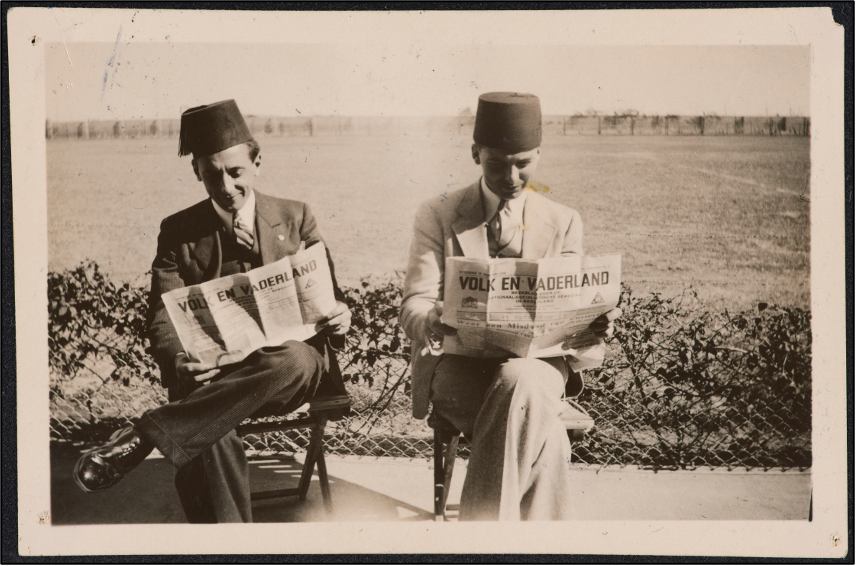
Thus, Mussert utilised doublespeak and positioned the NSB as a positive force for the Indonesian people. Noticeably, here, beyond advocating for the paternalist imperial dynamic, Mussert sought to portray himself to his Indonesian audiences as not just a guarantor of order, but also as someone who recognised, and even advocated for, the representation of Indonesian colonial subjects in the imperium. To this extent, one observes either a range of statements that appear at first glance to be contradictory or, possibly, it pertains to a story of more cynical, custom-made appeals to various audiences. This would fall in line with prior discoveries of mine, namely in the form of my MA thesis on the ambiguous nature of the Volk en Vaderland newspaper, whereby reading between the lines, especially in the early years, had been critical to understand how the NSB propaganda operated.[1] Nonetheless, we have here a rare snapshot of one of the NSB’s many faces: This one address was intended by Mussert to be shown to non-Dutch, Indonesian subjects to gain a more favourable standing among them, which separates it from the Dutch interviews given by Mussert at the time to the colonist-oriented papers Sumatrapost and Soerabaijasch Handelsblad, and the NSB’s own newspapers in the colonies.[2]
Lastly, in their reflection, the anticolonial-leaning newspaper commented on the final impressions of Mussert:
He can smile with such sharpness if he can power through such political gatherings, and his voice heavy if he promises that he will work for the dignity of his people. He does not hate the nation, but sees the people that are diligent, disciplined and strong. He keeps the promise of how [his] NSB will not push the people of this country, but will advance its strengths to protect its dignity. (Appendix V)
With this, Pemandangan also appears to have taken an unusual approach to this interview, not just providing a platform for him, but also noting its positive reception of him.
Conclusion
The Mussert interview provides a unique look at the NSB’s targeting of Indonesian colonial, and beyond the implications of its contents alone, it raises questions in response to the interview’s very existence.
Why did a leading anti-imperial Indonesian newspaper platform Anton Mussert, a self-proclaimed ‘proud nationalist and imperialist’ from the Dutch metropole, and transcribe his appeals into Indonesian? [13] For this, one may well reflect on Mussert and his NSB and wonder whether their attempt at creating a more appealing, normalised image of Dutch fascism likewise led to Pemandangan’s intrigue or possibly challenged the paper to undermine it. Yet, the paper’s concluding remarks seemingly contradict the latter.
In turn, the interview impacts our understanding of the receptions (and perceptions) between the NSB and Indonesia’s audiences. For example, one scholar argued that Mussert’s open door to the indigenes was for them to be leadership “décor” at best, and that it was a “casual instruction” when he permitted their membership until 1938, as he personally “knew almost nothing” about the social groups in the colonies.[14] Here, Mussert’s appeal, and its translation into Indonesian, offers a serious glimpse at how he may have attempted to positively shape his and the NSB’s image to the colonial subjects, especially when he expressed his supposed concern for their safety and their need for fair representation.
It also connects to another important question about the NSB’s overall appeal, as this interview, together with Mussert’s outreach through colonist-targeted ones, had followed his controversial invitation to meet the Dutch East Indies’ Governor-General a month prior, on 23 July 1935.[15] In turn, these events of media exposure at home and in the colonies narrowly preceded the NSB’s infamous electoral success at the Dutch Senate elections, held three days later (July 26), where the NSB won a respective 7.94% (300,000) metropolitan votes.[16] Local interviews of political leaders like Anton Mussert therefore help shape our understanding of the sorts of appeals they made to their various audiences, especially across complex multi-ethnic, multi-continental empires. Furthermore, less studied interviews like the one now treated may well fit into a longer series of events which shaped their public legitimacy.
APPENDIX: INTERVIEW EXCERPTS IN ORIGINAL INDONESIAN
(I) “Tentang Indie los van Holland
“Saja soedah dengar toean poenja pikiran tentang “Indie los van Holland” Waktoe toean pertama bitjara di [?] Theater. Bolehkah saja minta keterangan lebih djaoeh.
“Zonder toenggoe lagi Ir. Mussert djawab”, Oleh perhoeboengannja jang 300 tahoen lepih ini masa seakan2 Holland dan Indie ada mendjadi satoe. Berpisahnja artinja kekatjauan boeat Goea-doeanja, Holiand masih perloe leiden (pimpin) ini negeri. dengan ta’oesah Indie haroes lijden (sengsara). Holland dan Indie haroes meroepakan imperium satoe.
Banjaknja golongan Ji ini negeri ke doedoekannja ini poelau menjebabkan tidak bisa Indie lepas dari Opperlei- ding, Holland, sebab bisa djadi menje babkan kekatjauan antara pendoekoek senuri atau lekas ditangan keradjaan besar lain. Maka dari otoe di Holland dan djoega disini tereakan “Indie los van Holland“ haroes dibanteras habis. Wij zullen in Holland doen en hier laten wij aan onze kameraden!“ Di Holland ir. Mussert kata lebih heibat orang tereak perkara “Indie los van Holland”, tetapi ini akan dibikin berachir dengan segara.”
[Source: [n.a.], “Bitjara dengan Ir Mussert”. In Pemandangan, No 110, Tahun 04, 15 August 1935, p. 2.]
(II) “Indische Nederlanders
Lebih landjoet Ir, Mussert tidak soe ka ada pemisahan antara ra’jat di Nederland dan di ini negeri. Orang2 Belan da adalah Hollandsche Nederlanders dan orang disini lndische Nederlaaders, bagaimana djoega ra’jat di Holland dan disini ada satoe. Sebab satoe imperium mesti ada kerdja bersama tidak perdoe li Hollandsche atau Indische Nederlanders, oentoek kemadjoean Holland dan Indie.”
[Source: Ibid.]
(III) “Bedan perwakilan
Ir Mussert tidak menjetoedjoei pada parlement seperti adanja sekarang. Bahwa haroes ada perwakilan ra’jat itoe soedah seharhoesnja tetapi dengan lain dasar. Meskipoen itoe badan per-wakilan nanti adanja di Holland, djoega perloe ada wakil Indische Nederlander (Indonesier) tetapi haroes betoel di pilih oleh volk. Boekan seperti sekaranh jang ada di Holland (Roestam Effendi) hanja dipilih dan digoenakan perkakas oleh communisten. Badan perwakilan rakjat ini masa” kata Ir. Mussert, “sajang jang dikirim sebagai wakil boekan jang baik2, Din poen tadak boleh dikata wakil rajkat, hanja semata2 wakil dari politieke partyen. Rakjat sekarang Holland en hier. Djemoe pada politieke gekonkel mesti ada wakil rakjat jang betoel bekerdja boeat rakjat.”
[Source: Ibid.]
(IV) “Koloniale program N.S.B. dan sebagainja
“Apakah toean bisa toeroerkan pada saja bagaimana adanja Koloniale Program N.S.B.
“Dat hebben we niet, en gelukkig niet”. N.S.B. tidak poenja koloniale program dan anggap ini ditak perloe di ini masa. Apa jang ia sesalkan ja lah fihak kaoem merah di Holland jang oendjoek seakan-akan ini negeri pen doedoeknja sangat sengsara.
Di seloeroeh Praiangan ia liat (hanja dari loear) bahwa seolah-olah malaise tidak di kenal. Orang perempoean dengan kebaja dan kainnja jang endah. Lelaki dengan kainkepala dan anak2 bersih serta sehat nampak di djalanan.
Ir. Mussert lebih landjoet toetoerkan bahwa ia lebih soeka adat pendoekoek aseli djangan diperkosa oleh Barat. La anggap keliroe kalau semoae2 di sini. Rajat disini, Indische Nederlanders mempoenjai cultuur sendiri ig. Haroes dipegang tegoeh, djangan teroesak oleh pengaroeh Barat.”
[Source: Ibid.]
(V) “Kita penja indruk terhadap ia
Kita dapat indruk tentang soenggoeh2 nja ini pemoeka pada oesaha memadjoe kan bangsanja, Ia bisa senjoem begitoe tadjam djikalau djengeki perkoempoe- lan politiek, dan soearanja lantas berat djikalau ia berdjandji dan akan beker dja oentoek ketinggian bangsa.
La boekan membentji pada bansa kita, tetapi ia jekihatan orang jang soeka pada tucht dan dicipline jang tegoeh. La tetap berkejakinen bahwa N.S.B. tidak akan mengegentjet ra’jat ini negeri, tetapi akan memadjoekan sampai poenja kekoeatan oentoek diaga diri sendiri tetapi”
[Source: Ibid.]
[1] Pollmann, Tessel. “‘Either One Is a Fascist or One Is Not’: The Indies’ National–Socialist Movement, the Imperial Dream, and Mussert’s Colonial Milch Cow.” Indonesia, no. 92 (2011): 43–58. https://doi.org/10.5728/indonesia.92.0043, p. 45.
[2] Kunkeler, Nathaniël. “Dietsland Empire?: The International and Transnational Dimensions of Dutch Fascism and the NSB, 1922–42.” Locus 28, no. 2 (2022): 124–145. https://doi.org/10.34019/2594-8296.2022.v28.37259, p. 124.
[3] Klijn, Edwin & Te slaa, Robin. “Geen behoefte aan Lebensraum maar wel behoud van koloniën” in De NSB: Deel 1 – Ontstaan en Opkomst van De Nationaal-Socialistische Beweging, 1931-35 (Boom, 2009), 176.
[4] Pollmann, Tessel. “‘Either One Is a Fascist or One Is Not’: The Indies’ National–Socialist Movement, the Imperial Dream, and Mussert’s Colonial Milch Cow.” Indonesia, no. 92 (2011): 43–58. https://doi.org/10.5728/indonesia.92.0043.
[5] Foray, Jennifer L. “An Old Empire in a New Order: The Global Designs of the Dutch Nazi Party, 1931–1942.” European History Quarterly 43, no. 1 (2013): 27–52. https://doi.org/10.1177/0265691412468085.
[6] Geraldien von Frijtag Drabbe Künzel. ”Germanje’: Dutch empire building in Nazi-occupied Europe,“ In Journal of Genocide Research, 19:2 (2017): 240-257, https://doi.org/10.1080/14623528.2017.1313521
[7] Kunkeler, “Dietsland Empire”.
[8] Van der Wal, Simon L. “De nationaal-socialistische beweging in Nederlands-Indië”. In Bijdragen en Mededelingen van het Historisch Genootschap, 82. Antigonos, 1968.
[9] Mark, Ethan. “Japan’s Occupation of Java in the Second World War: A Transnational History”. In SOAS Studies in Modern and Contemporary Japan. Bloomsbury Academic, 2018. http://dx.doi.org/10.5040/9781350022225
[10] [n.a.], “Bitjara dengan Ir Mussert”. In Pemandangan, No 110, Tahun 04, 15 August 1935 [p. 2.]
[11] [n.a.], “Wij en Het I.E.V.” In Indië – Hou zee. 13 February 1936. https://resolver.kb.nl/resolve?urn=MMIISG23:236246054:00001 [p. 1.]
[12] Pollmann “‘Either One Is a Fascist or One Is Not”, p. 50.
[13] [n.a.], “Rede van Mussert op Den Landdag”. In Volk en Vaderland: Weekblad der Nationaal-Socialistische Beweging in Nederland, 14 January 1933, p. 1. https://resolver.kb.nl/resolve?urn=ddd:011189372:mpeg21:p001
[14] Pollmann “‘Either One Is a Fascist or One Is Not”, p. 47.
[15] Kunkeler “Dietsland Empire?”, p. 135.
[16] Kunkeler, Nathaniel. “Narratives of Decline in The Dutch National Socialist Movement, 1931–1945.” The Historical Journal 61, no. 1 (2018): 205–25. https://www.jstor.org/stable/26797289, p. 206.
[1] Stuffers, Mitchel. Abolitionism and Palingenesis: Jews, Marxists, and The ‘Establishment’ in Dutch Fascist Propaganda, 1933—44 (Master’s thesis, Uppsala Universitet, 2024). https://uu.diva-portal.org/smash/record.jsf?pid=diva2%3A1870907&dswid=5434
[2] Klijn, Edwin & Te slaa, Robin. “Mussert in Bandoeng: onvoorwaardelijke steun aan de Indischeregering”. In De NSB: Deel 1 – Ontstaan en Opkomst van De Nationaal-Socialistische Beweging, 1931-35 (Boom, 2009), p. 989-90.
 Imperial & Global Forum
You must be logged in to post a comment.