
Mitchel Stuffers
Assistant Editor at CIGH Exeter & PhD Candidate in History, University of Exeter
From Africa’s pre-colonial decentralisation to the origins of written language, here are this week’s top picks in imperial and global history.
In pre-colonial Africa, political decentralization was by design
Editorial Team
University of Chicago – Office of Communications
A new working paper from Nobel laureate James A. Robinson finds a vast landscape of 45,000 polities—deliberately fragmented to protect local autonomy. Pre-colonial African societies have long been seen through the lens of what they didn’t become. New research argues they should be understood on their own terms—as a result of deliberate institutional choices.
A new working paper, “Africa as a Success Story: Political Organization in Pre-Colonial Africa,” by University of Chicago Prof. James A. Robinson and coauthor Asst. Prof. Soeren J. Henn of the University of Wisconsin, offers a sweeping reinterpretation of African political institutions before European colonization. “Drawing on economics, history, and anthropology, we argue that African societies intentionally organized themselves to prevent political centralization—and that, by their own objectives, they largely succeeded in this political goal,” said Robinson, a Nobel laureate. [Continue reading]
African Union adopts resolution calling slavery and colonialism genocide
Rédaction
Africanews and Agencies
African Union leaders meeting at a two-day summit in Addis Ababa have adopted a resolution that describes slavery, deportation and colonialism as genocide and crimes against the people of Africa.
Chairman Mahmoud Ali Youssouf also called for an end to what he called the extermination of the Palestinian people. “The conference recognises colonisation as a crime against humanity. That’s very important. And the conference expresses its solidarity with Palestine and the Palestinian people.” [Continue reading]
Researching and remembering women in international organisations: The case of UN Assistant Secretary General Helvi Sipilä (1915-2009)
Haakon A. Ikonomou
University of Copenhagen
Once neglected, the role of women in international organisations has recently become a focus of renewed academic interest. In the case of the League of Nations, women have been studied, for instance, as civil servants, members of lobbying organisations working to advance women’s rights, etc.
Recently, Myriam Piguet has worked to parse through the subject from the League of Nations to the United Nations. She has looked at feminised jobs in the Secretariat, typical of organisations where, in Klaas Dykmann’s terms, “[w]omen were employed mostly as secretaries and rarely as officials”. Piguet has also examined the rare high-level positions occupied by women in both the League of Nations and the United Nations. Finding examples of such women in the top echelons of international organisations forces one to move beyond the League of Nations and examine its successor, the United Nations. One such case is the Finnish lawyer and women’s rights activist Helvi Sipilä. [Continue reading]
Why Russia’s Best Cold War Tank T-80 Is Disappearing
Vlad Litnarovych
United24Media
Russia may be running out of one of its most advanced Cold War–era tanks faster than previously believed, according to a new open-source intelligence investigation that suggests the once-formidable T-80 fleet is nearing the end of its lifecycle after years of heavy losses in Ukraine. Years of satellite imagery analysis of Russian storage facilities indicate that Russia’s reserve stockpiles of T-80 tanks have almost completely disappeared, according to OSINT researcher Covert Cabal on February 24.
According to the investigation, Russia entered the full-scale war against Ukraine with roughly 1,679 T-80 tanks across active service and storage. After four years of combat and refurbishment cycles, only 134 vehicles remain in storage depots identifiable via satellite imagery.[Continue reading]
Ancient art could hold clues to the origins of written language
Jackie Flynn Mogensen, (ed) Claire Cameron
Scientific American
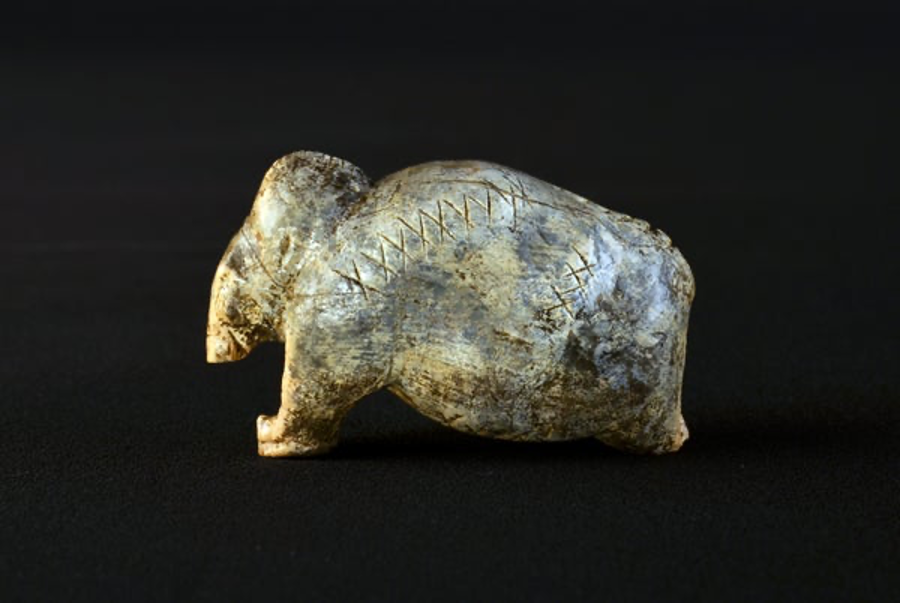
One of the oldest known pieces of art on the planet is a figurine of a mammoth that was carved in ivory by a Stone Age artisan some 40,000 years ago. Found in what is now Germany, it is marked with crosses and dots. The meaning of these markings is a mystery—but a new analysis of the object and hundreds of others found in the same region reveal that the markings may have meant something specific to their ancient creators.
Researchers analyzed more than 3,000 markings on 260 objects, including the mammoth, that were found in caves in Germany. They determined that the markings’ patterns are as statistically complex as protocuneiform, an early form of writing that was found on tablets from ancient Mesopotamia that were dated to around 3,500 B.C.E. The findings, which published Monday in PNAS, could shed light on why ancient humans made art and what purpose it served. [Continue reading]
 Imperial & Global Forum
You must be logged in to post a comment.