
Mitchel Stuffers
Assistant Editor at CIGH Exeter & PhD Candidate in History, University of Exeter
From President Lula da Silva’s call for UN reforms to Germany’s colonial restitution council, here are this week’s top picks in imperial and global history.
The security council has allowed unchecked power and brutality. To protect peace, we must reform the UN
Luiz Inácio Lula da Silva
Guardian
A world without rules is an insecure world. It’s time for multilateralism that truly reflects the global order. Every violation of international law invites the next. From Afghanistan to Iran, and across Iraq, Libya, Syria, Ukraine, Gaza and Venezuela, the line between what is permitted and what is prohibited has been steadily blurred by the complicit inaction of the UN security council. Wielding the veto as both a shield and a weapon, its permanent members too often act without grounding in the UN charter. They play with the fate of millions, leaving a trail of death and destruction.
Until recent years, there was at least an attempt to give interventions a veneer of legitimacy through UN endorsement. Today, the open exercise of power no longer even tries to keep up appearances. The guardrails of multilateral institutions are becoming too narrow to contain hegemonic rivalries. [Continue reading]
How Taiwan came to dominate the global chip industry
Robyn Klingler-Vidra
Conversation
One firm, Taiwan Semiconductor Manufacturing Company (TSMC), produces more than 90% of the world’s most advanced semiconductor chips. These chips are essential for smartphones, artificial intelligence, high-performance computing and cutting-edge military systems.
Taiwan’s dominance of advanced chips acts as a chokepoint for the global economy. Days or weeks without their manufacturing would affect the supply and price of numerous products around the world. This is comparable to how the current disruption to shipping in the Persian Gulf due to the Iran war is affecting oil-dependent markets globally. [Continue reading]
Court Rules Li Rui Collection to Remain at the Hoover Institution, Stanford University
Editorial Team
Hoover Institution – Press
A district court in Oakland, CA, has ruled to uphold the expressed wishes of Li Rui, a former secretary to Mao Zedong, to have his personal archives made publicly available for preservation and study at the Hoover Institution Library & Archives at Stanford University. The Hoover Institution and Stanford University undertook more than five years of legal proceedings and invested significant resources to defend in a U.S. court of law Li’s right to have his collection made available for study by scholars, historians and the public. Witnesses for both sides testified that, if returned to China, the collection and all of its history would at minimum be censored and would most likely be banned.
Director of the Hoover Institution and 66th Secretary of State Condoleezza Rice said, “This decision ensures one of the most valuable firsthand accounts on the history of modern China will be freely available for study.” Li entrusted Hoover’s Library & Archives with his life’s work, which included a vision for a more democratic China. [Continue reading]
German far-right politician calls for removal of US troops
John Vandiver
Stars and Stripes
The co-chair of Germany’s increasingly popular far-right party has called for the removal of all U.S. forces from the country, adding that Berlin should follow Spain’s lead and deny the use of its bases for the Iran war. Tino Chrupalla, who leads the Alternative for Germany party alongside Alice Weidel, used a political gathering in Saxony over the weekend to push for the removal of the roughly 37,000 U.S. troops based in the country
“Let’s start implementing this,” said Chrupalla, as quoted Saturday by Germany’s Bild newspaper. Chrupalla also said Germany should avoid being drawn into international conflicts. He cited Spain, which has come under fire from the Trump administration for refusing access to its bases for the Iran campaign, as an example to follow. The comments carry no practical effect on current German policy, since AfD is not part of Berlin’s coalition government. But AfD over the years has grown from a fringe movement in Germany to a major political force. [Continue reading]
Germany to create council to oversee restitution of colonial-era acquisitions
Catherine Hickley
The Art Newspaper
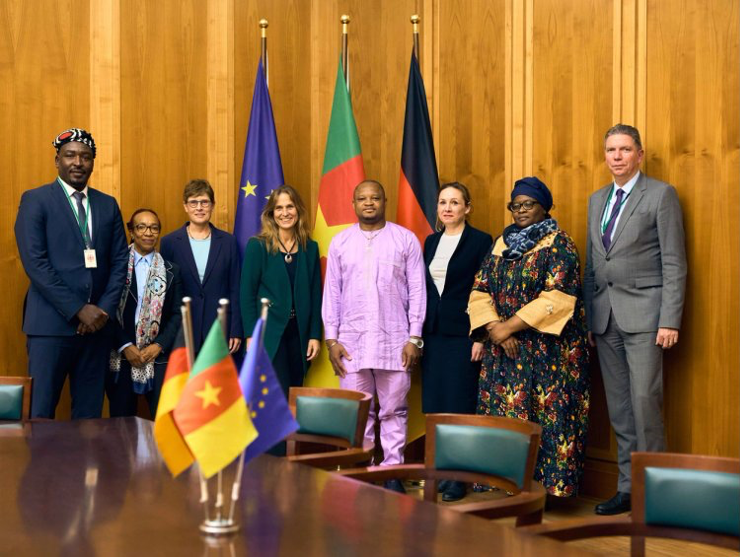
The German government and 16 states have agreed to set up a council to oversee the restitution of cultural property and human remains in public collections that were acquired in a colonial context.
The new panel, known as the Coordination Council for Returns of Cultural Property and Human Remains from Colonial Contexts, will include representatives of the central government, states and municipal authorities, according to a statement. The statement was released by 16 state culture ministers and representatives of Germany’s foreign ministry and culture ministry, following a meeting yesterday (30 March). Germany’s culture minister Wolfram Weimer described the new council as “an important step in responsibly handling cultural property and human remains from colonial contexts” [Continue reading]


You must be logged in to post a comment.