
Shagnick Bhattacharya
University of Exeter
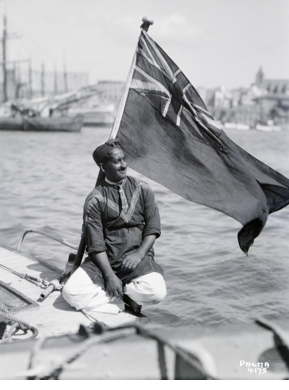
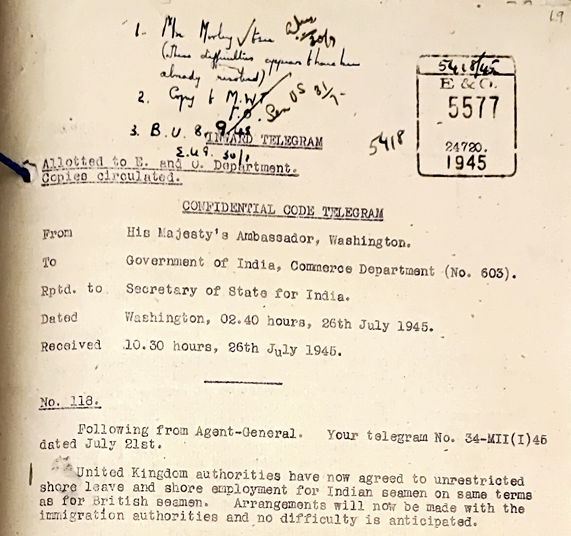
In July 1945, as the Second World War was almost at its end, a British intelligence asset stationed in the United States—codenamed ‘Agent General Washington’[1]—sent a report back home about Indian seafarers in Los Angeles. Among other things, the British Secretary of State for India was informed about how amidst (strikingly like today’s) American immigration department’s raids on local farms searching for illegal immigrants, Paramount Pictures had ‘donated’ US$3,000 to the British Ambassador in Washington in return for using Indian seamen as blacklegs for their upcoming film Calcutta.[2] Indian sailors were essentially being used as strike-breakers against a considerable strike by Hollywood workers, and in this situation had found themselves to have the ‘blessing of American authorities’ in them being unprecedentedly granted unrestricted shore leave in America.[3]
Thus, while the Hollywood Strike Strategy Committee in Los Angeles ‘protested strongly’ against the measure, by the end of that month UK authorities had reached an agreement with their US counterparts regarding indefinite shore leave and employment rights for Indian seamen in America ‘on same terms as for British seamen.’[4] This episode, remarkable as it was, was not an isolated incident of a group of labourers being used as a politically and diplomatically influential bargaining chip by sovereign states, as Natarajan’s latest monograph, Coolie Migrants, Indian Diplomacy, has demonstrated in the case of post-independence Indian diplomacy and indentured labourers in the Caribbean.[5]
These incidents reveal an interesting pattern within the established global socio-legal order of the time. Yet, this incident of the British state using Indian seamen as a foreign policy tool does seriously bring into question the rhetoric of becoming ‘an island of strangers’—making us realise how Britain’s past multicultural entanglements intricately correspond to its current geopolitical strengths. What Sanghera describes as ‘imperial amnesia’ can therefore be a significant hindrance when it comes to making informed policy decisions at both the domestic and diplomatic fronts.[6]
Just before the war broke out in Europe, in February 1939, proposals were being discussed in the US House of Representatives to restrict the employment of Indian seamen on North Atlantic shipping routes going through American ports.[7] In Democratic Congressman William Sirovich’s words when he tabled an investigation in the House into the working conditions of Indian seamen, they were ‘peculiarly liable to become physically unfit’ in colder climatic conditions, having a ‘lack of stamina to withstand disease,’ and were given only seventy-two cubic feet of crew space per person.[8] Oddly, all of these considerations appear to just have vanished into thin air in 1945—and, as established before, not in the least because American authorities had suddenly become immigrant-friendly. Things were, in fact, arguably no different over the several decades prior. One just has to look at, for example, the Komagata Maru incident of 1914, in which almost all the Indian passengers aboard a Japanese steamship were denied entry into Canada—despite being British subjects—to see how typical legalised hypocrisies functioned through enforced social hierarchies in a world where the mobility of colonial subjects was otherwise severely limited by the imperial state.[9]
And yet, the reason all this matters for contemporary policymaking is what such larger anomalies from the past reveal about how structural spaces of exploitation, and/or strategic instrumentalisation, themselves allow effective spaces for subaltern agency to function. Rather than visualising exploitation and subversion from contesting against, and undermining each other, what if we reconceptualised both as mutually coexisting and inhabiting the same structural spaces? This also then raises an important question for scholars of postcolonial theory: have we been listening at the right places to be able to hear the subaltern speak?
Just three years after the Hollywood workers’ strike, for example, British newspapers claimed how Indian seamen were not only ‘experts at smuggling dope,’ but also how most of them now preferred to sell their contraband in American ports ‘where they fetch much higher prices.’[10] According to one contemporary news article, in fact, whereas a pound of opium cost £2 in India and sold for £10-£12 in Britain, it could fetch a price of up to £100 in the USA—signalling an immense shift in global supply chains of illicit drugs moving through British ports which, until that point, were centred around the imperial metropole. Sherlock Holmes’ habits of abusing opium, and his suspicion of the ‘rascally lascar’[11] who ran an opium den in the East End in The Man With The Twisted Lip are unforgettable fictionalised references of the colonial subaltern’s smuggling networks that lived on in British popular culture since the late-nineteenth century. But by 1956, the Daily Mail was talking about official claims of an ‘international gang of dope pedlars’ involving mostly non-European, Chinese, and Indian sailors.[12] What this episode reveals is not simply that exploitation coexisted with agency, but that systems designed to control colonial labour often depended on and/or ended up enabling the very forms of transnational mobility, legal ambiguity (or even outright criminality), and aspirational (re)negotiation they sought to suppress. The British state could mobilise Indian seamen as disciplined labour only because those workers retained a degree of autonomy within the system—autonomy that could be exercised in ways not fully anticipated by policymakers. This tension between control and contingency is not unique to empire; it is a recurring feature of governance itself.
Recent British policy solutions, most particularly those centred around undocumented immigration—from the former Conservative Prime Minister Sunak’s ‘Rwanda Plan’ of offshore processing of asylum seekers to current Labour Prime Minister Starmer’s ‘One In, One Out’ treaty with France, or even promises to ‘smash the gangs’—prioritise control and immediate numbers over long-term behaviour, treating complex issues like migration and crime as taps that can simply be turned off. Such policies often rest on the assumption that mobility and individual motivation(s) can be tightly managed through physical force, strong political rhetoric, procedural deterrence, legal restriction, and other incentives. However, they tend to underestimate the extent to which individuals adapt to and navigate these constraints—a dynamic clearly visible in earlier imperial systems.
In retrospect, though, while historical evidence allows us to observe and appreciate such patterns of subversion from within systems of ostensibly absolute control, it also should not be seen in isolation from the present. Trump and the MAGA socio-political zeitgeist built around his image are no pioneers of public policy (or even of its abuse)—they are representative of a systemic issue with xenophobia in human societies. Thus, the current American administration’s ostensible crackdown on immigration is neither politically unique nor culturally unprecedented.
Almost a century ago too, under the Hoover administration at the peak of the Great Depression, there was a mass deportation drive with a target of having at least 100,000 ‘aliens’ deported in a stated bid to reduce unemployment (among US citizens) and curb cross-border drug smuggling.[13] Almost all aspects of this endeavour would have been recognisable to anyone today: the circulation of a rhetoric of ‘illegal invasion’, federal agents taking positions outside ‘churches and dance halls’ to catch people to deport, Congress spectacularly increasing immigration enforcement budgets by millions of dollars to employ hundreds of more agents on short notice upon unprecedented presidential requests, burden of proof of legal entry being placed on immigrants if detained, and rampant human rights violations, including arrests without warrants and deportations without due process.
And yet did all of these achieve anything for Hoover’s administration, or indeed even for America in the grand scheme of things? Not only were the mass deportation targets never met, including attempts that followed under successive American administrations, but many governments across the world seem to still be unsatisfactorily dealing with positive net migration where relevant.[14] The fundamental flaw of attempting to exert state power over sustained periods of time to curtail the agency of individuals, hence, is that such power is often far more fragile and fleeting than the driving forces, networks, and patterns which dictate human behaviour, specifically—in this case—geographical mobility.
Historically-informed policymaking, thus, should invert that paradigm by focusing on individual agency of persons whose behaviours it tries to influence in a way that could be implemented over a series of quick, small-scale interventions followed by sustaining a new and more desirable status quo. When supposedly rigid systems from 1945 were bent to accommodate commercial interests, it produced price differentials that, over time, pushed contraband towards foreign ports where underground markets were more profitable. By placing (white) British seamen on the same legal footing as (British) Indian seamen following the Hollywood strike, it also diminished the problem of undocumented migration and illegal employment in the area—in one swift policy move which, notably, federal agents consistently rounding up men working illegally in local farms did not accomplish.[15]
The historical point is not that exploitation disappears; it is that agency finds the seams. This has clear implications for contemporary policymaking, as efforts to tightly regulate any kind of human behaviour or labour often assume that compliance can be engineered by placing significant obstacles. Yet, as the historical record suggests, individuals operating within such systems adapt, negotiate, and sometimes subvert them in ways that reshape outcomes. Policies that ignore this dynamic importantly risk being not only ineffective, but essentially counterproductive. Efficient and thoughtful policy interventions, therefore, must stitch those seams into the system instead of treating them as negligible or non-existent.
Modern policymaking must acknowledge the limits of its control at a granular level and shift from attempting to suppress human behaviour towards channelling it more effectively. If irregular crossings across the English Channel are framed not simply as failures of enforcement but as symptoms of misaligned incentives, then expanding legal and regulated pathways for migration could reduce reliance on dangerous and informal routes. In this sense, the challenge is not to eliminate movement, but to reshape the conditions under which it occurs. Perhaps the best way to ‘stop the boats’ is to make sure that those who are the subjects of policy feel more in control over their lives in a way that is stable and secure enough and allows for them to make meaningful contributions (and, in time, integrate better), and that those profiteering from the operation of precarious small boats face relatively lesser economic incentives—in order to allow airports to replace the vast British coastline as the site of policy enforcement?
Shagnick “Nick” Bhattacharya is an independent economic and social historian of empire, labour, migration, and criminality in the modern world. He is a recent graduate of the University of Exeter, where he completed his Master of Research in Economic and Social History with distinction. His ongoing research is supported by the 2026 Joint BME Small Grant, awarded by the Social History Society in partnership with several UK history organisations; as well as the Anderson Fund Grant from the Society for Nautical Research. Besides his independent research work, lately he has been working as a Historical Consultant on an ARTE-commissioned international media project and as a Podcast Producer for the Economic History Society’s The History Ledger initiative.
[1] Which may quite likely have been institutional shorthand for referring to the British embassy in Washington, rather than a person.
[2] Inward Telegrams dated 21 July and 26 July 1945, IOR/L/E/9/974, British Library, London, UK, pp. 19–20.
[3] Ibid, p. 20.
[4] Ibid, p. 19.
[5] Kalathmika Natarajan, Coolie Migrants, Indian Diplomacy: Caste, Class and Indenture Abroad, 1914–67 (Hurst Publishers, 2025).
[6] Sathnam Sanghera, Empireland: How Imperialism Has Shaped Modern Britain (Penguin Books, 2021).
[7] “Proposed USA Investigation into the Conditions of Lascar Seamen,” IOR/L/E/8/1102, British Library, London.
[8] H. J. Res.153, 76th Congress, 1st Session, The US House of Representatives, 6 February 1939.
[9] See Ruth Almy, “‘More Hateful because of its Hypocrisy’: Indians, Britain and Canadian Law in the Komagata Maru Incident of 1914,” The Journal of Imperial and Commonwealth History, Vol. 46, Issue 2 (February 2018): 304–322; Radhika Mongia, Indian Migration and Empire: A Colonial Genealogy of the Modern State (Duke University Press, 2018).
[10] “Girls Learn The Smugglers’ Tricks,” The Evening Telegraph, 29 September 1948, 2.
[11] The archaic term that was used to describe colonial sailors of mostly South Asian origins (but often also from East Africa, Arabia, and Southeast Asia), including Indian seamen.
[12] “Drive Against Drug Smugglers,” The Northern Daily Mail, 20 July 1956, 12.
[13] “Drive Pressed To Oust Aliens,” Los Angeles Times, 16 February 1931, 5; “Undesirable Aliens Face Deportation,” The Hartford Courant, 16 February 1931, 5; “Move Under Way To Drive 100,000 Aliens From U.S.,” The Sun, 11 April 1931, 2; “Aliens’ Rights Are Violated, Report Finds,” The Christian Science Monitor, 15 April 1931, 1; “Expert Declares Deportation of Illegals Is Illegal,” New York Herald Tribune, 17 April 1931, 16.
[14] For example, ‘Operation Wetback’ (1954) under the Eisenhower administration.
[15] Inward Telegram dated 26 July 1945, IOR/L/E/9/974, BL, p. 19.
 Imperial & Global Forum
You must be logged in to post a comment.