
Mitchel Stuffers
Assistant Editor at CIGH Exeter & PhD Candidate in History, University of Exeter
From the saboteur of Apartheid’s nuclear dream to a modern village draped in Marxist relics, here are this week’s top picks in imperial and global history.
The man who blew up a nuclear power station and disappeared
Stephen Robert Mors
Guardian
At 21, Rodney Wilkinson was the best fencer in South Africa: national champion in foil and sabre, second in epee. He had toured Europe and Argentina. He had not stood on the Olympic podium, because South Africa was banned. The apartheid state had taken that from him, along with everything else it took from everyone.
One evening in August 1971, Wilkinson stood in the gym at the University of the Witwatersrand in Johannesburg, foil in hand. He was facing his coach Vincent Bonfil, a 25-year-old Englishman who had represented Britain as a reserve at the 1968 Mexico Olympics, and who was now in Johannesburg finishing a master’s thesis in metallurgy. They were working on a technique in which both fencers lunge simultaneously, and the one who reads the other’s move a split second earlier wins the point. They came at each other. Wilkinson’s foil caught the edge of Bonfil’s sleeve. There was a pop. [Continue reading]
Zimbabwe: Chiwenga breaks ranks in now-or-never fight over Mnangagwa’s 2030 plan
Farai Shawn Matiashe
Africa Report
Vice President Constantino Chiwenga’s public criticism of plans to extend President Emmerson Mnangagwa’s rule to 2030 signals a clear break from quiet internal dissent to overt political confrontation.
With a warning from the pulpit, Zimbabwe’s Vice President Constantino Chiwenga is no longer keeping his objections to extending President Emmerson Mnangagwa’s term behind closed doors. Speaking at a Roman Catholic gathering on 25 April in Murewa, Mashonaland East Province, Chiwenga framed his remarks around ethical governance. Drawing on scripture, he invoked the story of King Hezekiah, a ruler granted an extra 15 years who ultimately saw his kingdom unravel. The parallel, according to analysts, was clear. Though Chiwenga did not name Mnangagwa, the message was widely read as a warning to a president whose allies are pushing to extend his rule to 2030. [Continue reading]
Analysis-While Asia and Europe scramble for natural gas, the US glut has nowhere to go
Scott DiSavino & Curtis Williams
Global Banking and Finance Review
(Reuters) The war with Iran has boosted prices of globally traded natural gas by throttling exports from the Gulf. In West Texas, gas is so abundant that some producers must pay to have it taken away.
The war and Iran’s attacks on Gulf energy producers have halted 20% of global liquefied natural gas (LNG) supply. Qatari LNG facilities have been damaged and tankers have been unable to sail through the Strait of Hormuz waterway at the Gulf’s entry because of Iranian threats to fire on them. The crisis has exposed a major split in the global gas market: Import-dependent countries across Europe and Asia are scrambling for scarce supplies, but the United States – the world’s largest gas producer, consumer and exporter – remains awash in fuel, with prices near 17-month lows. But U.S. pipelines are full and LNG export plants are at capacity, so that cheap U.S. gas cannot reach overseas buyers, creating a bifurcation much more stark than in the oil markets. [Continue reading]
The real lesson of Reform’s war on the history curriculum
Editorial Team
News Symplexia
In order to reverse the rise of “woke history”, pupils in England will, under a Reform government, have to study a radically new curriculum — or rather, a radically old one. Under plans put forward by the party’s education spokesperson, Suella Braverman, pupils would have to cover the signing of the Magna Carta, the Wars of the Roses, the English Civil War, the Glorious Revolution, the Act of Union, the Enlightenment and Victorian Britain in a syllabus which would be at least 60 per cent devoted to “British” history. I take the view that there are no boring bits of history, and therefore no “wrong” answers on the curriculum. But I am baffled as to why only two out of three of England’s civil wars have made the cut, and indeed why it is that learning about them is meant to make you feel more patriotic afterwards. There are passages of history where we come out well, but Charles I’s wars of choice, or the republican experiments that followed him, are not among them.
Reform’s proposed history curriculum raises any number of questions, not least why “winning the second world war” is not higher up the list of worked examples of the UK’s patriotic history. Is it because Reform politicians or those in their orbit often seem to be agnostic about whether that one was an unalloyed good? [Continue reading]
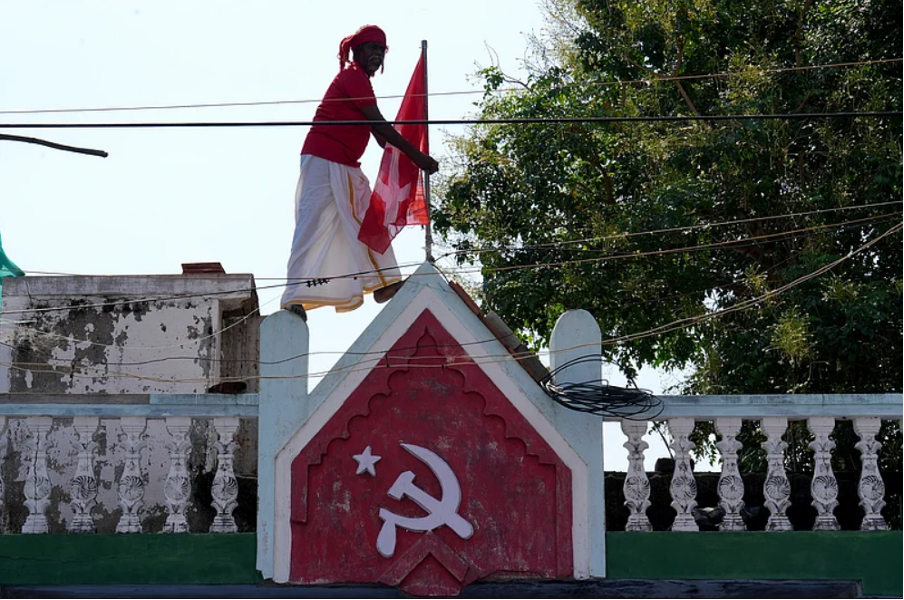
In Dravidian Land, A Village That Refuses To Forget Marx And Communist Icons
N.K. Bhoopesh
Outlook India
We reached Vennivelampatti, a nondescript village about 50 kilometres from Madurai, in search of Karl Marx. But it was no ordinary day in the village. It was festival day. From early morning, villagers gathered at the Vembalayan Murugan temple. After the first pooja, devotees began climbing a nearby hill as part of the annual ritual. Among them was Karl Marx, participating with complete devotion. Fifty-six-year-old Karl Marx is a construction worker who lives with his wife, Umapathy, in a cramped one-bedroom house. The walls of their modest home are lined with photographs — of Hindu gods alongside portraits of Marxist thinkers. “I am a communist, and I’m proud to have this name — Karl Marx. My father was a communist, and he gave me this special name,” he told us, gently wiping the dust off a bust of the original Marx, as he explained how he came to be named after the revolutionary thinker who sought to interpret — and change — the world.
Vennivelampatti may seem unremarkable at first glance — a small, rural settlement with four modest temples within a kilometre. Most residents depend on construction work in nearby towns or on agricultural labour for their livelihood. Yet, the village carries a distinct identity. Amid the larger canvas of Dravidian politics, Vennivelampatti stands out for its enduring communist character. [Continue reading]


You must be logged in to post a comment.