Marc-William Palen
History Department, University of Exeter

Marc-William Palen
History Department, University of Exeter

Marc-William Palen
University of Exeter
Nandini Chatterjee
University of Exeter
Cross-posted from Cast in Stone
I finally found time in January this year 2024 to take myself to Reading, to explore the Tweed archive, the collection of private papers, sketchbooks and artefacts deposited by the daughters of the sculptor John Tweed in Reading Museum in 1968. I received a wonderful welcome from the art curator and her team, as she gave up an entire day in order to accompany me to the museum store and literally walk me through the materials. This of course, is the reality of research in smaller, regional archives and museums, there is rarely dedicated staff available to facilitate research and access depends on the generosity of very busy staff with many other things to do. However, when one does secure the time of such colleagues, the depth of knowledge that they can offer about the area is a resource in its own right.
In our Cast in Stone database, which is actively in development, John Tweed stands out as the most prolific sculptor of colonial statues; within England, he is known to have sculpted twelve prominent statues of individuals who were colonial officials or British statesmen closely concerned with imperial or colonial matters. He may indeed be associated with further statues in Scotland and Wales, but we are not aware of this so far. Indeed, in a splendid thesis turned book, Nicola Capon called him the ’empire sculptor.’
Continue reading “The statuesque, the imperfect female body and fun in the archives”June 24-28, 2024
Call for applications: December 1, 2023 – March 5, 2024 via the VIU website
This course focuses on the growing interdisciplinary field of Linguistic Landscapes (LL), which traditionally analyses “language of public road signs, advertising billboards, street names, place names, commercial shop signs, and public signs on government buildings”, as they usually occur in urban spaces.
More recently, LL research has evolved beyond studying only verbal signs into the realm of semiotics, thus extending the analytical scope into the multimodal domain of images, sounds, drawings, movements, visuals, graffiti, tattoos, colours, smells as well as people.
Students will be informed about multiple aspects of modern LL research including an overview of different types of signs, their formal features as well as their functions.
Continue reading “Linguistic Landscapes: Using Signs and Symbols to Translate Cities”Marc-William Palen
University of Exeter
History & Policy’s Global Economics and History Forum is hosting a timely event in early February. Please be sure to register (link below) if you wish to attend.
When: Tuesday, Feb. 6, 2024, 17:00 pm – 19:30 pm
Where: Room G7, Ground Floor, Senate House, Malet Street, London WC1E 7HU
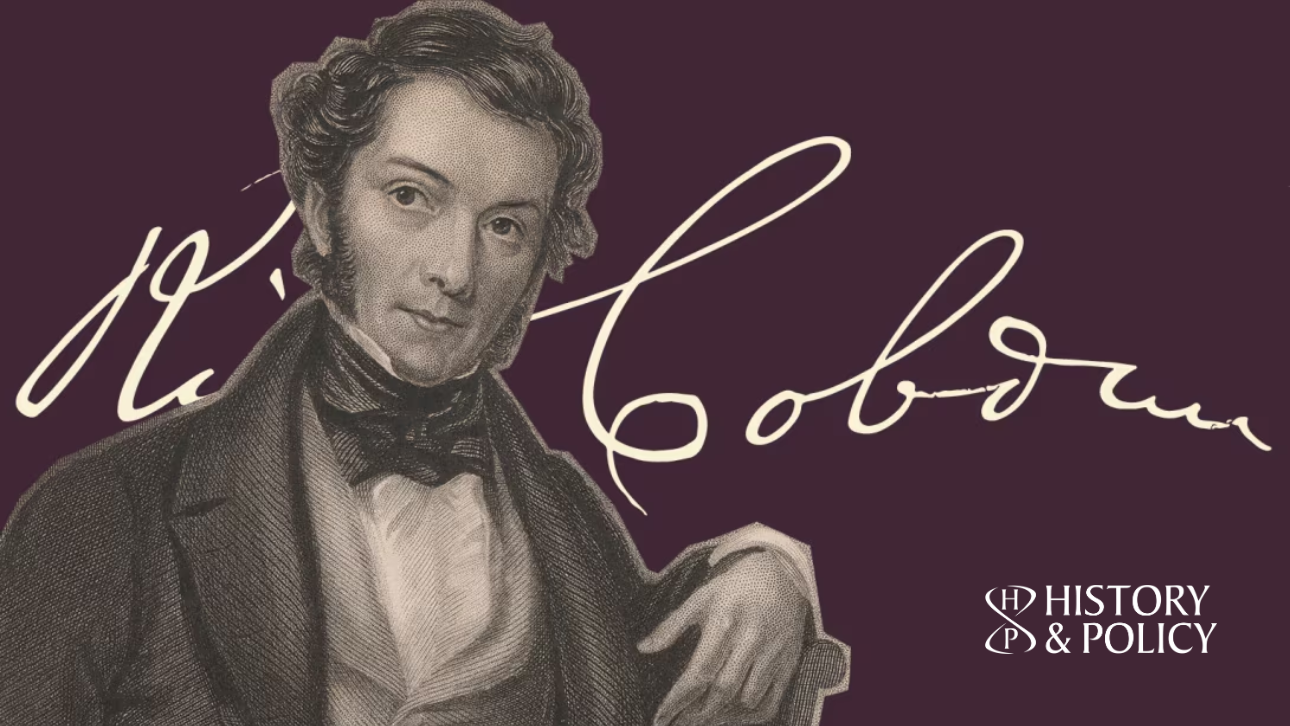
This workshop is designed broadly to come within the ambit of the AHRC-funded Letters of Richard Cobden Online project and will draw from those letters in order to enhance our understanding of British trade policy in its formative period. For not only was Richard Cobden (1804-65) central to establishing unilateral free trade in Britain through the Repeal of the Corn Laws in 1846 but in 1859-60 undertook the laborious negotiation of the first Britain free trade agreement, the Anglo-French commercial treaty of 1860. His letters also deal prominently with the expansion of British trade in India, Japan, and China, while having visited the United States twice, he was also an important contributor to, and commentator on, Anglo-American relations. He was also central to the liberal internationalist tradition linking trade, interdependence, and peace.
British free trade in the mid-nineteenth century remains a benchmark frequently cited in current trade discussions (e.g. Liz Truss, Times Red Box ed. 9 June 2020; Rishi Sunak, 31 Mar. 2023 ‘we are at heart an open and free-trading nation’), and it is to this contemporary discussion that the proposed workshop/ seminar is intended to contribute. The recent Australian Free Agreement was widely hailed as a return to British free trade policy, the such treaty since Britain joined Europe in 1973, and hence ‘the first trade deal to be signed by the UK as an independent free-trading nation in nearly half a century’ (Lord Younger, HL 11 July 2022). However, latest debate on the subsequent Comprehensive and Progressive Agreement for a Trans-Pacific Trade Partnership (House of Lords 21 Nov. 2023) has also focused on the lack of a published government trade strategy. The potential Labour approach to trade policy also remains to be defined. This workshop/seminar is therefore designed to provide a concrete analysis of British commercial policy between the repeal of the Corn Laws in 1846 (also referred to in the July 2022 debate) and joining Europe in 1973 with a view to informing current thinking on trade policy and the tradition to which, after an ‘European interlude’, it is the successor. To this end, the ‘British ‘way’ in trade policy will be contrasted with American, Chinese, and European ways in trade policy. This seminar is designed to bring together historians, policymakers, politicians, and members of think-tanks and interested academics and members of the public.
Confirmed speakers include:

Marc-William Palen
History Department, University of Exeter
Follow on Twitter @MWPalen or Bluesky @mwpalen.bsky.social
Professor Nandini Chatterjee (University of Exeter) works on law and cultural exchanges in the British and Mughal empires – with particular attention to religion and family. Her first book was on the shaping on the minority religious community of Indian Christians, through legal, political, racial and theological contests over the nineteenth and twentieth centuries. Her second book is a rare micro-history of a family of zamindars (landlords) and their negotiation of the laws of the Mughal empire.
Marc-William Palen
History Department, University of Exeter
Follow on Twitter @MWPalen

Marc-William Palen
History Department, University of Exeter
Follow on Twitter @MWPalen
Marc-William Palen
History Department, University of Exeter
Follow on Twitter @MWPalen

Marc-William Palen
History Department, University of Exeter
Follow on Twitter @MWPalen
The Centre for Imperial and Global History is delighted to report that Dr Ryan Hanley has been awarded a prestigious Philip Leverhulme Prize. Here’s what he will be working on:
The Philip Leverhulme Prize will enable me to lay the foundations for a new global history of British antislavery since the late eighteenth century. This long-term project will explore how Britain’s antislavery interventions around the world and throughout modern history resulted in partial victories, unexpected consequences and sometime perverse compromises. It promises to contribute to how we understand metropolitan activism, humanitarian imperialism, the history of international relations, and contemporary anti-trafficking politics, across a very long timeline. This project will result in a major new monograph, Unfinished Business: An Incomplete History of British Antislavery, under contract with Oxford University Press and slated for publication in 2032, in time for the bicentenary of passing of the Abolition of Slavery Act in 1833.
You can read more about the scheme and other winners here.

Marc-William Palen and Richard Toye
University of Exeter
Richard Toye, Professor of Modern History at the University of Exeter, needs little introduction to readers of the Imperial & Global Forum. Toye is a leading historian of modern British politics, the British Empire, and postwar internationalism. Among his previous publications are The Labour Party and the Planned Economy, 1931-1951 (2003), Churchill’s Empire (2010), Arguing about Empire: Imperial Rhetoric in Britain and France, 1882-1956 (with Martin Thomas, 2017), Winston Churchill: A Life in the News (2020), and, with David Thackeray, Age of Promises: Electoral Pledges in Twentieth Century Britain (2021). Toye is also former director of the Centre for Imperial and Global History and the host of the Imperial & Global Forum’s ‘Talking Empire’ podcast series. You can follow him on Twitter/X @RichardToye and on Threads @Richard_John_Toye. His newest publication, Age of Hope: Labour, 1945, and the Birth of Modern Britain, will be published with Bloomsbury on 12 October 2023, in advance of the 100th anniversary of the first Labour government in 2024. Age of Hope is the subject of our interview today.
MP: Briefly, how would you summarize Age of Hope?
RT: It is an attempt to put the Labour government of 1945 into long-term perspective. This involves both going back to the 1880s, when many of its leading figures were born, and forward to the present day, when its legacy continues to be felt. Although I hope that readers of all political persuasions can profit from it, I don’t attempt to be absolutely politically neutral. Especially in the conclusion I make some suggestions about how the Labour Party might learns some of the lessons of the Attlee era as it stands (probably) on the edge of power.
Continue reading “Age of Hope: A CIGH Interview with Richard Toye”| Location: | Exeter |
|---|---|
| Salary: | From £41,732 on Grade (F), depending on qualifications and experience. |
| Hours: | Full Time |
| Contract Type: | Fixed-Term/Contract |
| Placed On: | 4th October 2023 |
|---|---|
| Closes: | 24th October 2023 |
| Job Ref: | R64106 |
This full-time post is available from 01/01/2024 – 31/12/2024 on a fixed-term contract (maternity cover) in the Faculty of Humanities, Arts and Social Sciences (HASS). This role offers the opportunity for hybrid working – some time on campus and some from home.
The role
You will have responsibility for the design, development and production of teaching and learning material and deliver either across a range of modules within the field of Modern History. The ability to teach on the history of internationalism and modern eastern Europe will be necessary.
You will work with the Director of Education and Student Experience to ensure the efficient and effective delivery of teaching programmes in accord with the Faculty’s education strategy and implementing the External Affairs strategy. You will also contribute directly to foundation teaching in one or more of the discipline areas in the Faculty and to the development and implementation of innovative teaching practices across the Faculty.
Continue reading “Job Klaxon: Lecturer in Modern History (E&S)”
Marc-William Palen
History Department, University of Exeter
You must be logged in to post a comment.