Marc-William Palen
History Department, University of Exeter
Follow on Twitter @MWPalen
Cross-posted from History Today Magazine
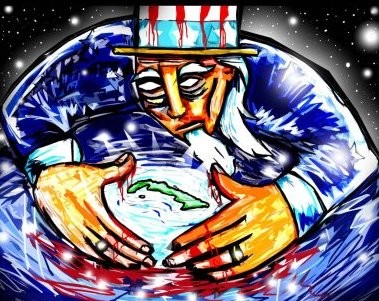
President Obama’s decision to reopen the US embassy in Havana and to begin easing commercial and travel restrictions continues to be regarded by supporters as the highpoint of Obama’s foreign policy agenda to date. But the move has its fair share of detractors, too. To understand the predominantly Republican opposition to trade liberalization with Cuba, we must look beyond the Cold War. We must look further back into America’s imperial past.
More Than a Cold War Hangover
The Democratic leadership has explained Obama’s sizeable shift in US policy toward Cuba. ‘We will end an outdated approach that for decades has failed to advance our interests’, Obama stated. ‘Neither the American nor the Cuban people are well-served by a rigid policy that is rooted in events that took place before most of us were born.’ Nancy Pelosi similarly noted that ‘we must acknowledge our policy towards Cuba is a relic of a bygone era that weakens our leadership in the Americas and has not advanced freedom and prosperity in Cuba.’
Obama and Pelosi should look much farther back than the 1961 Cuban Embargo. The unequal US-Cuban power relationship stretches back to the turn of the 20th century.
Americans may have largely forgotten the first 60 years of US interventions in Cuban affairs – from the late 19th century to the mid-20th – but Cuban memories are longer. When Fidel Castro took power in 1959, his justification for doing so was not in stark cold-war anti-capitalistic terms. Rather, he harkened back to an earlier era of US-Cuban relations and to Cuba’s right to international freedom of trade. In a January 1959 speech, he warned that American diminution of Cuban sovereignty, stretching back to the late 19th century, would no longer be tolerated, and in front of the United Nations in 1960, Castro denounced American economic nationalist policies toward Cuba, declaring that it was an inalienable right that Cuba be allowed to freely ‘sell what it produces’ and to see its exports increase: ‘Only egotistical interests can oppose the universal interest in trade and commercial exchange.’ So when the Eisenhower administration showed itself indisposed toward normalizing US-Cuban relations, Castro turned instead to the other major geopolitical player, the Soviet Union, ‘to sell our products’.
In January 1961, stemming in part from the Cuban-Soviet trade agreement, the United States put in place the now infamous trade embargo against Cuba and severed diplomatic relations. The embargo has since stunted Cuban political and economic growth, and has accordingly served as an easy scapegoat for Fidel and his brother Raúl by allowing them to blame the United States for any and all economic woes befalling Cuba.
Even a cursory look at US trade policies toward other communist states shows how the US embargo against Cuba was – and remains – far more than a Cold War hangover. Continue reading “US-Cuba Embargo Goes Beyond the Cold War” →

 Imperial & Global Forum
You must be logged in to post a comment.