
Shagnick Bhattacharya
University of Exeter
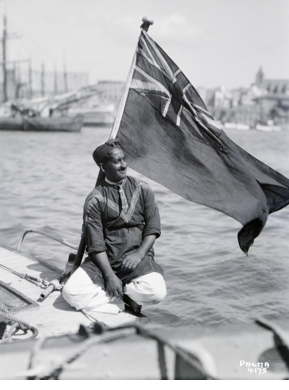
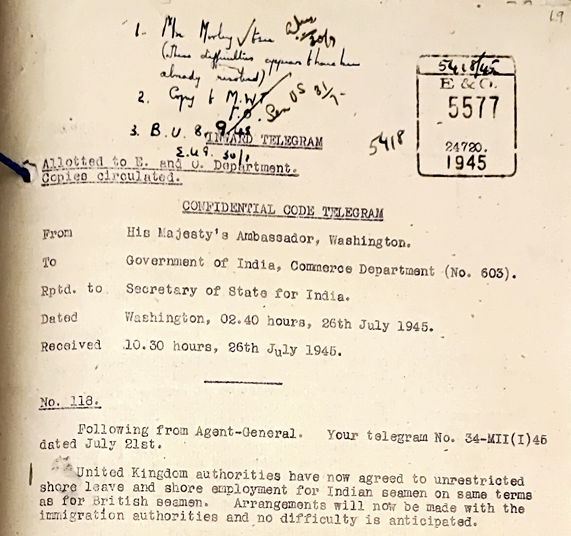
In July 1945, as the Second World War was almost at its end, a British intelligence asset stationed in the United States—codenamed ‘Agent General Washington’[1]—sent a report back home about Indian seafarers in Los Angeles. Among other things, the British Secretary of State for India was informed about how amidst (strikingly like today’s) American immigration department’s raids on local farms searching for illegal immigrants, Paramount Pictures had ‘donated’ US$3,000 to the British Ambassador in Washington in return for using Indian seamen as blacklegs for their upcoming film Calcutta.[2] Indian sailors were essentially being used as strike-breakers against a considerable strike by Hollywood workers, and in this situation had found themselves to have the ‘blessing of American authorities’ in them being unprecedentedly granted unrestricted shore leave in America.[3]
Thus, while the Hollywood Strike Strategy Committee in Los Angeles ‘protested strongly’ against the measure, by the end of that month UK authorities had reached an agreement with their US counterparts regarding indefinite shore leave and employment rights for Indian seamen in America ‘on same terms as for British seamen.’[4] This episode, remarkable as it was, was not an isolated incident of a group of labourers being used as a politically and diplomatically influential bargaining chip by sovereign states, as Natarajan’s latest monograph, Coolie Migrants, Indian Diplomacy, has demonstrated in the case of post-independence Indian diplomacy and indentured labourers in the Caribbean.[5]
These incidents reveal an interesting pattern within the established global socio-legal order of the time. Yet, this incident of the British state using Indian seamen as a foreign policy tool does seriously bring into question the rhetoric of becoming ‘an island of strangers’—making us realise how Britain’s past multicultural entanglements intricately correspond to its current geopolitical strengths. What Sanghera describes as ‘imperial amnesia’ can therefore be a significant hindrance when it comes to making informed policy decisions at both the domestic and diplomatic fronts.[6]
Just before the war broke out in Europe, in February 1939, proposals were being discussed in the US House of Representatives to restrict the employment of Indian seamen on North Atlantic shipping routes going through American ports.[7] In Democratic Congressman William Sirovich’s words when he tabled an investigation in the House into the working conditions of Indian seamen, they were ‘peculiarly liable to become physically unfit’ in colder climatic conditions, having a ‘lack of stamina to withstand disease,’ and were given only seventy-two cubic feet of crew space per person.[8] Oddly, all of these considerations appear to just have vanished into thin air in 1945—and, as established before, not in the least because American authorities had suddenly become immigrant-friendly. Things were, in fact, arguably no different over the several decades prior. One just has to look at, for example, the Komagata Maru incident of 1914, in which almost all the Indian passengers aboard a Japanese steamship were denied entry into Canada—despite being British subjects—to see how typical legalised hypocrisies functioned through enforced social hierarchies in a world where the mobility of colonial subjects was otherwise severely limited by the imperial state.[9]
And yet, the reason all this matters for contemporary policymaking is what such larger anomalies from the past reveal about how structural spaces of exploitation, and/or strategic instrumentalisation, themselves allow effective spaces for subaltern agency to function. Rather than visualising exploitation and subversion from contesting against, and undermining each other, what if we reconceptualised both as mutually coexisting and inhabiting the same structural spaces? This also then raises an important question for scholars of postcolonial theory: have we been listening at the right places to be able to hear the subaltern speak?
Continue reading “Agency Within Exploitative Systems: Historical Insights Into Power and Policymaking” Imperial & Global Forum
You must be logged in to post a comment.