Signs of Resistance: Linguistic Landscapes and Urban Tensions in Santa Marta, Venice

Berizzi Mariachiara[1], Boam Olivia[2], Fourie Nicholas Charles[3], Pizarro Jacinto Laura[4], Yücel Dinç Fatma[5]

 Linguistic Landscapes‘, Venice International University Summer School 2025

Faculty: Kurt Feyaerts, KU Leuven (Coordinator); Richard Toye, University of Exeter (Coordinator); Matteo Basso, Iuav University of Venice; Geert Brône, KU Leuven; Claire Holleran, University of Exeter; Eliana Maestri, University of Exeter; Michela Maguolo, Iuav, University of Venice; Paul Sambre, KU Leuven

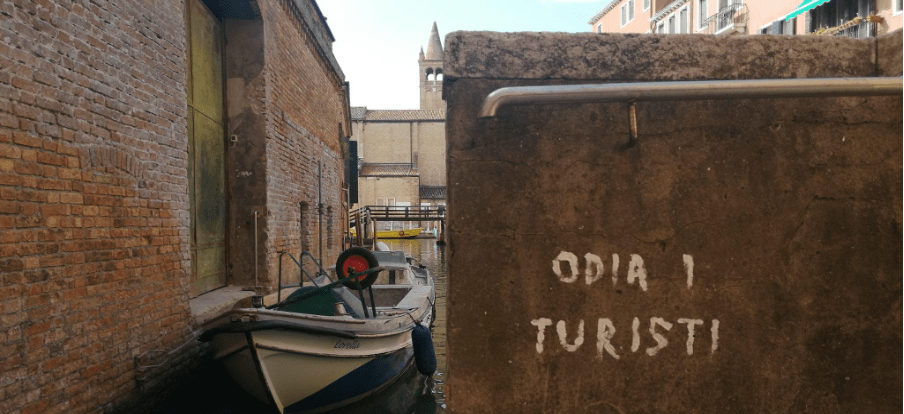
In Santa Marta, a quiet Venetian district, the city itself becomes a text: walls, streets, and public spaces speak through signs, graffiti, and infrastructures that reveal five interwoven themes: Anti-tourism, Transport & Mobility, Multilingualism & Symbolic Resistance, Government & Authority, and Prison as an Edge. From anti-tourism sentiments to the symbolic tensions of incarceration, our investigation examines how language, infrastructure, and public space interact to shape meaning and mobility. As shown in Figure 1, which provides a satellite view of Venice highlighting key landmarks and mobility nodes, our study is grounded in the spatial reality of the city. We begin by analysing local resistance to mass tourism, then move through the spatial logic of transport hubs like Piazzale Roma. We further consider multilingualism and graffiti as forms of symbolic resistance, explore the role of governance in shaping visibility and authority, and finally, interpret the Santa Maria Maggiore prison as both a physical and discursive edge.
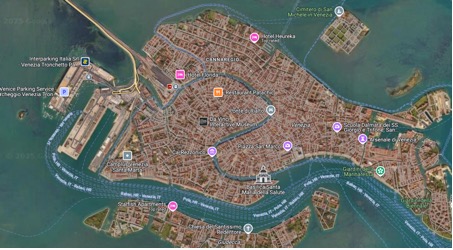
Satellite view of Venice highlighting key landmarks and mobility nodes, including Santa Marta and Piazzale Roma. (Snapshot by Boam Olivia Boam, 3 July 2025)
Continue reading “Signs of Resistance: Linguistic Landscapes and Urban Tensions in Santa Marta, Venice”

The Victorian Origins of Will and Kate’s Visit to India

The Duke and Duchess of Cambridge at India Gate, a memorial to Indian service in the First World War, its foundation stone laid by the Duke of Connaught in 1921 Credit: @PARoyal
The Duke and Duchess of Cambridge at India Gate, a memorial to Indian service in the First World War, its foundation stone laid by the Duke of Connaught in 1921. Credit: @PARoyal

Charles V. Reed
Elizabeth City State University
Editor, H-Empire

As the Duke and Duchess of Cambridge visit south Asia this week, doing the sorts of things that royals are expected to do whilst abroad in the former empire – attend fancy social events, commemorate, inaugurate, and patronize, play cricket, and so on – the celebrity-obsessed global media has enthusiastically followed their every move. An even cursory glance at the tweets tagged #RoyalVisitIndia reveals the performative and visual character of the royal tour – so essential to its purpose since the first visits of the nineteenth century. William and Kate’s touring ancestors would find much familiar in their itineraries, the ceremony, the responses. It’s a quite odd thing, when we think about it, considering nearly seventy years of Indian independence from British rule. Of course, the present Queen’s dedication to the Commonwealth and maintaining the monarchy’s role in the former empire — as chronicled in Philip Murphy’s Monarchy and the End of Empire — explains much of it. But the Victorian history of the royal tour is of equal significance. Continue reading “The Victorian Origins of Will and Kate’s Visit to India”