
Beatrice Gervasi, Katarzyna Jonkisz, Meng Hao, Sabeth Malfliet, and George Ellis
Students of ‘Linguistic Landscapes‘, Venice International University Summer School 2025
Faculty: Kurt Feyaerts, KU Leuven (Coordinator); Richard Toye, University of Exeter (Coordinator); Matteo Basso, Iuav University of Venice; Geert Brône, KU Leuven; Claire Holleran, University of Exeter; Eliana Maestri, University of Exeter; Michela Maguolo, Iuav, University of Venice; Paul Sambre, KU Leuven
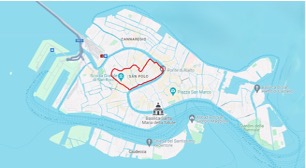
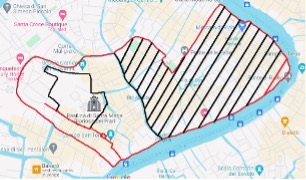
Our case study of Venice for the ‘Linguistic landscapes: signs and symbols’ summer school was centred around the storied neighbourhood of Santa Maria Formosa. This area boasts a historic Basilica, the Fondazione Querini Stampalia library and a new art installation of 2 lions and 2 lionesses which is intended to promote public interaction with art and celebrate Venetian pride. In short, this area offers a lot culturally and historically. This is strongly evident when walking down the side streets. During our first excursion, our group got the immediate sense that this was a residential area that had developed a strong tourist population due to its historical significance and geographic location (en route to the Rialta bridge).
We were fortunate in the sense that this region of Venice was not a particularly large one, being measured at 0.0072km^2. However, this did not mean that our investigations were without challenge. The geography of this area (a seeming thoroughfare for tourist populations) led to difficulties in photo collation. This combined with the high-content-per-area (a total of 73 relevant primary photos) and the labyrinthine streets led to our group having an abundance of data and difficulties delimiting our data set and research question. To overcome this, we adopted a thematic approach which split our data set into three relevant points for discussion: action flows, multilingualism and polyfunctionality. We then used relevant semiotic and anthropological studies (for example Landry and Bourhis 1997, Scollon and Scollon, 2003) to dissect the data set and apply a linguistic landscapes lens with the end goal of finding out whether Santa Maria Formosa is a healthily functioning neighbourhood or another victim of the increasing globalization faced all over the western world.
Continue reading “Striking a balance between residents and tourists? The Linguistic Landscape of Santa Maria Formos”
 Imperial & Global Forum
You must be logged in to post a comment.