
Marc-William Palen
History Department, University of Exeter
Cross-posted from History Matters
A fragmenting world of trade wars. Food insecurity despite an abundance of food. European food wars. A broken Brexit Britain undermining European unity. The resurgence of right-wing nationalism. Human rights under attack. Children starving from wartime blockades.
The world disorder of 2024 would have looked all too familiar to the international women’s peace movement of a century ago.
Feminists back then tended to see themselves as the mothers of the world, believing that women’s active participation in politics would curb or counter men’s militant predilection for nationalism and war. ‘First wave’ feminist internationalists numbered among the leaders of the early-20th-century fight for world peace, what Harriet Alonso has described as “the suffragist wing” of the international peace movement from the First World War onwards.
Free trade was a key – but oft-overlooked – ingredient to their feminist vision for a peaceful world. Chicago social reformer Jane Addams, the figurehead of the international women’s peace movement, emphasized this free-trade dimension throughout the 1920s and 1930s.
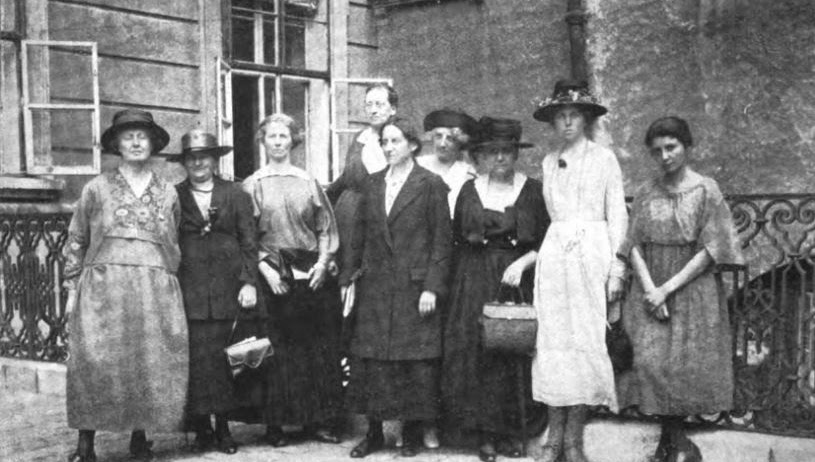
Jane Addams made landfall in Europe in early July 1919 to bear witness to the destructive aftermath of the First World War. Addams’s main concern was the famine afflicting millions of Europe’s children.
Addams’s 1919 trek marked the beginning of what would become a multi-year European humanitarian mission of a new left-leaning feminist organization: the Women’s International League for Peace and Freedom (WILPF), which remains active today. Addams was WILPF’s inaugural president.
Addams had her first of many encounters with Europe’s malnourished children during a stopover in Lille in northern France. There, inside a schoolhouse, Addams looked on as a physician examined them by the hundreds. ‘Stripped to the waist’, the children looked more like ‘a line of moving skeletons; their little shoulder blades stuck straight out, the vertebrae were all perfectly distinct as were their ribs, and their bony arms hung limply at their sides.’
Adding to the macabre scene, an eerie quiet hung over the improvised emergency room. You see, the French physician on duty had lost his voice, a side effect of wartime shellshock. He therefore ‘whispered his instructions to the children as he applied his stethoscope and the children, thinking it was some sort of game, all whispered back to him.
Addams encountered similarly graphic scenes in Switzerland and throughout Germany. The 1919 WILPF mission’s findings reinforced her belief that, while the war may have ended, securing the peace had just begun.
Addams therefore headed a follow-up WILPF humanitarian mission amid the hot summer of 1921, this time to southeastern Europe, where she once again encountered mass hunger. ‘Food resources which were produced in Europe itself and should have been available for instant use,’ Addams wrote, ‘were prevented from satisfying the desperate human needs. Why? Because ‘a covert war was being carried on by the use of import duties and protective tariffs’, which the war’s food blockades had legitimized.
These small starving European states, seeking self-preservation, mistakenly ‘imitated the great Allies with their protectionist policies, with their colonial monopolies and preferences.’ To Addams, such suffering in the name of ‘hypernationalism’ only amplified the need for a new international system of ‘free labor and exchange’ The world faced a clear choice: either ‘freedom of international commerce or international conflict of increasing severity.’
To meet world food demands, her envisaged free-trade order would also require supranational regulation of global transportation lines to counter ‘the ambition of rival nations.’
She called her cosmopolitan vision ‘Pax Economica’.
Continue reading “Feminism’s Forgotten Free-Trade Past”
 Imperial & Global Forum
You must be logged in to post a comment.