
Dr Lori Lee Oates
Memorial University
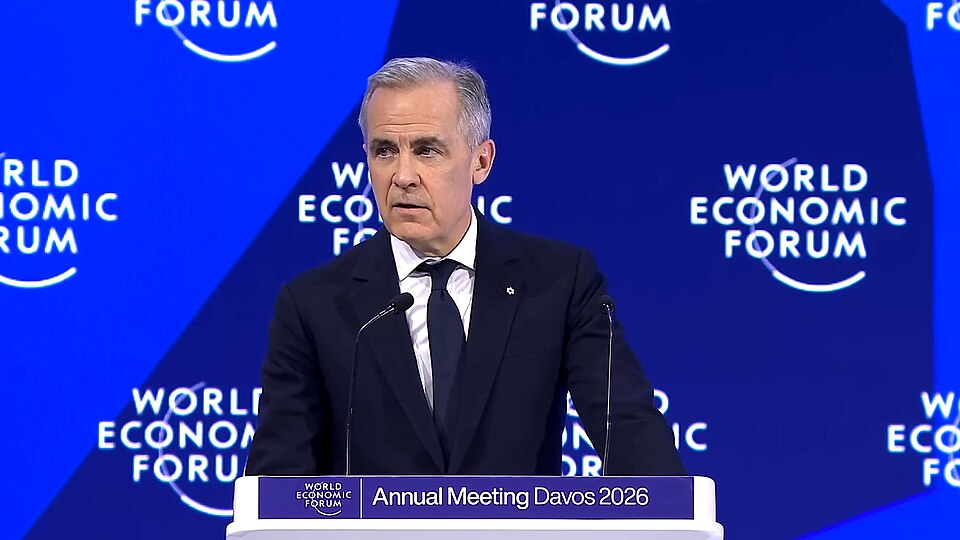
On January 20 of this year, Canadian Prime Minister Mark Carney gave a speech at the World Economic Forum in Davos, in which he claimed that, “we are in the midst of a rupture. Not a transition.” This speech is said to have “sent shockwaves through the international community” by New York Times journalist and podcaster Ezra Klein. Carney was arguably the first member of the western alliance to seriously acknowledge the current problems with the hegemony of the United States in present day geopolitics. However, what Carney calls a rupture is arguably just the latest stage in a larger transition that scholars have been warning about for at least the last decade.[1]
This transition, scholars would argue, is rooted in weaknesses that have long existed in the geopolitical order. Some of these problems were embedded in the systems that emerged at the end of the Second World War, and some are part of the colonial systems that built the modern world. For example, historian Jamie Martin has effectively argued in The Meddlers (2022) that the international financial systems such as the World Bank and International Monetary Fund have infringed on the sovereignty of many states that have required their services, and that this is rooted in approaches that were developed in the early twentieth century. The problems with these systems have become more obvious and exacerbated in recent decades. Furthermore, this geopolitical order has become ever more dysfunctional, and the problems are far broader than the increasingly dangerous U.S. hegemony that Carney described in Davos.
In the now-famous speech Carney argued that “we knew that the story of the rules-based international order was partially false. That the strongest would exempt themselves when convenient.” He maintained that states have been going along to ensure their safety, as integration becomes an increasing threat in the contemporary period. He called on middle powers to act in concert so that together we can build an order that is once again based on values, rather than bowing to U.S. hegemony. Certainly, Carney has pursued new transnational relationships since the Davos speech with European powers, China, and now India. However, his short time as Canadian Prime Minister has also been marked by ignoring breaks with international law on the part of the U.S. He has even actively supported them at times.
Since coming to office on March 14, 2025, Carney’s foreign policy seems quite at odds with the values-based order of middle powers he proposed. He has notably been silent about, and even at times supported, U.S. imperial actions. His government said nothing as the U.S. bombed speed boats in international waters. When the U.S. kidnapped the president of Venezuela, Carney called this “welcome news” on January 6, 2026, at a media availability in Paris. Carney was again silent as the United States sanctioned a Canadian judge of the International Criminal Court over an investigation into Israel’s war against Gaza. Most recently, he offered Canadian support for the U.S. attack on Iran. However, his Foreign Affairs Minister Anita Anaud has since said that Canada “will not be participating in the war.”
Commentators, including some scholars, often make the mistake of focusing on Donald Trump and Carney, as the powerful national leaders who are driving geopolitics. However, as global and imperial historians we should be aware that the forces of geopolitics do not change direction overnight and events that seem like ruptures are often decades in the making. Such occurrences are moved forward by the ever-changing structures of globalization and the shifts in both local and global relationships that are often driven by technological change. There are many smaller transitions that lead up a truly global shift.
Continue reading “Mark Carney’s “rupture” of the international order is actually a transition – but to what?”
 Imperial & Global Forum
You must be logged in to post a comment.