Marc-William Palen
History Department, University of Exeter
Follow on Twitter @MWPalen

Marc-William Palen
History Department, University of Exeter
Follow on Twitter @MWPalen

Sadiah Boonstra and Caroline Drieënhuizen
Before the holidays we read Paul Doolan’s response to our post with great interest. We appreciate the time and effort Mr Doolan took to reply to our post as we think a fruitful debate will progress knowledge. With this writing we give a final reaction to Mr Doolan and if it is not for knowledge progression, it will at least get Dr Sadiah Boonstra’s name spelled correctly.
In his response Doolan claims that our critique was based on a misreading and that he was referring to a specific period of time, namely 1945-1949, but that we “prefer to talk about something else”. However, in our view this period cannot be separated from the larger framework of colonialism as political, social, cultural and economic structures of domination. And this is exactly what Dutch historians and others have been trying to deconstruct over the past decades as set out in our previous response. We therefore uphold our argument against Doolan’s representation of a Dutch historical “guild” based in Leiden. Instead of calling on “outsiders”, as Doolan suggests, we favor collaborative methods to uncover the depth, multilayeredness and reach of colonialism. Continue reading “Rewriting Dutch colonial histories – Final response”

Marc-William Palen
History Department, University of Exeter
Follow on Twitter @MWPalen
Marc-William Palen
History Department, University of Exeter
Follow on Twitter @MWPalen
I’ve just arrived in warm, sunny Denver for the 2017 American Historical Association Meeting, and now face the difficult decision concerning which sessions to attend. So I thought it might it might be helpful to compile the sessions relating to imperial and global history, to make my decision (and possibly yours) a bit easier. The list is based on titles only, so please feel free to include in the comments section any pertinent sessions that I may have missed. Continue reading “Imperial & Global History Sessions at #AHA17”
a
a
a
a
a
Attendance to both events is free but booking your place is recommended (see below). Continue reading “The End of Empire”
Editor’s Note: In the weeks leading up to the new year, please help us celebrate 2016 at the Imperial & Global Forum by checking out the past year’s 10 most popular posts.

Gil Shohat
Humboldt University Berlin
In today’s history cosmos, terms such as ‘History from Below’, ‘People’s History’ and ‘Social History’ belong to the essential canon of most academics and students. Thus, it is important to remember how these terms found their way into historiography before they were considered legitimate. Members of the Communist Party Historians’ Group in the UK laid the cornerstone for a new paradigm in historiography, today largely referred to as Social History, in the late 1940s and early 1950s. But exactly how did these historians perceive their own role as academic insurgents in the heart of ‘Whig history’ and what were the problems facing them as historians and members of the Communist Party of Great Britain (CPGB)?
In late 1946 a group of historians, friends, and members of the Communist Party started regularly meeting in Marx’s House in London. By means of discussion papers, presentations, and conferences it was sought to alter the way the British people perceived their own history. Eventually, so was the audacious hope, a ‘history from below’ would empower the common people to emancipate themselves from the confining and patronising ‘high history’ of British monarchs, prime ministers and great thinkers, yielding the deeply entrenched notion of Britain as a nation of constant evolution, not revolution. [continue reading]
Editor’s Note: In the weeks leading up to the new year, please help us celebrate 2016 at the Imperial & Global Forum by checking out the past year’s 10 most popular posts.
Rachel Herrmann
University of Southampton
Follow on Twitter at @Raherrmann
On any given weekend, you might find yourself on a train platform, surrounded by sports fans wearing “Native American” headdresses and “war paint,” and wavinginflatable tomahawks. They’ll be wearing apparel purchased from the team’s online store (the “Trading Post”), where you can also buy a “Little Big Chief” mascot. During the event, supporters will chant the Tomahawk Chop to get into the spirit of things, and afterward, perhaps they’ll rehash the game on the team’s message boards (“The Tribe”).
No, this isn’t the Atlanta Braves. It’s not the Washington Redskins. This is a rugby match for the Exeter Chiefs. And it evokes Britain’s forgotten imperial American past.
The Exeter Chiefs were called the Exeter Rugby Club until 1999, when they rebranded themselves. They also have an A-League team that (you might have guessed) is named the Braves. The Chiefs’ name and their apparel are problems because they reference the practice of scalping, they erase Native Americans today, and they evoke a history of violent settler colonialism.[1] And it’s an imperial history that belongs to Great Britain as much as the United States. [continue reading]
Editor’s Note: In the weeks leading up to the new year, please help us celebrate 2016 at the Imperial & Global Forum by checking out the past year’s 10 most popular posts.

Rachel Chin
University of Exeter
Follow on Twitter @chinra4
Billionaire stockbroker Peter Hargreaves recently claimed that leaving the EU could be likened to the British evacuation from Dunkirk in late May 1940. This withdrawal signalled the British retreat from the continent and immediately preceded the French capitulation to German forces two weeks later. Hargreaves declared, “We will get out there and we will become incredibly successful because we will be insecure again.”[1]
As a scholar of rhetoric and the Second World War, I have become particularly attuned to how conflict is used and abused by politicians as a means to convince the British public of the value of a particular issue. Most recently, Tory politicians and campaigners like Hargreaves have mobilised Britain’s role in the Second World War as a justification to vote either for or against staying in the European Union (EU). This type of rhetoric is, at its core, emotive and nostalgic. It’s also deeply troubling because such oversimplified ideas of national identity and wartime patriotism are circumventing any chance of having a meaningful discussion about how Brexit would or would not change life on this island nation. It also ignores the fact that the Second World War was a global conflict, however much that might challenge ingrained nationalistic nostalgia. [continue reading]
Editor’s Note: In the weeks leading up to the new year, please help us celebrate 2016 at the Imperial & Global Forum by checking out the past year’s 10 most popular posts.

Paul Doolan
Zurich International School and the University of Konstanz
Last month the academic year commenced at the University of Amsterdam (UvA) with speakers celebrating diversity and internationalism. Ironically, the audience in the auditorium was almost entirely white. In Amsterdam the majority of school age children come from migrant backgrounds, yet the university has an overwhelmingly white faculty that lectures to an overwhelmingly white student body. Most remarkable is the widely held attitude that this is not a problem.
As a historian interested in the roots of Eurocentrism and the legacies of imperialism, I would suggest that such an attitude is linked to the failure in teaching imperial history in the Netherlands. Through eight decades since the eviction of the Dutch from Indonesia, Dutch historians have consistently abdicated their responsibility by refusing to properly teach the public about the nature of Dutch rule in the former Dutch East Indies and, in particular, the nature of Dutch warmaking during the final years of the Asian colony, 1945-1949. [continue reading]
Editor’s Note: In the weeks leading up to the new year, please help us celebrate 2016 at the Imperial & Global Forum by checking out the past year’s 10 most popular posts.
Keisha N. Blain*
University of Iowa
Historically, black men and women in the United States frequently linked national and geopolitical concerns. Recognizing that the condition of black people in the United States was “but a local phase of a world problem,” black activists articulated global visions of freedom and employed a range of strategies intent on shaping foreign policies and influencing world events.

During the early twentieth century, John Q. Adams, an African American journalist, called on people of African descent to link their experiences and concerns with those of people of color in other parts of the globe. Born in Louisville, Kentucky in 1848, Adams moved to St. Paul, Minnesota in 1886, where he became associate editor, and subsequent owner, of the Appeal newspaper. The paper’s debut coincided with key historical developments of the period including the hardening of U.S. Jim Crow segregation laws, the rising tide of anti-immigration sentiment, and the rapid growth of American imperial expansion overseas. [continue reading]
Editor’s Note: In the weeks leading up to the new year, please help us celebrate 2016 at the Imperial & Global Forum by checking out the past year’s 10 most popular posts.
Marc-William Palen
History Department, University of Exeter
Follow on Twitter @MWPalen
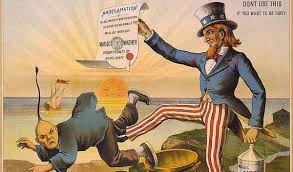
Living as we do in an era where many of the world’s political elites commonly support free trade initiatives, it is perhaps difficult to imagine that the global economy looked very different in the late 19th century. Aside from the notable case of Free Trade England, most nations in the latter half of the 19th century sought safety from the gales of modern global market competition behind ever higher tariff walls, buttressed with government subsidies to domestic industries and imperial expansion. The United States was the exemplar of this global turn to economic nationalism and empire.
In the wake of the Second World War, the United States would become the leading proponent of free trade. But for nearly a century before, American foreign trade policy was dominated by extreme economic nationalism. What brought about this pronounced ideological, political, and economic about face? How did it affect Anglo-American imperialism? What were the repercussions for the global capitalist order? In answering these questions, my new book, The “Conspiracy” of Free Trade (Cambridge University Press, 2016), offers the first detailed account of the controversial Anglo-American struggle over empire and economic globalization in the mid to late 19th century. [continue reading]
Editor’s Note: In the weeks leading up to the new year, please help us celebrate 2016 at the Imperial & Global Forum by checking out the past year’s 10 most popular posts.
Sadiah Boonstra and Caroline Drieënhuizen
Paul Doolan (Zürich International School / University of Konstanz) recently criticized Dutch historians for their failure to decolonize Dutch and colonial history, and suggested the contribution of what he calls ‘outsiders’ as a solution. In doing so, however, he overlooks the fact that there are and have been many initiatives to rewrite Dutch colonial history. We propose instead that approach, method, and the writing of multiple histories are of much greater importance in decolonizing Dutch history. [continue reading]
Editor’s Note: In the weeks leading up to the new year, please help us celebrate 2016 at the Imperial & Global Forum by checking out the past year’s 10 most popular posts.

Anthony Howe
University of East Anglia
Amid much discussion of alternatives to Britain’s current relationship with Europe, the Canadian, Norwegian, and Swiss models have featured widely. But surprisingly little attention has been paid to the closest historical model of what Brexiteers might hail as ‘a free trade Europe’.[1]
The first version of a ‘common market’ based on free trade treaties was created in Europe in the 1860s. Following the signing of the 1860 Anglo-French (Cobden-Chevalier) commercial treaty, a further 50-60 interlocking trade treaties were negotiated between European states, in effect creating a free trade area, the closest Europe got to a single market before the 1970s.
The economic benefits of this first common market are still contested by economic historians, but, as a model of a loose institutional framework it successfully lowered tariffs between participating states (only Russia of major European states remained outside it).
And at first glance this treaty network appears remarkably similar to the goals of those wishing to avoid a European super state in favour of simpler trade-based relationships. However, the fate of this model should be less than encouraging for the Leave campaign. [continue reading]
Editor’s Note: In the weeks leading up to the new year, please help us celebrate 2016 at the Imperial & Global Forum by checking out the past year’s 10 most popular posts.
Timothy Nunan
Harvard Academy for International and Area Studies
Follow on Twitter @timothynunan
How did Afghanistan in 2016 end up, yet again, as the graveyard of empires? Not only do Taliban franchises control much of the countryside outside of Kabul, but the start-up Islamic State battles them for influence. Tens of billion of dollars of aid have gone missing. Many Afghans are voting with their feet, forming one of the largest refugee diasporas in the world (a title they held until the Syrian Civil War).
Yet as my recent book, Humanitarian Invasion: Global Development in Cold War Afghanistan (Cambridge: Cambridge University Press, 2016) shows, tortured attempts to develop Afghanistan have a long history. Sure, events like the First Anglo-Afghan War (1839-1842) have left a deep imprint on how outsiders view the place. But for much of the twentieth century, neutral Afghanistan wasn’t at war with any of the superpowers. And when the Soviets went into Afghanistan, they did not annex it into some “Soviet empire.” The Democratic Republic of Afghanistan was a dues-paying member of the U.N. General Assembly, and Kabul played host to international conferences touting the regime’s solidarity with the Third World. [continue reading]
Editor’s Note: In the weeks leading up to the new year, please help us celebrate 2016 at the Imperial & Global Forum by checking out the past year’s 10 most popular posts.

Daniel Cullen
Overshadowed by Oxford’s ongoing Rhodes statue controversy, in late April a motion was debated by student representatives at Queen Mary, University of London, calling for the removal of plaques commemorating the 1887 visit of King Leopold II of Belgium. Presenting the motion, the university’s Pan-African Society referred to atrocities committed during Leopold’s rule of the Congo Free State and argued that the presence of the “deeply offensive relics” was “glorifying and uncritical”. The group proposed that the plaques be relocated and recontextualised, “preferably in a space dedicated to the memorialization of the crimes of genocide, colonialism and imperialism”.
Transnational protestors across the world are presently demanding critical reflection on the legacies of prominent imperial figures and the “decolonisation” of higher education institutions, addressing wider issues of institutional racism, from Oxford to Princeton. This protest movement began in 2015 when students demonstrated against statues of Cecil Rhodes in Cape Town, before protests spread internationally, taking up the hashtag #RhodesMustFall. [continue reading]
You must be logged in to post a comment.