Ben Holmes History Department, University of Exeter
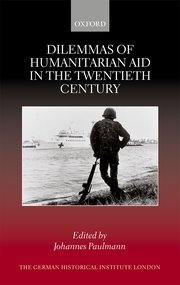
Dilemmas of Humanitarian Aid in the Twentieth Century (2016), edited by Johannes Paulmann (Director of the Leibniz Institute of European History and Professor of Modern History at the University of Mainz), exemplifies the burgeoning field of the history of humanitarianism. In providing historical context to a sector that is often stuck in the ‘perpetual present’, the volume shares a common purpose with a fast-growing body of literature.[1] Specifically, the volume examines 150 years of history to demonstrate that the technical and ethical crises central to modern humanitarianism – such as competition between aid organisations, the tendency of aid to ‘do more harm than good’, and the manipulation of aid by political actors – are not unique to the twenty first century. They have, in fact, ‘been inherent in humanitarian practice for more than a century’ [3].[2]Continue reading “Dilemmas of Humanitarian Aid in the Twentieth Century”→
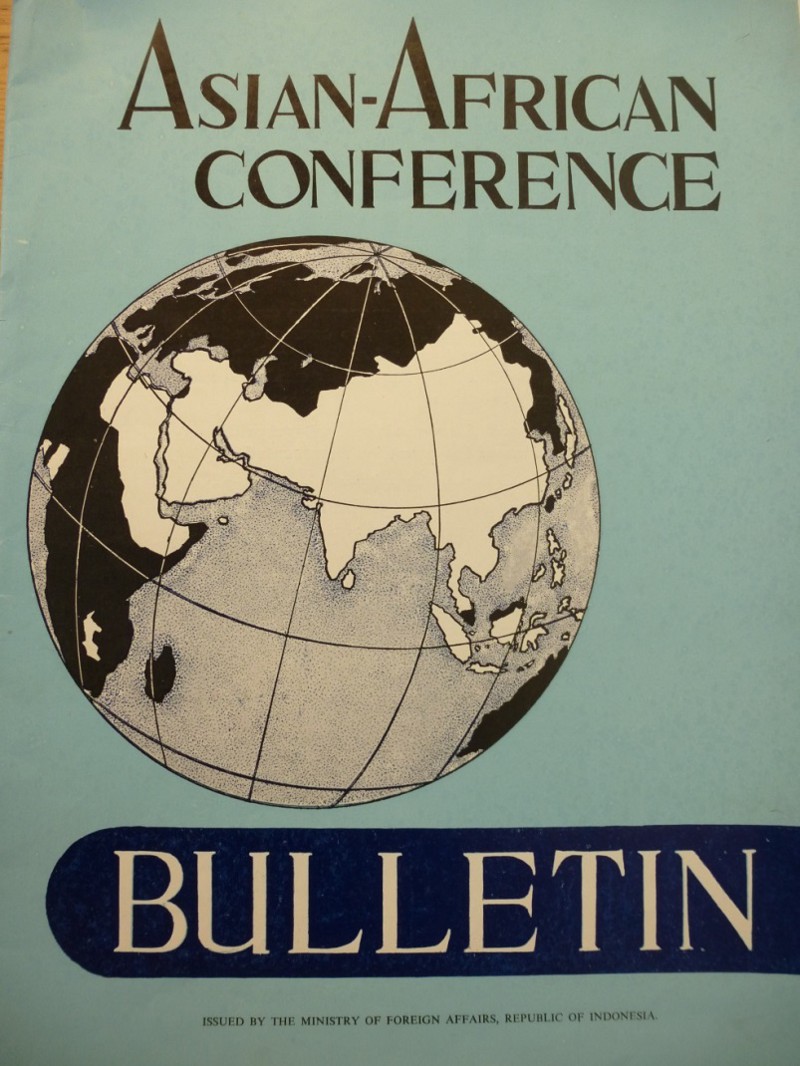
Copy of the Asian-African Conference Bulletin held at the Foreign Affairs Archives in Belgium. The Indonesian government produced a Bulletin on the Bandung Conference, intended to bolster its prestige, 1955.
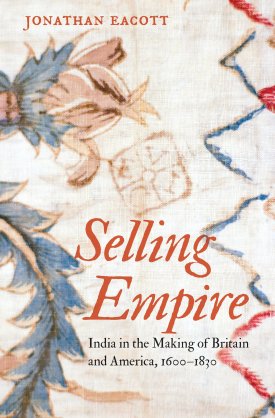
Review of Jonathan Eacott, Selling Empire: India in the Making of Britain and America, 1600–1830. Chapel Hill: University of North Carolina Press, 2016. $45.00 (Cloth).
Jonathan Eacott’s Selling Empire: India in the Making of Britain and America, 1600– 1830 (2016) reinforces two important historiographical points. One is that, contrary to David Armitage’s insistence that ‘the emergence of the concept of the “British Empire” . . . was long drawn out, and only achieved by the late seventeenth century at the earliest’,[1] the English polity that later incorporated the kingdoms of Scotland and Ireland was consciously imperial as early as the late sixteenth century. The second is that Britain’s imperial efforts were, from the start, transoceanic in nature. On the latter point, Selling Empire breaks with the older historiographical trend of distinguishing between a ‘first’ and ‘second’ British Empire delineated by a late eighteenth-century ‘swing to the east’.[2] Instead, Eacott asks readers to consider ‘America the India’ as well as ‘India the place’, for it was the idea of India that ‘fostered, propelled, and supported English and British imperial expansion and power in America’ (1–3). Rather than ‘separate “worlds” of empire’, Eacott sees ‘the British empire in the world’ (7), an important shift in perspective that, along with other recent studies of the peripheries of Britain’s American empire,[3] will continue to push scholars of early modern British imperialism nearer towards contemporary interdisciplinary debates surrounding notions of indigeneity and the legacies of settler colonialism.[4]Continue reading “Selling Empire: India in the Making of Britain and America”→
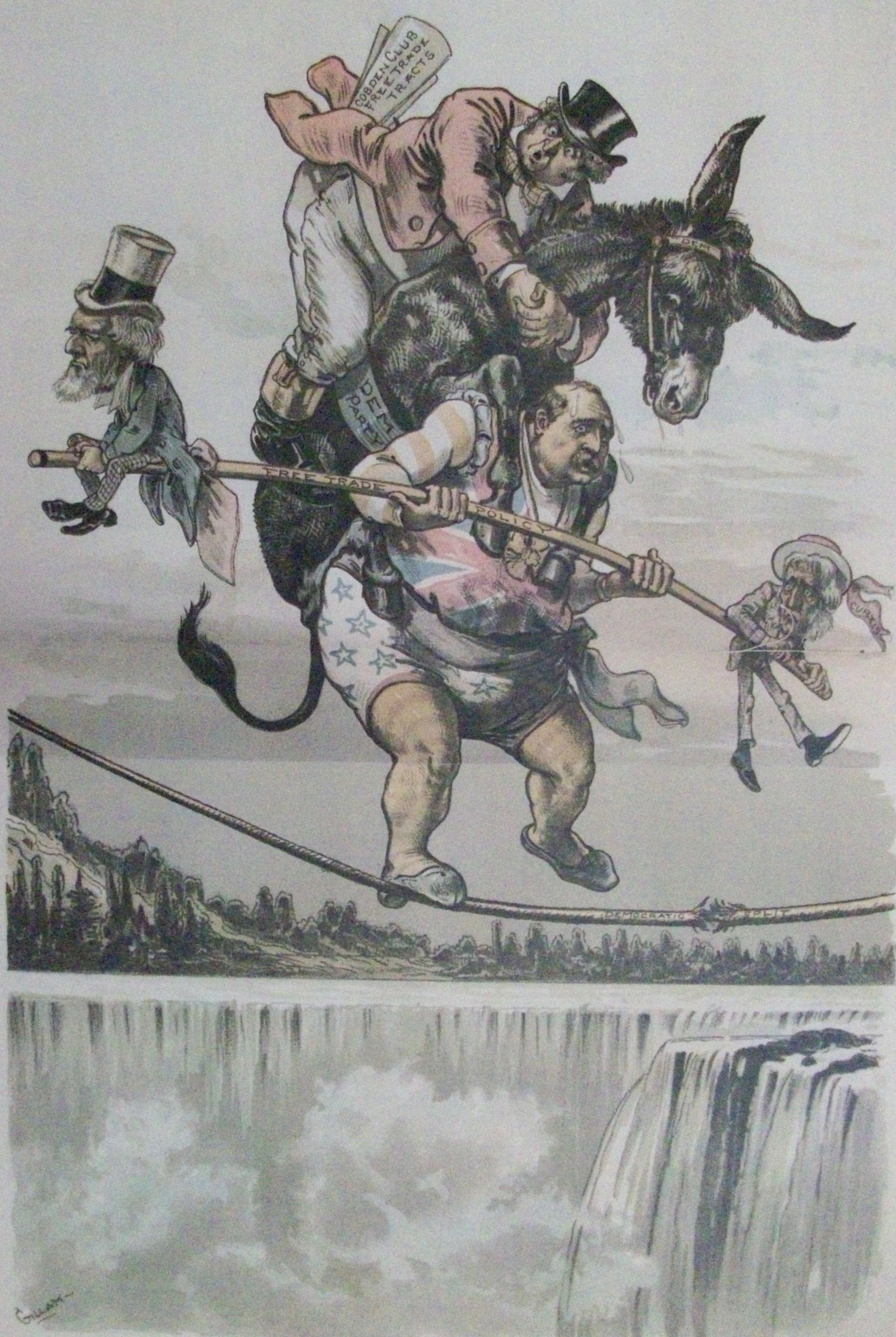
“Cleveland Will Have a Walk-Over.” Republican magazine Judge depicts Grover Cleveland balancing precariously on a fraying rope, holding a balancing pole labeled “Free Trade Policy” and carrying the Democratic Party donkey and John Bull, a common representation of Britain, on his back. John Bull’s back pocket is stuffed with “Free Trade Tracts.” Judge, 25 Aug. 1888.
How the 1888 elections decided the protectionist course of U.S. economic expansion for decades to come.
For most people alive today, Republicans have been the advocates of a free trade strategy for the United States, while the Democrats usually have sat on the fence.
The emergence of Donald Trump brings back the memory of when it was the other way around – when Republicans vehemently opposed open trade relations with the world, while Democrats advocated for free trade.
Era when Democrats were pro-free trade
The year was 1888, the tail end of Grover Cleveland’s first administration (1885-89). He was the only Democrat to hold the U.S. presidency in the half-century since the Civil War. And because of his actions, it was the tariff question that overshadowed all other economic issues that year.
The “Great Debate” of 1888 over U.S. trade policy arose after Cleveland, in his December 1887 annual message to Congress, had voiced his support for freer trade.
Plenty of attention is being paid to the political and constitutional effects of Brexit, but what will its economic impact be on life’s most basic commodities? How did food prices inform the debate in the weeks and months leading up to the referendum, and how have they informed debate in the past? How have the spectres of want and hunger been invoked over the last century and a half in political contexts, and are we paying them enough attention now?
Debating these questions will be five historians and policy makers with combined expertise covering the period since the 1840s, the “Hungry Forties,” which live in political memory as the UK’s last serious sustained period of food poverty. The discussion is aimed at policy makers and practitioners working in the area of food poverty and food security, and aims to show how lessons from the past can inform decision-making today. Continue reading “Brexit and food prices: the legacy of the Hungry Forties”→
British tabloids like The Sun, Daily Star, Daily Express and Daily Mail are currently agog at the news that Himmler’s diaries have been discovered in Russia, having learned that their German equivalent Bild is serialising excerpts (behind a paywall) of a remarkable discovery by German and Russian historians in the Russian archives.
Exeter’s Centre for Imperial and Global History is once again launching its free online course, which starts on 8 August.
The British Empire was the largest empire ever seen. It ruled over a quarter of the world’s population and paved the way for today’s global economy. But British imperialism isn’t without controversy, and it continues to cause enormous disagreement among historians today. This free online course will help you understand why. Continue reading “Free Course: ‘Empire – the Controversies of British Imperialism’”→
On Thursday 23 June 2016 the British electorate voted 51.9% to 48.1% to leave the European Union (EU). On election night the former leader of the UK Independence Party (UKIP) Nigel Farage declared this to be Britain’s ‘independence day.’ With ‘independence day’ on pro-Brexit lips, US pundits have been quick to connect 2016 with 1776, the year the Declaration of Independence was signed. The Federalist’s Robert Tracinski, for example, was among the first ‘to welcome the mother country to our revolution.’ And, in a similar act of transatlantic camaraderie, the Republican magazine National Review has accordingly rebranded the 1776 signing of the Declaration of Independence as ‘Amerexit.’
Critics have since been quick to point out some of the big historical problems with proclaiming the 23rd June as Britain’s ‘independence day’, including the common association between it and the outbreak of the American Revolution. And of course it’s worth noting that the EU referendum vote and the American Revolution (1775-1783) have obvious differences, not least that in the former the question of independence was settled by the ballot box, whilst in the latter it was decided by the barrel of a gun. Nevertheless, let’s assume for the moment that there are some useful comparisons to be drawn between the American Revolution and Brexit. If so, is 1776 the ideal date for comparison, as many pundits have recently suggested? I would suggest instead that events during the latter years of the American Revolution share far more in common with today. Continue reading “Brexit, the American Revolution, and the Problem with ‘Independence Day’”→




 Imperial & Global Forum
You must be logged in to post a comment.