President Donald Trump renewed fears of a global trade war after he vowed to slap steep tariffs on foreign aluminum and steel.
The tariffs haven’t even been formally proposed, yet other countries are already threatening countermeasures. The European Union, for example, promised to impose tariffs on iconic American products like Harley-Davidsons, Kentucky bourbon and blue jeans, while China, Australia and Canada all promised a response.
Brushing all that aside, the president tweeted that “trade wars are good.”
When a country (USA) is losing many billions of dollars on trade with virtually every country it does business with, trade wars are good, and easy to win. Example, when we are down $100 billion with a certain country and they get cute, don’t trade anymore-we win big. It’s easy!
Successful presidents do not need to come through the political process, but whatever their background, they need to be able to lead intelligently and to make sense of and mould the coalitions of interest—both domestic and international—that provide the opportunity to ensure the implementation of policy. One of the most impressive non-politician presidents was Dwight Eisenhower, the Republican president elected in 1952 and re-elected in 1956. A self-styled moderate conservative, Eisenhower provided an effective hard-edged moderation.
Eisenhower benefited from, and helped to mould, the conservative ethos of the 1950s. His re-election in 1956 with a margin of nine million votes displayed widespread satisfaction with the economic boom and social conservatism of those years. There was an upsurge in religiosity as church membership and attendance rose, and Eisenhower encouraged the addition of “under God” to the Pledge of Allegiance and “In God We Trust” on the currency. At the same time, Eisenhower left the New Deal intact and crucially extended it to incorporate African-Americans, even using federal forces to enforce the integration of Central High School in Little Rock, Arkansas.
The Eisenhower years were to be the background to modern America. In many respects, the new social and political currents of the 1960s were a reaction to this conservatism. Yet, to an extent that exponents of the “Sixties” prefer to forget, many of the developments of the 1950s had a lasting impact, notably the growing suburbanisation and car culture, the growing significance of the South and, far more, the West, and the willingness of government to challenge institutional Southern racism. Continue reading “Eisenhower and the Cold War”→
When I was a young student in history and philosophy at the University of Geneva, I had never thought that one day I may work for the International Committee of the Red Cross (ICRC). Yet it happened. While I was preparing my Masters thesis, the protection division at the ICRC was looking for a young historian to carry out a research in their archives. I got hired for a one-year traineeship contract, which was extended by two shorter terms within the relations with the arms carriers unit and at the archives division. This experience was a turning point in my career. As a consequence, I decided to write my PhD dissertation on the history of the ICRC, which was part of a research project dedicated to Switzerland during the First World War. I analyzed the interactions between humanitarian action and neutrality at that time.
In July 2015, during my research, I got the chance to participate in the very first Global Humanitarian Research Academy. This academy played a very positive role for me, as it was an occasion to meet other researchers working on the history of humanitarian action. Our various talks and debates made me think about other practices and ways of studying the past of humanitarian organizations. We shared different perspectives, some close and some more distant from mine, however all of them very interesting and challenging. It also gave me the opportunity to posit my hypotheses and research results to more advanced scholars. They gave good advice that I then used during the writing process of my dissertation. Meeting others PhD students was useful in terms of networking, of course. Beyond that, the excellent atmosphere created during the academy allowed us to maintain amicable contacts, as well. Still today, I regularly exchange with my fellows. At the end, this experience was really rewarding. Continue reading “Why Historians Can Be Valuable Members of the Humanitarian Family”→
The gap between the Cold War’s history and its new historiography spanned only about a decade and a half. The Cold War concluded during the George H.W. Bush presidency, but for the field we now call “the US and the world,” the Cold War paradigm reached its terminus, if we have to be specific, in 2005. That year saw the publication of two books that together marked a milestone in how scholars would write about the Cold War. John Lewis Gaddis’ The Cold War: A New History told its story through engaging prose and a top-down approach that gave pride of place to Washington and Moscow as the centers of a bifurcated world. For its part, Odd Arne Westad’s The Global Cold War: Third World Interventions and the Making of Our Times offered a triangular model in which empires of liberty and of justice interacted with Third World revolutionaries who led campaigns for decolonization that shifted into high gear after World War II. Gaddis’ survey represented a culmination of the traditional two-camps schema which tended to reflect self-understandings of the US government but which, after Westad’s concurrent synthesis, could no longer stand without qualification, without reference to the colonial dimension of the Cold War itself. In this sense, 2005 was a before-and-after historiographical event.
The classic Cold War concept, in which the governing and formal decolonization of Western Europe’s empires was one thing, and the rivalry between the superpowers something altogether else, has become diminished, but not because of one book alone. Various social movements have rejected the tenets of the Cold War at different times, and as far back as 1972, historians Joyce and Gabriel Kolko argued that “The so-called Cold War…was far less the confrontation of the United States with Russia than America’s expansion into the entire world.”[2] In 2000, Matthew Connelly called attention to the distortions accompanying attempts to have postwar history fitted to the constraints of the Cold War paradigm. The “Cold War lens,” as Connelly memorably called it, had obscured racial and religious realities. As more scholars began to push the weight of culture, decolonization, gender, public opinion, and more against the Cold War paradigm’s once stable conceptual walls, the foundations faltered. And since Westad’s 2005 landmark, a notable tendency has developed across the disciplines in which scholars – notably Mark Philip Bradley, Jodi Kim, Heonik Kwon, and the authors (including Westad) contributing to Joel Isaac and Duncan Bell’s volume on the Cold War idea – have further troubled the notion that what followed World War II is best understood by focusing on how the leaders of the US and USSR saw the world.[3]
It’s also worth noting that the recent literature’s rough division between works that sit more comfortably within the Cold War paradigm and those that prompt a rethinking of its foundations does not map neatly onto the difference between local and globally-oriented studies. Melvin Leffler’s 2008 transnational history of US-Soviet relations and Samuel Zipp’s New-York focused book on urban renewal of 2010 both fit within Cold War studies, for example, while Masuda Hajimu’s global reinterpretation of the Korean War and Yuliya Komska’s cultural genealogy of the West German-Czech borderlands (both published in 2015) render suspect what we thought we knew about the Cold War.[4] All four books are excellent, and it would be unhelpful to make a “without paradigm good, within paradigm bad” argument across wide swaths of insightful scholarship. The point is, rather, to note that The Cold War: A World History arrives at what Federico Romero calls a historiographical crossroads, on a conceptual terrain conspicuously remapped since the publication of The Global Cold War. Continue reading “The Cold War’s World History and Imperial Histories of the US and the World”→
Since the Brexit vote the ‘Anglosphere’ has featured prominently in debates about the UK’s future trade strategy. It may seem odd that the CANZUK countries (Canada, Australia and New Zealand) have featured so prominently in these discussions. After all, combined together these countries accounted for less than four percent of UK exports in 2017. While Brexiteers may talk wistfully of reviving trade with these ‘old friends’, their efforts build on a problematic historical legacy.
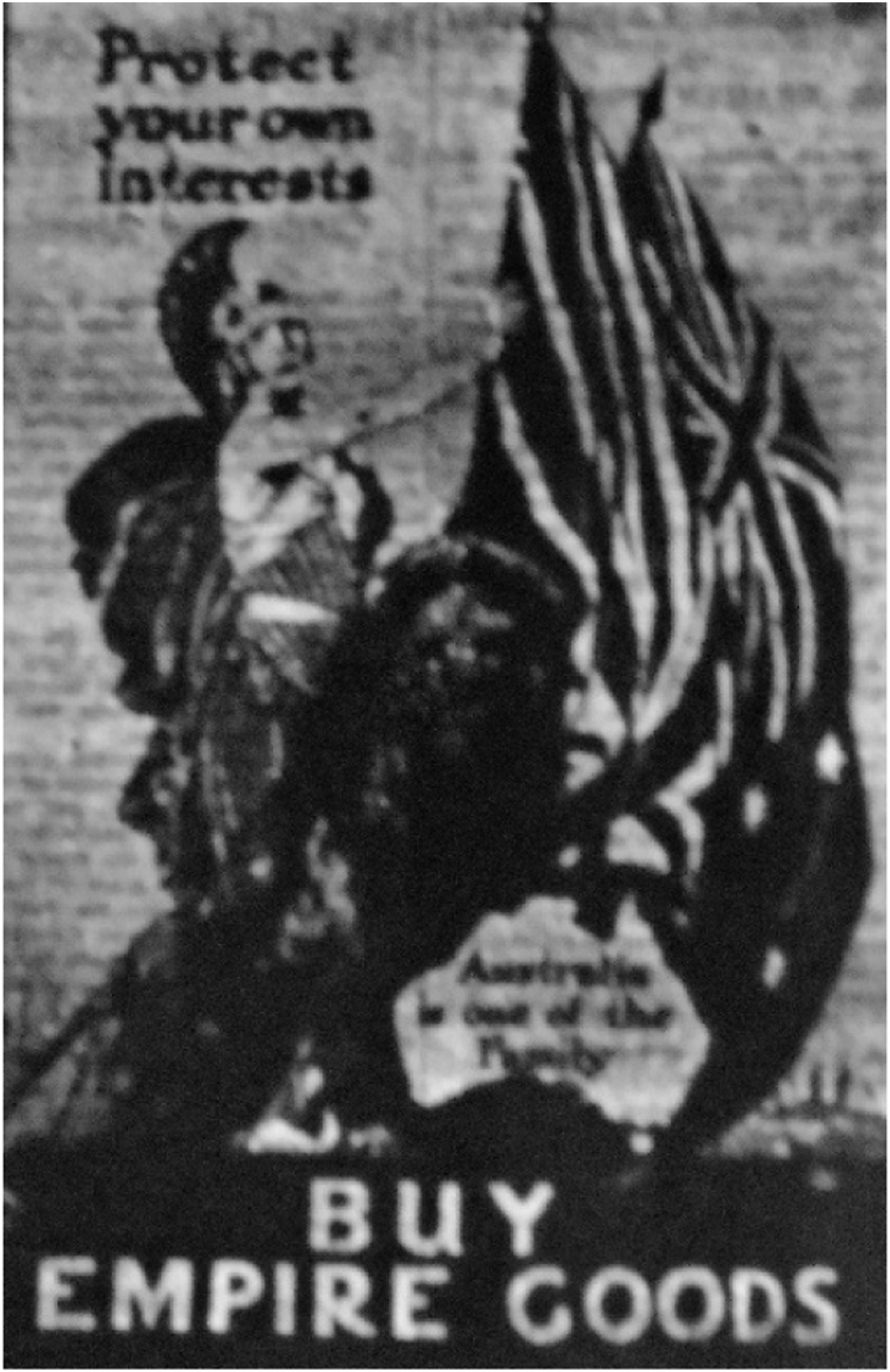
In the 1920s and 1930s various efforts were made to encourage consumers to support trade between ‘British’ countries, based on ties of race. This was only one of a range of attempts to promote ethnically-based trade communities. For example, rival Buy Indian and Buy Chinese movements connected diaspora populations across the British Empire. At much the same time, Marcus Garvey’s Universal Negro Improvement Association promoted the idea of ‘buying black’, a cause which was subsequently adopted by the National Association for the Advancement of Colored People in the United States.
The practice of running empire shopping weeks was started by the British Women’s Patriotic League in 1923, and subsequently endorsed in the UK by the government-sponsored Empire Marketing Board. Shoppers were encouraged to exercise a voluntary preference for national and imperial goods. The shopping week movement extended into Australia in 1925, and reached Canada and South Africa in 1928. However, the language of empire shopping varied significantly between countries. Within the UK and Australia there was much focus on promoting links across the ‘British’ race at home and overseas. However, the question of the ‘British’ character of empire shopping proved more controversial in Canada, with its large French-speaking Québecois population, and in South Africa, where Afrikaners outnumbered the descendants of British settlers. Continue reading “The politics of buying British: From the Great Depression to Brexit”→
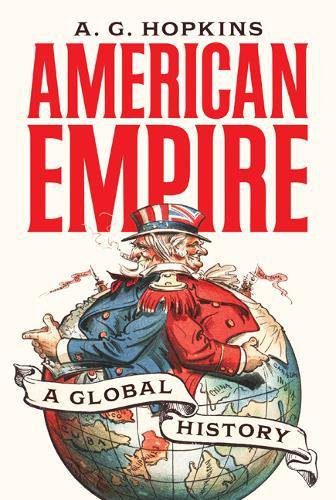
Whether commentators assert that the United States is resurgent or in decline, it is evident that the dominant mood today is one of considerable uncertainty about the standing and role of the “indispensable nation” in the world. The triumphalism of the 1990s has long faded; geopolitical strategy, lacking coherence and purpose, is in a state of flux. Not Even Past, or perhaps Not Ever Past, because the continuously unfolding present prompts a re-examination of approaches to history that fail to respond to the needs of the moment, as inevitably they all do.
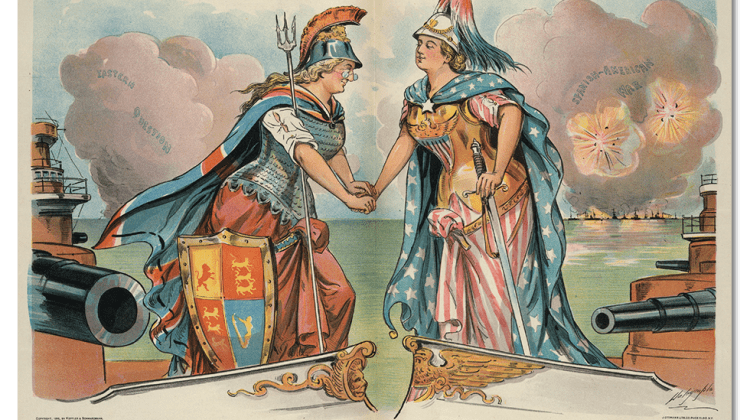
This as good a moment as any to consider how we got “from there to here” by stepping back from the present and taking a long view of the evolution of U.S. international relations. The first reaction to this prospect might be to say that it has already been done – many times. Fortunately (or not), the evidence suggests otherwise. The subject has been studied in an episodic fashion that has been largely devoid of continuity between 1783 and 1914, and becomes systematic and substantial only after 1941.
There are several ways of approaching this task. The one I have chosen places the United States in an evolving Western imperial system from the time of colonial rule to the present. To set this purpose in motion, I have identified three phases of globalisation and given empires a starring role in the process. The argument holds that the transition from one phase to another generated the three crises that form the turning points the book identifies. Each crisis was driven by a dialectic, whereby successful expansion generated forces that overthrew or transformed one phase and created its successor.
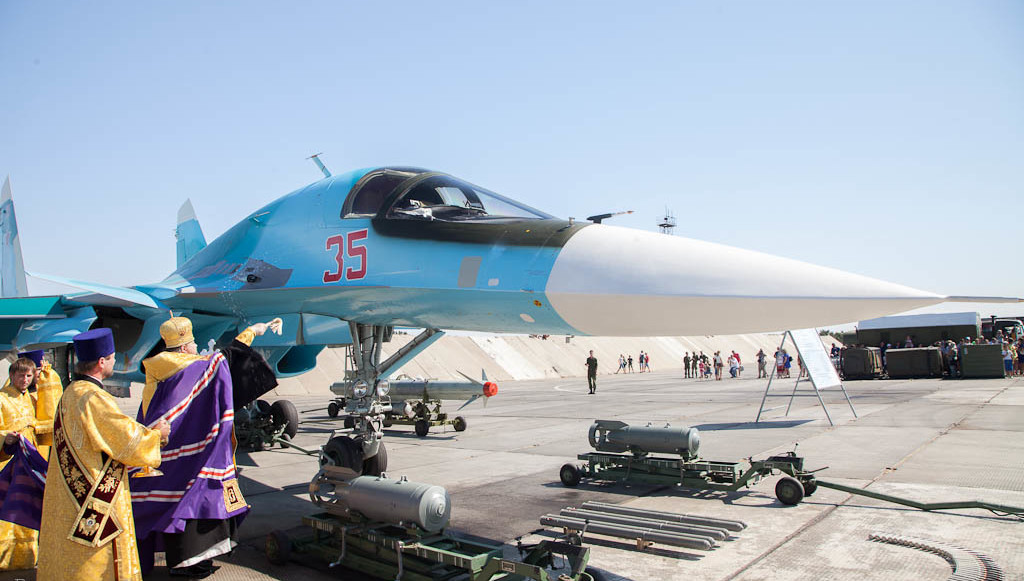
The Russian Orthodox Church was vocal in its support of the Russian military intervention in Syria. ‘The fight with terrorism is a holy battle and today our country is perhaps the most active force in the world fighting it,’ declared Vsevolod Chaplin, former head of the Church’s public affairs department, who also called for a more active Russian military engagement in Ukraine.
Tobias Rupprecht University of Exeter Follow on Twitter @Tobepastpresent
Russia has re-emerged as an imperial power during Vladimir Putin’s third term as president. In the Syrian civil war, the Russian military intervention turned the tides in favour of Bashar al-Assad. The Kremlin has incited separatism and war in Ukraine, supports Serbian nationalists and secessional Abkhazians, has refreshed traditional friendships with Bulgaria and Macedonia, and it has struck a deal with the Cypriote government that allows the Russian navy to use the island’s ports. In the Southern European debt crisis, Russia offered substantial financial aid to Greece. What links all these countries is that they all are traditionally home to large groups of Orthodox believers. Is this a coincidence?
In a recent article in Comparative Studies in Society and History, I argue that religious traditions and religion-based visions of world order often impinge on the making of foreign policy and on the nature of International Relations. I make that case using the history of the mutual cross-relationship of church and state in modern Russia and Ethiopia. From the late nineteenth century, both multi-ethnic empires with traditionally orthodox Christian ruling elites, developed a special relationship that outlived changing geopolitical and ideological constellations. Russians were fascinated with what they saw as exotic brothers in the faith; Ethiopians took advantage of Russian assistance and were inspired by various features of modern Russian statecraft. Religio-ethnic identities and institutionalised religion have grounded tenacious visions of global political order and cross-border identities. Orthodoxy was the spiritual basis of an early anti-Western type of globalisation, and was subsequently co-opted by states with radically secular ideologies as an effective means of mass mobilization and control. Continue reading “Orthodox Internationalism: Why religion matters in global history and International Relations”→
This conference aims to provide a truly global account of the rise and entrenchment of the modern neoliberal order. Contributors will consider how neoliberal ideas travelled (or did not travel) across regions and polities; and analyse how these ideas were translated between groups and regions as embodied behaviours and business practices as well as through the global media and international organisations. As the fate of neoliberalism appears in question across many regions, it is an opportune moment to make sense of its ascendancy on a global scale.
Convenors: Professor James Mark, University of Exeter Professor Richard Toye, University of Exeter Dr Ljubica Spaskovska, University of Exeter Dr Tobias Rupprecht, University of Exeter
Speakers include: Professor Jennifer Bair, University of Virginia
Professor Susan Bayly, University of Cambridge
Professor Johanna Bockman, George Mason University
Professor Stephanie Decker, Aston Business School
Mr Julian Gewirtz, University of Oxford
Professor Vanessa Ogle, UC Berkeley
Professor Daisuke Ikemoto, Meijigakuin University
Professor Artemy Kalinovsky, University of Amsterdam
Dr Alexander Kentikelenis, University of Oxford
Professor Pun Ngai, Hong Kong University
Professor Pal Nyiri, University of Amsterdam
Professor David Priestland, University of Oxford
Professor Bernhard Rieger, University of Leiden
Professor Quinn Slobodian, Wellesley College and Harvard University
Dr Jorg Wiegratz, University of Leeds
Registration: A registration fee is payable at the time of booking. For further information and details of how to book please click on ‘Book event’.
Standard Admission: £95 for both days; £50 for one day
Early Bird booking (before 31 January 2018): £75 for both days; £40 for one day
Concessions: £36 for both days; £20 for one day
Date
Thu 7 Jun 2018 09:00 to Fri 8 Jun 2018 17:00
Location
The British Academy, 10-11 Carlton House Terrace, London, SW1Y 5AH
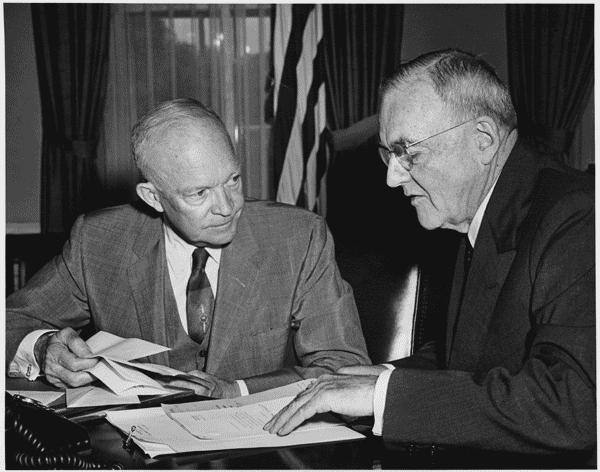
To experts on the history of U.S. foreign policy, the Dulles brothers’ service during Dwight D. Eisenhower’s presidency marks an important watershed in the evolution of American interventionism. In the context of brewing conflict with the Soviet Union, Eisenhower’s administration aimed to protect developing countries of the “Third World” from being converted to Communism. However, as recovery efforts following World War II mobilized international diplomatic efforts to broker world peace, U.S. officials were reluctant to deploy troops abroad. John Foster Dulles was Eisenhower’s secretary of state during this time. His brother, Allen Dulles, served as director of the recently founded Central Intelligence Agency. Together, the Dulles brothers used this agency to eliminate perceived communist threats in the Third World through covert operations, establishing a powerful precedent for “regime change” as foreign policy strategy.
What fewer scholars and policy enthusiasts know is that the Dulles brothers were products of an elite political family with a strong internationalist tradition. John Foster Dulles’ personal papers, stored at his alma mater Princeton University, exhibit how the eldest brother’s upbringing and family network, consisting of diplomats, missionaries, and international lawyers, influenced his developing world view. This is particularly the case with his maternal grandfather, John W. Foster, a prominent patriarchal presence during Dulles’ childhood. Ideological continuity between Foster and his oldest grandson is evident in their comparable career paths, their methods of preparing subsequent male generations, and their published texts and speeches which analyze the role of U.S. foreign policy in international affairs.





 Imperial & Global Forum
You must be logged in to post a comment.