
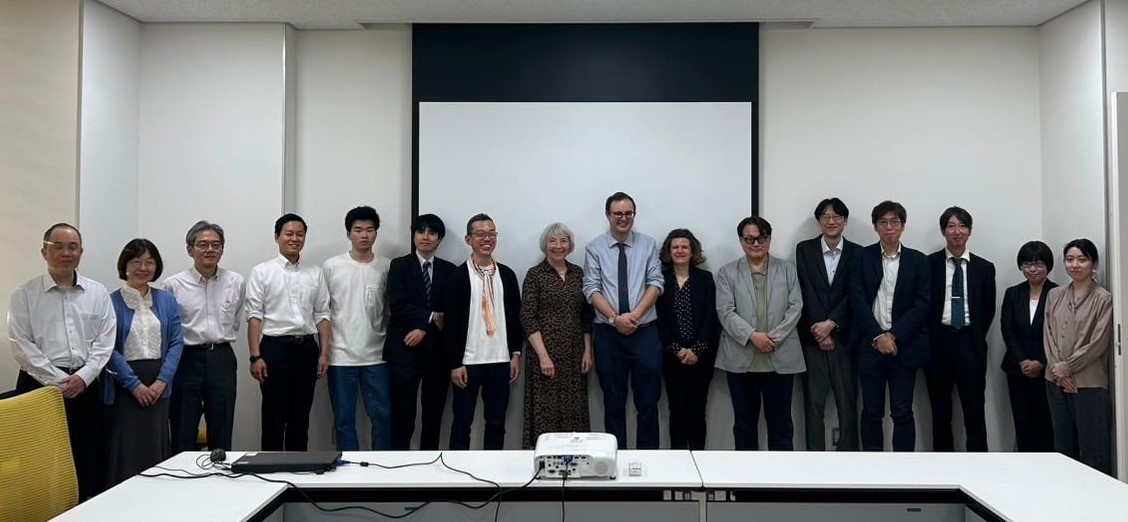
David Thackeray (University of Exeter) and Mahito Takeuchi (Nihon University)
Last month I (David) had the pleasure of speaking at a research workshop held at Nihon University as part of an ongoing British World histories project led by Prof. Mahito Takeuchi, the first of its kind in Japan. The Tokyo and Kansai regions play host to a thriving cluster of scholars working in this field, several of whom will contribute to the project. Building on existing work which has focused on the role of networks in the development of British World ties, the project will pay particular attention to issues of racism and unequal power relations, which have sometimes been elided in existing works.
The workshop was the first of its kind that the research group have held since the pandemic. Several of the earlier English-language publications of the research group and their guests are collected here. David Thackeray explored the Empire/ Commonwealth Parliamentary Association, an organisation which following its founding in 1911 sought to promote the ‘British World’ as a cohesive political and economic community, rooted in ideas of racial kinship and shared constitutional tradition. However, the Parliamentary Association struggled to reconcile its historical focus on informal co-operation with the political realities of a Commonwealth being reshaped by decolonisation and waned in influence after 1950. Prof. Hilary Carey (University of Bristol) discussed the development of Imperial Church Congresses and their relationship with the British World. These congresses brought together tens of thousands of delegates from the mid-nineteenth century onwards. While London initially played a central role in the development of this spiritual empire America became increasingly central to the advance of Evangelicalism as a global movement. Although there were significant differences between denominations such congresses promoted ideas of a united Anglosphere.
Continue reading “British World Studies in Japan”


You must be logged in to post a comment.