Feminism’s Forgotten Free-Trade Past

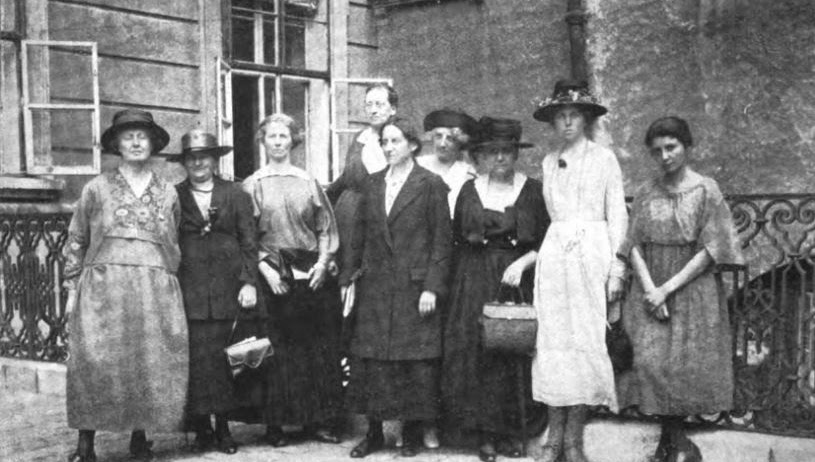
1921 WILPF Executive Committee: Front row, left to right: Cornelia Ramnodt-Hirschmann, Gabrielle Duchêne, Lida Gustava Heymann, Yella Hertzka, Jane Addams, Catherine Marshall, Gertrude Baer. Back row, left to right: Emily Greene Balch and Thora Daugaard. WikiCommons, https://en.m.wikipedia.org/wiki/File:1921_WILPF_Executive_Committee.jpg

Marc-William Palen
History Department, University of Exeter

Cross-posted from History Matters

A fragmenting world of trade wars. Food insecurity despite an abundance of food. European food wars. A broken Brexit Britain undermining European unity. The resurgence of right-wing nationalism. Human rights under attack. Children starving from wartime blockades.

The world disorder of 2024 would have looked all too familiar to the international women’s peace movement of a century ago.

Feminists back then tended to see themselves as the mothers of the world, believing that women’s active participation in politics would curb or counter men’s militant predilection for nationalism and war. ‘First wave’ feminist internationalists numbered among the leaders of the early-20th-century fight for world peace, what Harriet Alonso has described as “the suffragist wing” of the international peace movement from the First World War onwards.

Free trade was a key – but oft-overlooked – ingredient to their feminist vision for a peaceful world. Chicago social reformer Jane Addams, the figurehead of the international women’s peace movement, emphasized this free-trade dimension throughout the 1920s and 1930s.

Jane Addams made landfall in Europe in early July 1919 to bear witness to the destructive aftermath of the First World War. Addams’s main concern was the famine afflicting millions of Europe’s children.

Addams’s 1919 trek marked the beginning of what would become a multi-year European humanitarian mission of a new left-leaning feminist organization: the Women’s International League for Peace and Freedom (WILPF), which remains active today. Addams was WILPF’s inaugural president.

Addams had her first of many encounters with Europe’s malnourished children during a stopover in Lille in northern France. There, inside a schoolhouse, Addams looked on as a physician examined them by the hundreds. ‘Stripped to the waist’, the children looked more like ‘a line of moving skeletons; their little shoulder blades stuck straight out, the vertebrae were all perfectly distinct as were their ribs, and their bony arms hung limply at their sides.’

Adding to the macabre scene, an eerie quiet hung over the improvised emergency room. You see, the French physician on duty had lost his voice, a side effect of wartime shellshock. He therefore ‘whispered his instructions to the children as he applied his stethoscope and the children, thinking it was some sort of game, all whispered back to him.

Addams encountered similarly graphic scenes in Switzerland and throughout Germany. The 1919 WILPF mission’s findings reinforced her belief that, while the war may have ended, securing the peace had just begun.

Addams therefore headed a follow-up WILPF humanitarian mission amid the hot summer of 1921, this time to southeastern Europe, where she once again encountered mass hunger. ‘Food resources which were produced in Europe itself and should have been available for instant use,’ Addams wrote, ‘were prevented from satisfying the desperate human needs. Why? Because ‘a covert war was being carried on by the use of import duties and protective tariffs’, which the war’s food blockades had legitimized.

These small starving European states, seeking self-preservation, mistakenly ‘imitated the great Allies with their protectionist policies, with their colonial monopolies and preferences.’ To Addams, such suffering in the name of ‘hypernationalism’ only amplified the need for a new international system of ‘free labor and exchange’ The world faced a clear choice: either ‘freedom of international commerce or international conflict of increasing severity.’

To meet world food demands, her envisaged free-trade order would also require supranational regulation of global transportation lines to counter ‘the ambition of rival nations.’

 She called her cosmopolitan vision ‘Pax Economica’.

Continue reading “Feminism’s Forgotten Free-Trade Past”
Young Women against Apartheid: Gender, Youth and South Africa’s Liberation Struggle

Emily Bridger
University of Exeter

On a night in 1983, the apartheid police came knocking on the door of a family home in the township of Soweto, located just outside Johannesburg. They were looking for ‘Vicky’ – a seventeen-year-old school student who, according to their informant, was involved in local anti-apartheid politics in the area. They found Vicky asleep in the bedroom she shared with her sisters and drove her to the local police station along with the six young male activists they had also rounded up that night.

Upon arriving at the station, Vicky was relieved. Her father, a local township policeman, was on duty. Surely he would release her, she thought. Yet instead, he was furious to see his daughter amongst the night’s catch of young political troublemakers. To him, her transgression was two-fold: first, in participating in the liberation struggle she was defying apartheid laws and threatening the hegemony of the apartheid state; and second, she had done this as a girl. ‘What’s wrong with you?’ He shouted at her. ‘Why don’t I get your brothers here? I only get you here, hey? You are a woman! How can you do this?’

This belief that girls and young women had no place in South Africa’s liberation struggle was held by many in Soweto at this time. And, in the almost four decades since, the presumption that political militarism was a male prerogative has led historians to paint the final, turbulent years of the country’s anti-apartheid struggle as a male-dominated affair in which girls and young women appear only as marginalised bystanders or victims of male-instigated violence. Since the mid-1970s, the struggle had been increasingly led by the country’s black male youth – children and students who became the vanguards and shock-troops of the anti-apartheid movement. As township politics grew increasingly confrontational during the 1980s, with renewed political resistance met by the state’s increased militarisation, girls and young women were thought to have been largely excluded from township politics.  

Yet from 2013 to 2016 I met and interviewed dozens of women in Soweto who, like Vicky, had put their lives on the line to fight against apartheid while still teenagers and school students. Alongside young men, they had protested in the streets, picked up stones to throw at police vehicles, launched petrol bombs at enemy targets, and been detained, interrogated, and tortured by the apartheid state. Yet unlike young men, these young women had fought a battle on two fronts: against both the white supremacy of apartheid and local gender norms which confined them to the home, made them vulnerable to overlapping forms of personal and criminal violence, and stigmatised their political militarism.

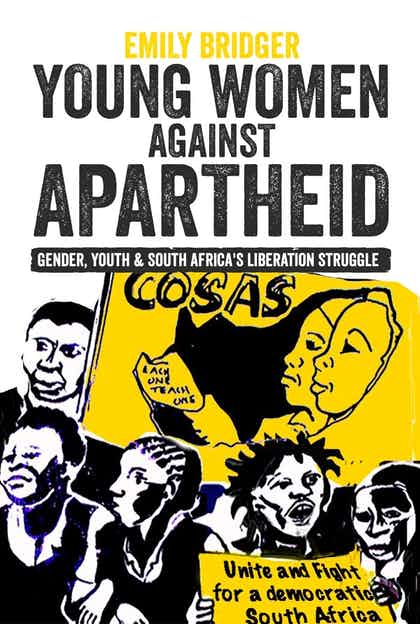
It is these girls’ stories that Young Women against Apartheid seeks to tell. Based on three years of oral history and archival research, it explores what life was like for African girls under apartheid, why some chose to join the liberation struggle, and how they navigated the benefits and dangers that political activism posed. At the heart of the book lies the life histories of these women themselves. Now in their forties and fifties, most were eager to share their past experiences, repudiating arguments of young women’s absence from political activism during these years and constructing themselves as decisive actors in South Africa’s liberation struggle. Continue reading “Young Women against Apartheid: Gender, Youth and South Africa’s Liberation Struggle”

Virginity Testing: Racism, Sexism, and British Immigration Control

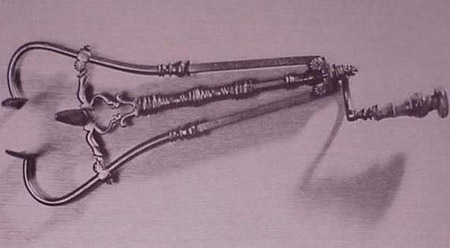
A Victorian-era vaginal speculum.

Evan Smith and Marinella Marmo
Flinders University

How racist and sexist attitudes formed in the Victorian era resulted in the harsh and discriminatory treatment of women by the immigration control system in the 1960s and 1970s.

In February 1979, The Guardian reported that a number of women had been given gynaecological examinations by immigration control staff in the UK and at British High Commissions in South Asia, in a practice colloquially known as ‘virginity testing’. These tests were predominantly performed on South Asian women seeking to enter the UK on fiancée visas, which were not subject to waiting lists under the Immigration Act 1971. But while these rules allowed fiancées to enter without much paperwork, British immigration officials were also highly suspicious that these visas were being abused, feeding off a wider belief that many South Asian migrants were coming to Britain under false pretences. Continue reading “Virginity Testing: Racism, Sexism, and British Immigration Control”