
The ‘Bordering on Brexit: Global Britain and the Embers of Empire‘ Conference was held last weekend at Garrison Library, Gibraltar. Professor Richard Toye, Director of Exeter’s Centre for Imperial and Global History, interviews Fintan O’Toole (Irish Times) about his conference keynote.
Tag: Richard Toye
Interview with Prof. Astrid Rasch – ‘Bordering on Brexit: Global Britain and the Embers of Empire’ Conference
The ‘Bordering on Brexit: Global Britain and the Embers of Empire‘ Conference was held last weekend at Garrison Library, Gibraltar. Professor Richard Toye, Director of Exeter’s Centre for Imperial and Global History, interviews Prof. Astrid Rasch (NTNU) about the conference and the ‘Embers of Empire’ project.
Winston Churchill, France and Europe
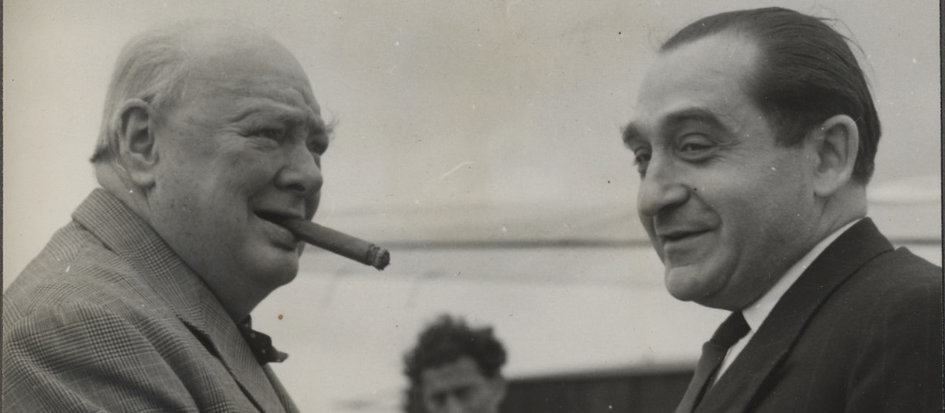
Centre Director Richard Toye recently discussed how Churchill has been utilized within the Brexit debate, and Churchill’s relationship with Europe – you can listen through the links below.
Cross-posted from France in the UK
A special Franco-British conversation about leading figures of our shared history.
Historians Richard Toye and Christian Destremau examine Winston Churchill’s relationship to France and Europe, and the different narratives that have been built since.
As part of The Fabric of Citizenship seminar series.
Podcasts
You can now listen to this special evening thanks to Culturethèque.
Tristan Mendès France on his grandfather Pierre Mendès France
Richard Toye explores Winston Churchill’s relationship to France and Europe
Christian Destremau explores Winston Churchill’s relationship to France and Europe
Imagining Britain’s economic future, c.1800-1975
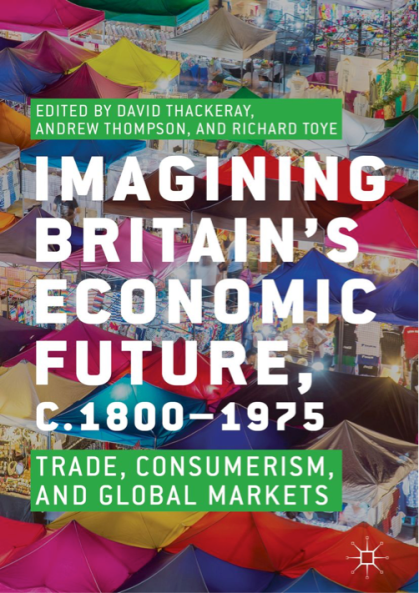
David Thackeray, Richard Toye, and Andrew Thompson
University of Exeter
This book considers how Britain has imagined its economic role in the wider world and how British ideas have influenced global debates about market relationships between the start of the nineteenth century and the UK’s first European referendum. In doing so, the authors explore the interplay between the high political thought of theorists, the activities of officials and businesspeople, and the everyday experience of the wider public. Across the contributions to this book there is a consideration of the competing factors which affected market decisions and the processes of ‘economic imagination’.
The economist Joseph Schumpeter put the concept of imagination at the heart of the entrepreneurial process. It was this quality which, above all, businesspeople required if they were to succeed: ‘the capacity of seeing things in a way which proves afterwards to be true, even though it cannot be established [as such] at the time’.[1] He saw that economies are, in a sense, imaginative constructs – making calculations about and placing faith in the future and its possibilities are key qualities of investors and entrepreneurs.
Schumpeter’s work on the entrepreneurial imagination was an important influence in the development of Ronald Robinson and John Gallagher’s concept of the ‘official mind’, which they saw as the key driving force behind British imperial expansion in the nineteenth century. As they noted in Africa and the Victorians, London policy-makers ‘were usually dealing with countries they had never seen, with questions apprehended intellectually from reports and recommendations on paper….it was the idea and analysis of African situations in Whitehall, and not the realities in Africa as such which moved Victorian statesmen to act or not to act’.[2]
The question of how changing levels of information available to economic actors has affected the role of imagination in decision making in the modern world is an important one. As international business scholars have acknowledged, economic imagination is ultimately shaped by the interpretation of past experience, access to information about markets (which can sometimes be faulty), and hopes placed in the future. Perceptions of distance between markets are ultimately culturally constructed. The ‘physic distance’ between markets perceived by businesspeople, policy makers, and consumers may not correspond to actual measurable differences in institutions, preferences, and values as economic actors may exaggerate or underestimate the cultural distance between two countries involved in a transaction.[3]
The 2016 EU referendum provides a good example of how public debates about an imagined economic future can radically reshape public policy. Continue reading “Imagining Britain’s economic future, c.1800-1975”
Old Man in A Hurry
Richard Toye
Director, Centre for Imperial & Global History
Felix Klos, Churchill’s Last Stand: The Struggle to Unite Europe (I.B.Tauris, 2017)
Marco Duranti, The Conservative Human Rights Revolution: European Identity, Transnational Politics, and the Origins of the European Convention (Oxford University Press, 2017)
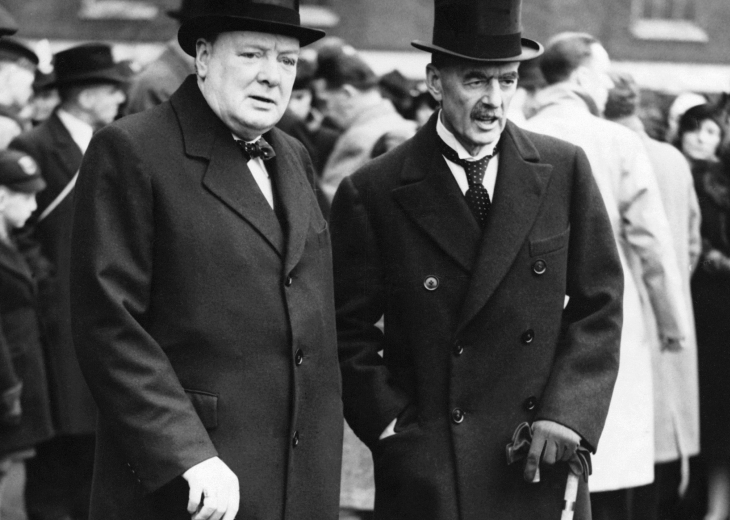
In the run-up to 2016 Brexit referendum, advocates of staying in the EU made significant efforts to invoke the memory of Winston Churchill. Remainers pointed to the fact that, in Zurich in 1946, he had urged the creation of ‘a kind of United States of Europe’. They seemed to regard him as something of a trump card – if Britain’s iconic wartime leader had been one of the fathers of the EU, who would dare to be against? However, as a persuasive tool, it never quite seemed to work. On the one hand, Leavers could legitimately point out that Churchill had said that Great Britain should be one of the ‘the friends and sponsors of the new Europe’, not one of its actual members. On the other hand, the message was just not quite simple enough; against the ingrained, popular bulldog image, it was tough to sell Churchill as a complex figure who was prepared to make concessions on British sovereignty in the interests of future peace.
It also didn’t help that Churchill’s pro-European campaign took place during a period of his life – the 1945-51 Opposition years – that few members of the public know much about. Popular memory of Churchill focuses to some extent on the 1930s but above all on the war years, and the summer of 1940 in particular. In fact, then, the referendum campaign’s most rhetorically effective invocation of Churchill was made by David Cameron during his appearance on Question Time. He did not attempt to argue that Churchill would have favoured membership of the EU as such, but rather – in response to an audience member who described him (Cameron) as a Twenty First Century Neville Chamberlain – he deployed a more emotionally powerful response:
At my office I sit two yards away from cabinet room where Winston Churchill decided in May to fight on against Hitler. The best and greatest decision perhaps anyone has made in our country. He didn’t want to be alone. He wanted to be fighting with the French, the Poles and the others. But he didn’t quit. He didn’t quit on democracy, he didn’t quit on freedom.
We want to fight for those things today. You can’t win if you’re not in the room.
Moreover, when one actually looks at the details of Churchill’s position on Europe, it’s not clear that he fits neatly into either the Leave or the Remain narrative. The two books under review, both excellent in their different ways, illustrate the point. Continue reading “Old Man in A Hurry”
Global Neoliberalisms: Lost and Found in Translation

This conference aims to provide a truly global account of the rise and entrenchment of the modern neoliberal order. Contributors will consider how neoliberal ideas travelled (or did not travel) across regions and polities; and analyse how these ideas were translated between groups and regions as embodied behaviours and business practices as well as through the global media and international organisations. As the fate of neoliberalism appears in question across many regions, it is an opportune moment to make sense of its ascendancy on a global scale.
Convenors:
Professor James Mark, University of Exeter
Professor Richard Toye, University of Exeter
Dr Ljubica Spaskovska, University of Exeter
Dr Tobias Rupprecht, University of Exeter
Speakers include:
Professor Jennifer Bair, University of Virginia
Professor Susan Bayly, University of Cambridge
Professor Johanna Bockman, George Mason University
Professor Stephanie Decker, Aston Business School
Mr Julian Gewirtz, University of Oxford
Professor Vanessa Ogle, UC Berkeley
Professor Daisuke Ikemoto, Meijigakuin University
Professor Artemy Kalinovsky, University of Amsterdam
Dr Alexander Kentikelenis, University of Oxford
Professor Pun Ngai, Hong Kong University
Professor Pal Nyiri, University of Amsterdam
Professor David Priestland, University of Oxford
Professor Bernhard Rieger, University of Leiden
Professor Quinn Slobodian, Wellesley College and Harvard University
Dr Jorg Wiegratz, University of Leeds
Registration:
A registration fee is payable at the time of booking. For further information and details of how to book please click on ‘Book event’.
Standard Admission: £95 for both days; £50 for one day
Early Bird booking (before 31 January 2018): £75 for both days; £40 for one day
Concessions: £36 for both days; £20 for one day
Date
Location
Some people got depressed by Churchill’s speeches
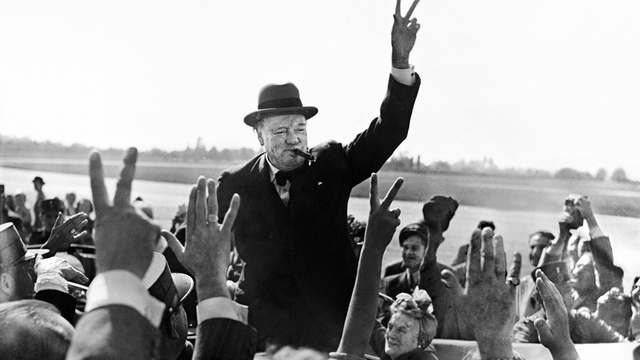
Richard Toye, the English historian and rhetoric expert, talks about the influence Winston Churchill’s speeches had at the time – and what kind of reaction they got.
Cross-posted from Tages-Anzeiger
How does the Brexit situation harp back to longings about the British Empire?
Certainly things seemed to have changed very abruptly, and I would put down a lot of what has happened to the pursuit of austerity policies since 2010, and the fact that people’s living standards have sort of frozen or gotten worse. That creates an opportunity for people to play out various sentiments. It’s probably worth saying that when people have these discourses about Britain becoming great again they may be talking in almost total ignorance of what happened at the time.
About the time during the war?
No, I’m trying to explain why opinion has changed in the last few years to become more sympathetic to Brexit and towards imperial nostalgia. It has to do with the policies of cutting public spending and public services that have taken place. Then the situation becomes ripe for people to exploit discontent by blaming immigrants. So you have the playing up of the glorious past. Continue reading “Some people got depressed by Churchill’s speeches”
Dockter on Thomas and Toye, ‘Arguing about Empire: Imperial Rhetoric in Britain and France, 1882-1956’
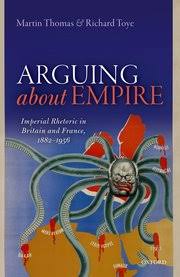 Authors: Martin Thomas, Richard Toye
Reviewer: Warren Dockter
Martin Thomas, Richard Toye. Arguing about Empire: Imperial Rhetoric in Britain and France, 1882-1956. Oxford: Oxford University Press, 2017. 320 pp. $55.00 (cloth), ISBN 978-0-19-874919-6.Reviewed by Warren Dockter (Aberystwyth University)
Published on H-Diplo (November, 2017)
Commissioned by Seth OffenbachPrintable Version: http://www.h-net.org/reviews/showpdf.php?id=49706“A Silent, Rankling Grudge”
Published on H-Diplo (November, 2017)
Commissioned by Seth OffenbachPrintable Version: http://www.h-net.org/reviews/showpdf.php?id=49706“A Silent, Rankling Grudge”
In the autumn issue of Nineteenth Century Review in 1877, W. E. Gladstone wrote an article on legacy of the British Empire and the Eastern Question entitled, “Aggression on Egypt and Freedom in the East.” In addition to supporting notions of self-rule in Egypt, Gladstone warned of the perils of imperial interventions, arguing, “My belief is that the day which witnesses our occupation of Egypt will bid a long farewell to all cordiality of political relations between France and England. There might be no immediate quarrel, no exterior manifestation, but a silent, rankling grudge” (p. 19). These words proved so prophetic that political radical Wilfred Scawen Blunt employed Gladstone’s rhetoric against him in his work The Secret History of the English Occupation of Egypt (1907), writing that “this article is so remarkable and so wonderfully prescient of evils he was himself destined to inflict upon Egypt that it deserves quoting” (p. 57). This exchange serves to illustrate the fluid nature of imperial rhetoric and the discursive relationship which formed between the British and French Empires.
Martin Thomas and Richard Toye have written a remarkably ambitious and excellent study which examines the intersections of imperial rhetoric between the French and British Empires during the late nineteenth and twentieth centuries. The book is based on seven case studies that focus on moments of imperial intervention in which both the French and Britain played an equal part, ranging from Tunisia and Egypt in the early 1880s through to Suez in 1956. This breadth allows the reader to see the evolution of imperial rhetoric in Britain and France while illustrating how policymakers in their respective metropoles became intrinsically linked, forcing them toward “co-imperialism.” This is particularly true regarding the Middle East and North Africa, where the British and French Empires remained in concert from nineteenth century until the realities of full-scale decolonization became apparent in latter half of the twentieth century. Continue reading “Dockter on Thomas and Toye, ‘Arguing about Empire: Imperial Rhetoric in Britain and France, 1882-1956’”
Crafting your PhD proposal: Routes to originality in historical research

Richard Toye
Director, Centre for Imperial & Global History
For anyone contemplating a research career in History, perhaps the most daunting thing is coming up with an original project. Whatever your period or area of interest is, there is likely a considerable body of scholarship on it already, and in some fields the volume will look simply enormous. How, then, can you work out what remains left to be done? Even more importantly, how can you craft a PhD proposal that promises to do more than simply “fill a gap”?
Director, Centre for Imperial & Global History
For anyone contemplating a research career in History, perhaps the most daunting thing is coming up with an original project. Whatever your period or area of interest is, there is likely a considerable body of scholarship on it already, and in some fields the volume will look simply enormous. How, then, can you work out what remains left to be done? Even more importantly, how can you craft a PhD proposal that promises to do more than simply “fill a gap”?
After all, if you aspire to become a professional historian you ultimately need to write a thesis that can plausibly be presented as a major academic intervention. You will have to sell what you do to hiring committees in that way. That sounds scary, especially if you have only recently completed your undergraduate degree and, perhaps, are faced with the challenge of your Master’s work at the same time as drawing up applications for PhD places and funding.
The good news is that your BA and MA work will already have given you many of the skills you need, notably the ability to search the web effectively and to skim read large amounts of material rapidly. Your dissertation work should also have helped you find out which aspects of your field are under-researched.
You should also take advice from potential supervisors. You mustn’t expect them to give you a PhD topic “off the peg”, but they can certainly give you guidance that can save you a lot of time. Talk to them in person and take note when something that you say seems to strike them as intriguing. Continue reading “Crafting your PhD proposal: Routes to originality in historical research”
CFP – The Munich Crisis and the People: International, Transnational and Comparative Perspectives
Call for Papers
The Munich Crisis and the People: International, Transnational and Comparative Perspectives
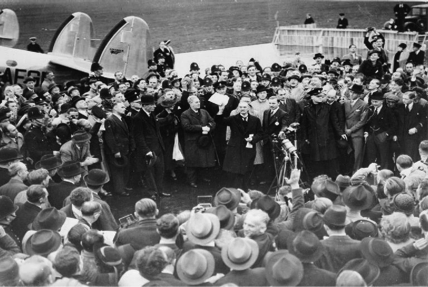
Humanities Research Institute (HRI), University of Sheffield, 29-30 June 2018
Recent events in international politics have highlighted the intricate interconnectedness between diplomatic crises and public opinion, notably public expressions of emotion. As the 80th anniversary of the Munich Crisis approaches, this conference will revisit this ‘model’ crisis and its aftermath, exploring both its lessons and its contemporary resonance. Few diplomatic incidents, before or since, have aroused such public excitement as the events of September 1938 and yet the ‘public’, the ‘people’, the ‘material’, and the ‘popular’ have hitherto been marginalised within a historiography that remains dominated by traditional ‘high’ politics perspectives, often reiterating the ‘Guilty Men’ orthodoxy. Recent incursions into the debate have made progress by experimenting with different methodologies, conceptual frameworks, and a greater plurality of sources, yet there has been a noticeable stagnation in original research. A re-evaluation is long overdue, and this conference will tap into the potential that rests in cross-disciplinary approaches and comparative frameworks. Indeed, the most neglected aspects of the crisis – despite the abundance of sources – are the social, cultural, material, and emotional, as well as public opinion. The conference will also internationalise the original ‘Munich moment’, as existing studies are overwhelmingly Anglo- and Western-centric. Continue reading “CFP – The Munich Crisis and the People: International, Transnational and Comparative Perspectives”
On the Trail of the Presidents
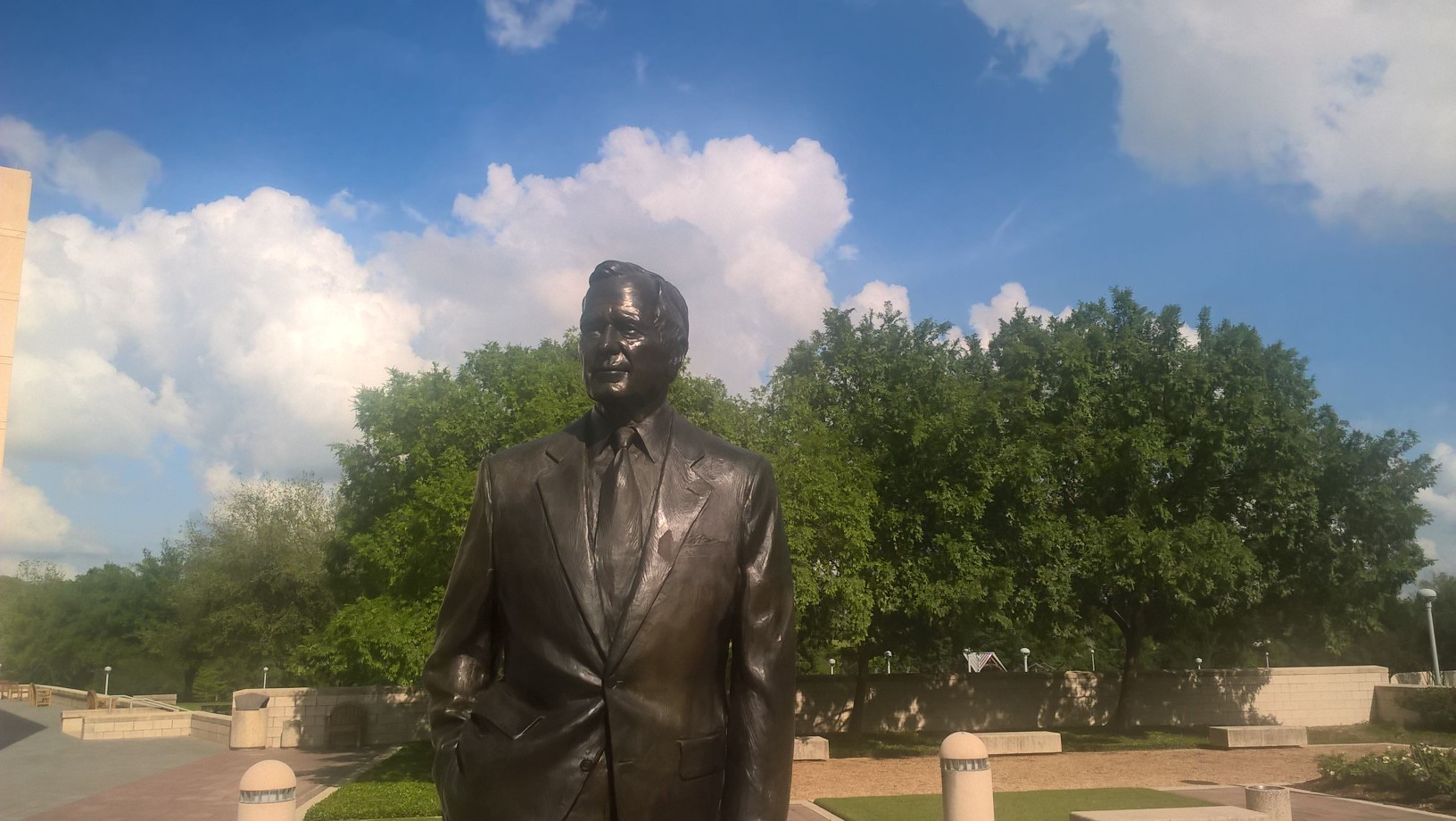
Richard Toye and Mark Wickham-Jones
One of the distinctive features of American politics in comparison to the UK is the establishment of Presidential Libraries and Museums. Franklin D. Roosevelt started the trend with the creation of a library at his home at Hyde Park, New York in the early 1940s. Since then, every president has had such an institution, administered by the National Archives and Records Administration, and one was created retrospectively for Herbert Hoover. Texas is particularly well-served, because it has three presidential libraries: those of Lyndon B. Johnson, George H.W. Bush, and George W. Bush.
This April we explored Texas’s presidential libraries and museums, looking at available archival material (relating especially to Anglo-American relations, and Space policy) and assessing the interpretation that each offers of the record of the president concerned. We started at Dallas, with George Bush Junior’s library, located at Southern Methodist University, then moved on to LBJ at the University of Austin, Texas, and are currently writing this blog in College Station, home to the library of Bush Senior. Continue reading “On the Trail of the Presidents”
Arguing about Empire: The Dreyfus Affair and the Fashoda Crisis, 1898

We are delighted to announce a new online collaboration with our colleagues in the Department of History at the University of Texas at Austin. Not Even Past and the Imperial & Global Forum will be cross-posting articles, sharing podcasts, and sponsoring discussions of historical publications and events. We are launching our joint initiative this month with a blog, cross-posted from Not Even Past, based on a new book by Exeter’s own Martin Thomas and Richard Toye, Arguing About Empire: Imperial Rhetoric in Britain and France.
Martin Thomas and Richard Toye
“At the present moment it is impossible to open a newspaper without finding an account of war, disturbance, the fear of war, diplomatic changes achieved or in prospect, in every quarter of the world,” noted an advertisement in The Times on May 20, 1898. “Under these circumstances it is absolutely essential for anyone who desires to follow the course of events to possess a thoroughly good atlas.” One of the selling points of the atlas in question – that published by The Times itself – was that it would allow its owner to follow “most minute details of the campaign on the Atbara, Fashoda, Uganda, the Italian-Abyssinian conflict &c.” The name Atbara would already have been quite familiar to readers, as the British had recently had a battle triumph there as part of the ongoing reconquest of the Sudan. Continue reading “Arguing about Empire: The Dreyfus Affair and the Fashoda Crisis, 1898”
France and Britain – colonial rivals, or co-imperialists?
Martin Thomas and Richard Toye
University of Exeter
‘The struggle of races and of peoples has from now on the whole globe as its theatre; each advances towards the conquest of unoccupied territories.’ Tempting as it might be to ascribe such inflated rhetoric to Friedrich Nietzsche or Adolf Hitler, its originator was Gabriel Charmes, a disciple of leading late nineteenth-century French republican, Léon Gambetta.
In September 1882, Charmes was trying to persuade his fellow parliamentarians that France’s recent seizure of Tunisia was ethically imperative. Similar rhetoric could be found across the political spectrum, in Britain as well as in France. In 1888, the Conservative Prime Minister Lord Salisbury described small imperial wars as ‘merely the surf that marks the edge of the advancing wave of civilisation’. But if Britain and France both claimed to be the spearhead of civilizing influences, what happened when their interests clashed, and what new arguments emerged to rationalize the struggle for power between rival ‘civilized’ nations?
That is one theme of our new book, Arguing About Empire, but in order to answer the question we need equally to ask what happened when Anglo-French interests appeared to coincide. How did the two countries’ respective elites justify their mutual collaboration in the face of challenges from other powers and, increasingly as time went on, from domestic anti-colonial critics and local nationalist opponents too? Continue reading “France and Britain – colonial rivals, or co-imperialists?”
Call for Applications – Beaming the British Empire: the Imperial Wireless Chain, c. 1900-1940: AHRC-funded Collaborative Doctoral Award
AHRC-funded Collaborative Doctoral Award with the University of Exeter and BT Archives
Beaming the British empire: the Imperial Wireless Chain, circa 1900-1940
Ref: 2583
About the award
Applications are invited for an AHRC-funded Collaborative Doctoral Award with the University of Exeter and BT Archives to research and study the origins, development and impact of the Imperial Wireless Chain, the global network of shortwave radio stations that reputedly played a critical role in British colonial integrity from the 1920s to the 1940s.
This project focuses on one of the most extraordinary milestones in the history of global telecommunications and represents an exciting opportunity for students with backgrounds in the history of science, technology, and modern British and imperial history. First conceived by Guglielmo Marconi in 1906 to use long-wave transmitters, the Imperial Wireless Chain (IWC) was postponed following a political scandal and the outbreak of the First World War. In the early 1920s, and at some financial risk, the Marconi Wireless Telegraph Company developed its innovative ‘beam’ short-wave system and this was eventually adopted by the British government for the IWC. The first pair of ‘beam’ stations opened in Britain and Canada in 1927 and within a few years similar stations followed in Australia, India, New Zealand, South Africa and South America. It soon became one of the most widely used forms of long distance communication in the British empire and posed such a threat to the ageing submarine cable business that had constituted the ‘nervous system’ of the British empire that the British government was eventually forced to amalgamate the newer and older forms of telegraphy into one of the largest telecommunication firms of the 1930s: Cable and Wireless. Despite its importance, the history of the Imperial Wireless Chain has not been the subjects of systematic scholarly study.
We’re Hiring! Lecturer in Global and Imperial History

The University of Exeter is a Russell Group university that combines world-class research with very high levels of student satisfaction. Exeter has over 21,000 students from more than 130 different countries and is in the top 1% of universities in the world with 98% of its research rated as being of international quality. Our research focuses on some of the most fundamental issues facing humankind today.
The post of Lecturer in Global and Imperial History will contribute to extending the research profile of History at Exeter, particularly in areas related or complementary to the transnational history of imperialism, globalization, and decolonization since 1750. This full time post is available from 1st September 2017 to 31st August 2020 in the College Humanities on a fixed term basis. Continue reading “We’re Hiring! Lecturer in Global and Imperial History”
 Imperial & Global Forum
You must be logged in to post a comment.