This course focuses on the growing interdisciplinary field of Linguistic Landscapes (LL), which traditionally analyses “language of public road signs, advertising billboards, street names, place names, commercial shop signs, and public signs on government buildings”, as they usually occur in urban spaces.
More recently, LL research has evolved beyond studying only verbal signs into the realm of semiotics, thus extending the analytical scope into the multimodal domain of images, sounds, drawings, movements, visuals, graffiti, tattoos, colours, smells as well as people.
Students will be informed about multiple aspects of modern LL research including an overview of different types of signs, their formal features as well as their functions.
Faculty Kurt Feyaerts, KU Leuven (Coordinator) Richard Toye, University of Exeter (Coordinator) Matteo Basso, Iuav University of Venice Bert Oben, KU Leuven Eliana Maestri, University of Exeter Michela Maguolo, Independent researcher Paul Sambre, KU Leuven
Guest lecturers Alberto Toso Fei, Director Urbs Scripta (tbc) Desi Marangon, Director Urbs Scripta
Who is it for? Applications are welcome from current final year Undergraduates (finalists, BA3), MA and MPhil/PhD Students in Linguistics, Sociology, Classical Studies, (Business) Communication Studies, History, Cultural Studies, Political Studies, Translation Studies or any other related discipline.
Faculty: Kurt Feyaerts, KU Leuven (Coordinator); Richard Toye, University of Exeter (Coordinator); Matteo Basso, Iuav University of Venice; Geert Brône, KU Leuven; Claire Holleran, University of Exeter; Eliana Maestri, University of Exeter; Michela Maguolo, Iuav, University of Venice; Paul Sambre, KU Leuven
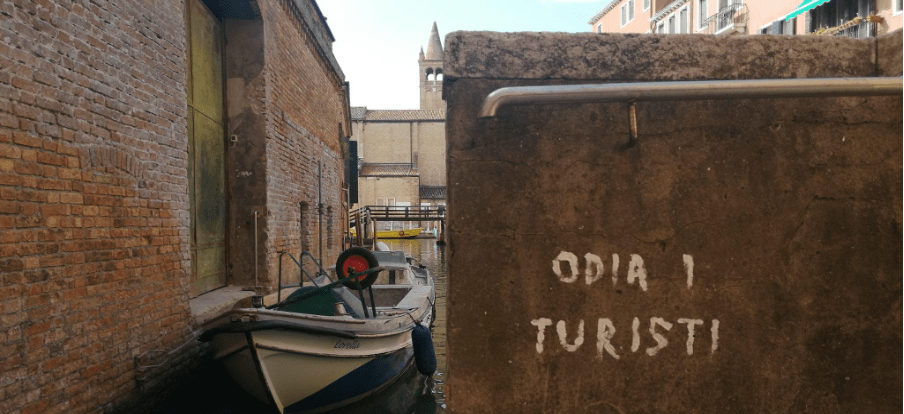
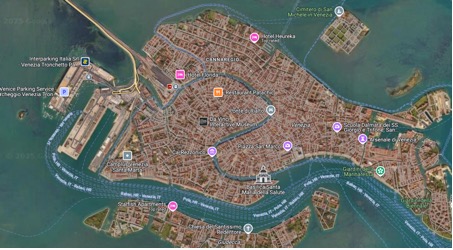
In Santa Marta, a quiet Venetian district, the city itself becomes a text: walls, streets, and public spaces speak through signs, graffiti, and infrastructures that reveal five interwoven themes: Anti-tourism, Transport & Mobility, Multilingualism & Symbolic Resistance, Government & Authority, and Prison as an Edge. From anti-tourism sentiments to the symbolic tensions of incarceration, our investigation examines how language, infrastructure, and public space interact to shape meaning and mobility. As shown in Figure 1, which provides a satellite view of Venice highlighting key landmarks and mobility nodes, our study is grounded in the spatial reality of the city. We begin by analysing local resistance to mass tourism, then move through the spatial logic of transport hubs like Piazzale Roma. We further consider multilingualism and graffiti as forms of symbolic resistance, explore the role of governance in shaping visibility and authority, and finally, interpret the Santa Maria Maggiore prison as both a physical and discursive edge.
Satellite view of Venice highlighting key landmarks and mobility nodes, including Santa Marta and Piazzale Roma. (Snapshot by Boam Olivia Boam, 3 July 2025)
Beatrice Gervasi, Katarzyna Jonkisz, Meng Hao, Sabeth Malfliet, and George Ellis
Students of ‘Linguistic Landscapes‘, Venice International University Summer School 2025
Faculty: Kurt Feyaerts, KU Leuven (Coordinator); Richard Toye, University of Exeter (Coordinator); Matteo Basso, Iuav University of Venice; Geert Brône, KU Leuven; Claire Holleran, University of Exeter; Eliana Maestri, University of Exeter; Michela Maguolo, Iuav, University of Venice; Paul Sambre, KU Leuven
Our case study of Venice for the ‘Linguistic landscapes: signs and symbols’ summer school was centred around the storied neighbourhood of Santa Maria Formosa. This area boasts a historic Basilica, the Fondazione Querini Stampalia library and a new art installation of 2 lions and 2 lionesses which is intended to promote public interaction with art and celebrate Venetian pride. In short, this area offers a lot culturally and historically. This is strongly evident when walking down the side streets. During our first excursion, our group got the immediate sense that this was a residential area that had developed a strong tourist population due to its historical significance and geographic location (en route to the Rialta bridge).
We were fortunate in the sense that this region of Venice was not a particularly large one, being measured at 0.0072km^2. However, this did not mean that our investigations were without challenge. The geography of this area (a seeming thoroughfare for tourist populations) led to difficulties in photo collation. This combined with the high-content-per-area (a total of 73 relevant primary photos) and the labyrinthine streets led to our group having an abundance of data and difficulties delimiting our data set and research question. To overcome this, we adopted a thematic approach which split our data set into three relevant points for discussion: action flows, multilingualism and polyfunctionality. We then used relevant semiotic and anthropological studies (for example Landry and Bourhis 1997, Scollon and Scollon, 2003) to dissect the data set and apply a linguistic landscapes lens with the end goal of finding out whether Santa Maria Formosa is a healthily functioning neighbourhood or another victim of the increasing globalization faced all over the western world.
Hualing Zhai[1], Quinten Heymans[2], Bartolomeo Perazzoli[3], Sophie Paynter[4], Alice Wadsworth[5]
Students of ‘Linguistic Landscapes‘, Venice International University Summer School 2025
Faculty: Kurt Feyaerts, KU Leuven (Coordinator); Richard Toye, University of Exeter (Coordinator); Matteo Basso, Iuav University of Venice; Geert Brône, KU Leuven; Claire Holleran, University of Exeter; Eliana Maestri, University of Exeter; Michela Maguolo, Iuav, University of Venice; Paul Sambre, KU Leuven
Introducing San Francesco della Vigna
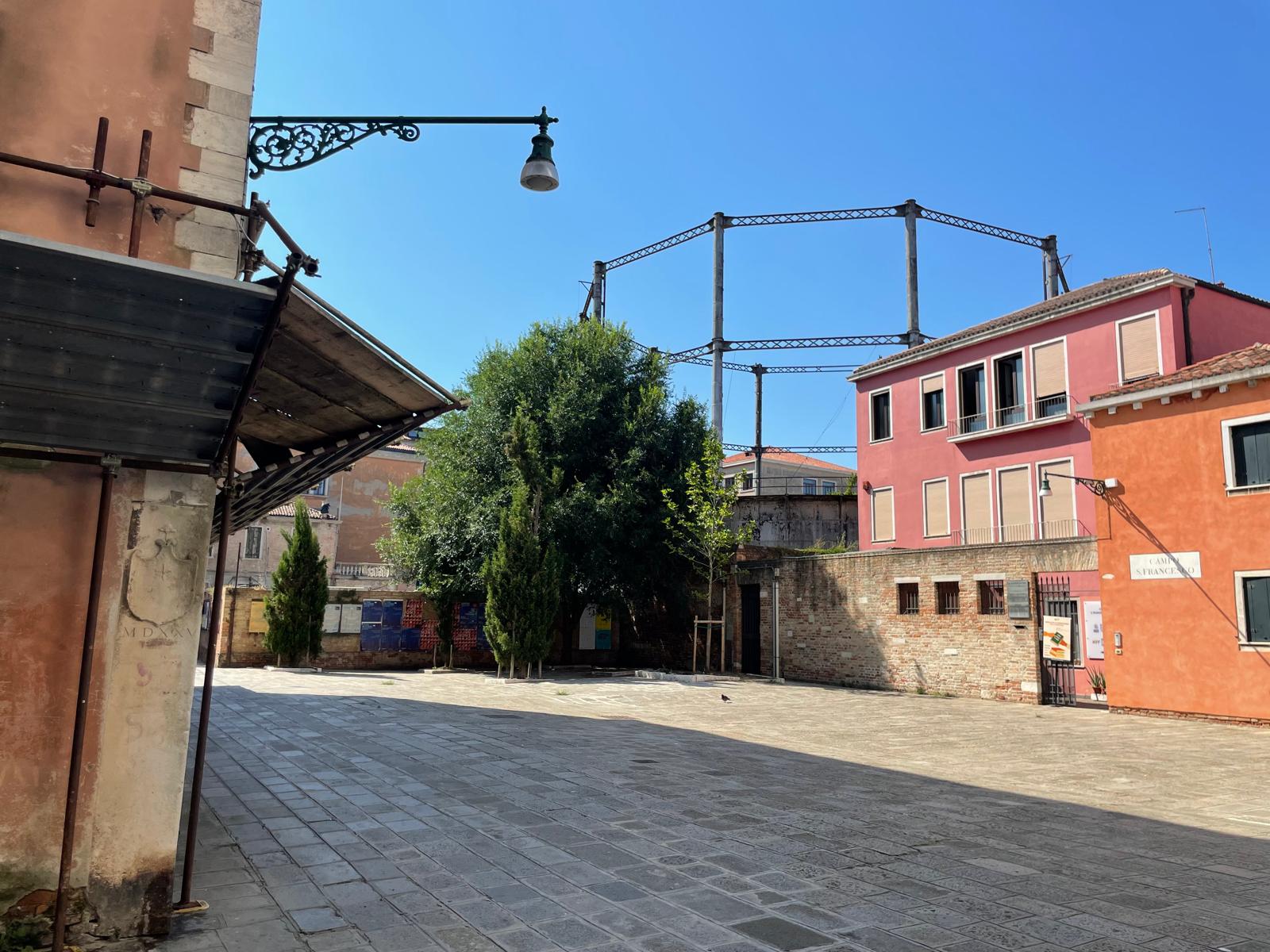
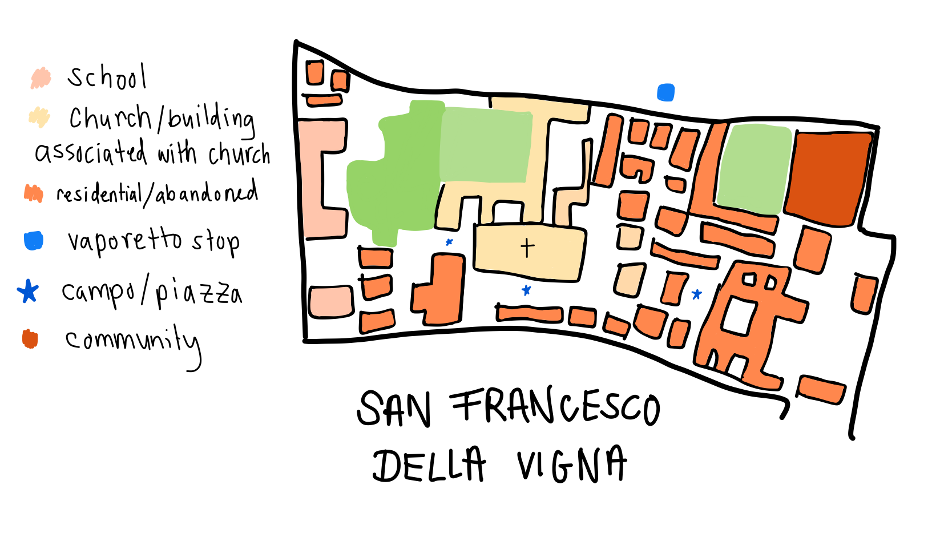
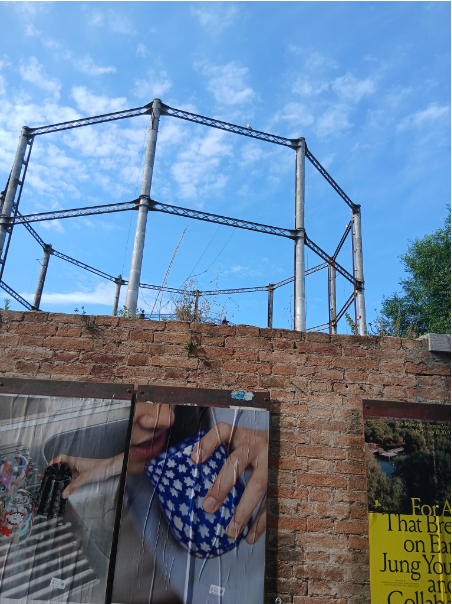
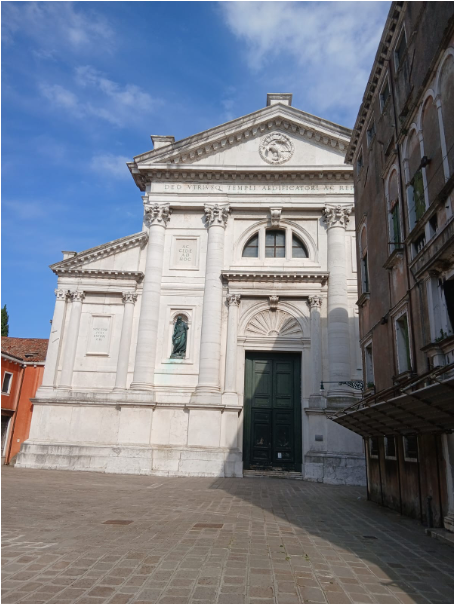
San Francesco della Vigna (later also SFdV), located on the northeastern edge of Venice, presents a sharp contrast to the city’s typical romantic image. The area may feel, in some ways, stuck in time, with the campo (the Venetian equivalent of a piazza) overlooked by a large gasholder (image 3) on one side, and the beautiful if somewhat imperious 16th-century church of San Francesco della Vigna (image 4). Our group, as part of the 2025 VIU Linguistic Landscapes summer school, explored this working-class neighbourhood focusing on the themes of presence and absence. At first, the area seems quiet and almost forgotten, with few signs of life such as shops, cafés, or passersby. However, through exploring the linguistic and semiotic landscapes and the soundscape of the area, we found a quietly strong local identity to be bubbling away beneath the seemingly barren surface.
Map of San Francesco della Vigna (Alice Wadsworth)
Campo San Francesco
Church of San Francesco della Vigna
We were lucky enough to explore every inch of the isola, and the walls were deep in conversation with the neighbourhood and with each other. So perhaps this work, and any work of mapping out a linguistic landscape, can be considered a kind of ethical ‘eavesdropping’. We observed- and listened- from outside but we were also able to conduct a few interviews as part of our research. Interviews with residents highlighted ongoing gentrification and local feelings of resistance. One construction worker noted that scaffolding usually indicates Airbnb renovations, reflecting economic and demographic changes.
This course focuses on the growing interdisciplinary field of Linguistic Landscapes (LL), which traditionally analyses “language of public road signs, advertising billboards, street names, place names, commercial shop signs, and public signs on government buildings”, as they usually occur in urban spaces.
More recently, LL research has evolved beyond studying only verbal signs into the realm of semiotics, thus extending the analytical scope into the multimodal domain of images, sounds, drawings, movements, visuals, graffiti, tattoos, colours, smells as well as people.
Students will be informed about multiple aspects of modern LL research including an overview of different types of signs, their formal features as well as their functions.
Faculty
Kurt Feyaerts, KU Leuven (Coordinator) Richard Toye, University of Exeter (Coordinator) Matteo Basso, Iuav University of Venice Geert Brône, KU Leuven Claire Holleran, University of Exeter Eliana Maestri, University of Exeter Michela Maguolo, Independent researcher Luca Pes, Venice International University Paul Sambre, KU Leuven
Katie Baker, Emily Cooper, Gabriel Labrie, Nicla Pennacchio, and Esther Roza
Faculty: Kurt Feyaerts, KU Leuven; Richard Toye, University of Exeter; Matteo Basso, Iuav University of Venice; Geert Brône, KU Leuven; Claire Holleran, University of Exeter; Eliana Maestri, University of Exeter; Michela Maguolo, Independent researcher; Luca Pes, Venice International University; Paul Sambre, KU Leuven
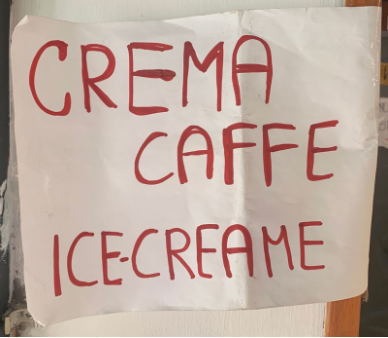
While exploring the area around the Frari, we noticed the following sign in front of a bar:
What does this divergent text tell us about the potential audience? What do the spelling mistakes tell us about the owner or the creator? (cf. Spolsky Handwrittenbottom-up sign with divergent text 2008, 31). in Italian and English (Calle de le Chiovere)
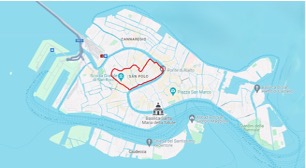
The boundary of the sestiere of San Polo, highlighted.
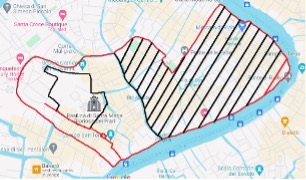
The questions raised by this image piqued our curiosity about multilingual signage. Therefore, we decided to focus on signs containing more than one language (cf. Backhaus 2005 on Tokyo and Moser 2020 on Luxembourg City). Due to time constraints, the shaded area of the sestiere was omitted for this analysis, thus limiting our evaluation to the streetsimmediately surrounding the Santa
A larger version of the previous map with all insulaeapart from Frari and Nomboli shaded, and the routes around the basilica and the Vaporetto stop are highlighted.
Maria Gloriosa dei Frari Basilica,which permeates the insulae of Frari and Nomboli. We also examined the shortest path from the Basilica to its closest vaporetto stop, San Tomà, as this is a common route taken by ourselves and other tourists (cf. Lynch 1960, 46−49).
Furthermore, only signs of the A4 format or larger were included. The size and language criteria allowed for systematic, thorough data collection in the defined area. Our final corpus accounts for 105 signs.
Faculty: Kurt Feyaerts, KU Leuven; Richard Toye, University of Exeter; Matteo Basso, Iuav University of Venice; Geert Brône, KU Leuven; Claire Holleran, University of Exeter; Eliana Maestri, University of Exeter; Michela Maguolo, Independent researcher; Luca Pes, Venice International University; Paul Sambre, KU Leuven
In this blog, we present our exploratory study of the linguistic landscape of the neighbourhood surrounding the Chiesa dei Santi Apostoli di Cristo in Venice. By the term linguistic landscape, we refer to “the visibility and salience of languages on public and commercial signs in a given territory or region”, as defined by Landry and Bourhis (1997). The fieldwork was carried out in the context of the VIU Summer School ‘Linguistic Landscapes: Using Signs and Symbols to Translate Cities’ that took place from June 24 until June 28, 2024. Our survey of the area focused on how bottom-up street communications (meaning those not put up by the city and its officials) differ between residential areas, more frequently utilised by locals, and busy thoroughfares frequented by large amounts of tourists.
By Ikuo Harimoto, Marian Gabani Gimenez, Dongfang Liu, Javiera Scarratt, and Alexander Van Herpe
Faculty: Kurt Feyaerts, KU Leuven; Richard Toye, University of Exeter; Matteo Basso, Iuav University of Venice; Geert Brône, KU Leuven; Claire Holleran, University of Exeter; Eliana Maestri, University of Exeter; Michela Maguolo, Independent researcher; Luca Pes, Venice International University; Paul Sambre, KU Leuven
When we were assigned the Basilica dei Santi Giovanni e Paolo, in the neighborhood of Castello, as the central point of our fieldwork for the 2024 “Linguistic Landscapes” Summer Course at Venice International University, we had to decide on the criteria to delimit the area we would be exploring. Based on Kevin Lynch’s (1960) typology of the contents of the city image, i.e. referable physical forms that people recognize and rely on in their wanderings through the urban space, we reflected on the various possible maps that Venice offered. As pointed out by Lynch, the image of the same physical reality shifts according to the circumstances of viewing, and Venice is the locus where numerous circumstances coexist: for instance, the canals seem to work as an edge for earth-bound wanderers, but a path for water-bound locals. In this reflection, we realized that water could be seen as this ambiguous–or fruitful–element according to which the “circumstances of viewing” shift profoundly. We opted, thus, to define the canals as the limit for our explorations.
Venice is formed by several small islands, connected by canals, lagoons, and waterways. One could argue that this is what makes Venice distinctively attractive to people all over the world. Such geographical features, coupled with its unique history, foreground a particular identity, expressed in signs, art, images, and structures across the city. On the flip side, Venice’s geography and history also bring their own issues: over-tourism, rise in water levels, and sinking foundations. This tension is what intrigued us and guided this project. Starting from the Basilica dei Santi Giovanni e Paolo, a 14th-century church of Gothic architecture, we wandered through the paths and followed the margins of the canals seeking structures, signs, and images that referred to water, however loose the reference might be. Our goal was to understand if and how water informed and still informs the architectural, semiotic, and linguistic landscape of Venice.
We divided the results of our research into three topics: the uses of water (utility), protection from water-related events (defense), and water as a cultural element. The first topic explores the structures in place to make use of water in Venice and how they differ depending on who is making use of it. The second topic investigates the remnants and the new strategies to defend the land from water-related events and disasters. In the third and last topic, we argue that water is also present as a symbol in the cultural landscape of Venice.
The Summer School Linguistic Landscapes: Using Signs and Symbols to Translate Cities aims at equipping participants with a comprehensive understanding of modern Linguistic Landscapes (LL) research. This course focuses on the growing interdisciplinary field of LL, which traditionally analyses “language of public road signs, advertising billboards, street names, place names, commercial shop signs, and public signs on government buildings”, as they usually occur in urban spaces. More recently, LL research has evolved beyond studying only verbal signs into the realm of semiotics, thus extending the analytical scope into the multimodal domain of images, sounds, drawings, movements, visuals, graffiti, tattoos, colours, smells as well as people. Students will be informed about multiple aspects of modern LL research including an overview of different types of signs, their formal features as well as their functions.
Suitable for: current final year Undergraduates (finalists, BA3), MA and MPhil/PhD Students in Linguistics, Sociology, Classical Studies, (Business) Communication Studies, History, Cultural Studies, Political Studies, Translation Studies or any other related discipline.
Call for applications: December 1, 2023 – March 5, 2024 via the VIU website
This course focuses on the growing interdisciplinary field of Linguistic Landscapes (LL), which traditionally analyses “language of public road signs, advertising billboards, street names, place names, commercial shop signs, and public signs on government buildings”, as they usually occur in urban spaces.
More recently, LL research has evolved beyond studying only verbal signs into the realm of semiotics, thus extending the analytical scope into the multimodal domain of images, sounds, drawings, movements, visuals, graffiti, tattoos, colours, smells as well as people.
Students will be informed about multiple aspects of modern LL research including an overview of different types of signs, their formal features as well as their functions.
Last week I was in the very privileged position of attending the PhD Academy at Venice International University. The week long course promised to improve research practice and transversal skills for young scholars, but in reality it offered far more than that. Nineteen PhD researchers from sixteen nations, based in Europe, Asia, Africa, and the Americas and representing the widest possible range of research topics, alongside faculty staff from Italy, Belgium, and Slovenia, came together to both learn from each other and share experiences and ideas. It was a true example of international collaboration between well-established scholars and those just setting out on their research journeys. For me, it was incredible to be at an academic event and be the only representative from the United Kingdom. As such, it allowed me to gain a wide range of valuable insights, alongside getting to know a group of people who are all either leaders in their field, or with the potential to be so in the future. All this, in one of the most beautiful settings in the world (and one which offers many research questions of its own), Venice.
The Grand Canal looking towards the Chiesa della Salute from the Accademia Bridge.
Venice International University is a collaboration between nineteen universities from all over the world. It offers summer schools (such as the one I attended in June on Linguistic Landscapes), the PhD Academy, and opportunities for undergraduates to spend a semester at the university on the island of San Servolo, located between the historic centre of Venice and the Lido. As such, the university is a true example of both interdisciplinarity and international collaboration.
Call for applications: December 1, 2022 – February 28, 2023 via the VIU website
This course focuses on the growing interdisciplinary field of Linguistic Landscapes (LL), which traditionally analyses “language of public road signs, advertising billboards, street names, place names, commercial shop signs, and public signs on government buildings”, usually as they occur in urban spaces. More recently, LL research has evolved beyond studying only verbal signs into the realm of semiotics, thus extending the analytical scope into the multimodal domain of images, sounds, drawings, movements, visuals, graffiti, tattoos, colours, smells as well as people.
Students will be informed about multiple aspects of modern LL research including an overview of different types of signs, their formal features as well as their functions.
Faculty Kurt Feyaerts, KU Leuven Claire Holleran, University of Exeter Eliana Maestri, University of Exeter Michela Maguolo, Iuav University of Venice Luca Pes, Venice International University Paul Sambre, KU Leuven Richard Toye, University of Exeter



 Imperial & Global Forum
You must be logged in to post a comment.