The Victorian Origins of Will and Kate’s Visit to India

The Duke and Duchess of Cambridge at India Gate, a memorial to Indian service in the First World War, its foundation stone laid by the Duke of Connaught in 1921 Credit: @PARoyal
The Duke and Duchess of Cambridge at India Gate, a memorial to Indian service in the First World War, its foundation stone laid by the Duke of Connaught in 1921. Credit: @PARoyal

Charles V. Reed
Elizabeth City State University
Editor, H-Empire

As the Duke and Duchess of Cambridge visit south Asia this week, doing the sorts of things that royals are expected to do whilst abroad in the former empire – attend fancy social events, commemorate, inaugurate, and patronize, play cricket, and so on – the celebrity-obsessed global media has enthusiastically followed their every move. An even cursory glance at the tweets tagged #RoyalVisitIndia reveals the performative and visual character of the royal tour – so essential to its purpose since the first visits of the nineteenth century. William and Kate’s touring ancestors would find much familiar in their itineraries, the ceremony, the responses. It’s a quite odd thing, when we think about it, considering nearly seventy years of Indian independence from British rule. Of course, the present Queen’s dedication to the Commonwealth and maintaining the monarchy’s role in the former empire — as chronicled in Philip Murphy’s Monarchy and the End of Empire — explains much of it. But the Victorian history of the royal tour is of equal significance. Continue reading “The Victorian Origins of Will and Kate’s Visit to India”

Apply by April 17 for an International PhD Student Award @ExeterCIGH

exeter logo

The deadline (April 17) is fast approaching to apply for an international PhD student award, through which you can become a crucial part of the Centre for Imperial and Global History.

We offer internationally-recognised supervision with geographical coverage from staff across African, Asian (including Chinese), Middle Eastern, North American, Latin American, European, Imperial, and Global history from early-modern to contemporary eras. We have strong inter-disciplinary links with colleagues across the humanities and social sciences at Exeter, particularly with the Centre for War, State and Society and the Institute of Arab and Islamic Studies. The Centre has particular research interests in:

  • Globalisation’s past and present
  • Comparative empires and transnationalism
  • Humanitarianism, development and human rights
  • Law and colonialism
  • Political economy and the imperial state
  • Europe, decolonisation and the legacies of empire
  • The impact of armed conflict on society
  • Colonial warfare and counterinsurgency

Continue reading “Apply by April 17 for an International PhD Student Award @ExeterCIGH”

This Week’s Top Picks in Imperial & Global History

Senegal festival 1966

Marc-William Palen
History Department, University of Exeter
Follow on Twitter @MWPalen

From 21st-century death merchants to the Cold War’s ‘black world’, here are this weeks top picks in imperial and global history.

Continue reading “This Week’s Top Picks in Imperial & Global History”

This Week’s Top Picks in Imperial & Global History

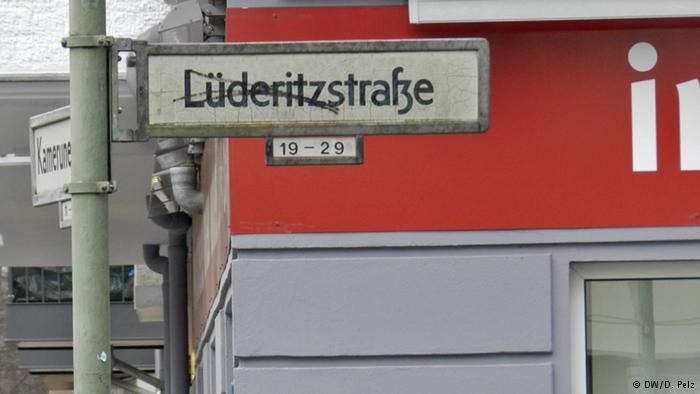
street sign 1

Marc-William Palen
History Department, University of Exeter
Follow on Twitter @MWPalen

From the forgotten women behind the British Black Panthers to Berlin’s battle over colonial-era street names, here are this week’s top picks in imperial and global history. Continue reading “This Week’s Top Picks in Imperial & Global History”

India’s War: World War II and the Making of Modern South Asia

india's war

Nigel Collett
Cross-posted from Asian Review of Books

On 6 November 2002, the Queen inaugurated the Commonwealth Memorial Gates and Memorial Pavilion at the Hyde Park Corner end of London’s Constitution Hill. The Gates are inscribed “In memory of the five million volunteers from the Indian sub-continent, Africa and the Caribbean who fought with Britain in the two World Wars” and the Pavilion’s ceiling is inscribed with the names of the seventy-four of those volunteers who won the George and Victoria Crosses. It had thus taken the British fifty-seven years to publicly recognize that without the men and women of the British Empire, Britain would not have survived the World Wars.

This seems now an extraordinary and unforgivable lapse, but the denial it manifests had begun to emerge even as even as the second of the two wars in question was still being fought. Bill Slim’s 14th Army, which defeated the Japanese in Burma in 1944 and 1945 and was about two-thirds Indian in composition, ruefully called itself “The Forgotten Army”, and at the time there was more than a little truth in that. In Allied strategy, in the supply of manpower and materiel, even in the newsreels shown at home of the fighting around the world, the theaters of war around the Indian sub-continent always took third place to the campaigns in Europe and the Pacific.

This comparative neglect was followed at the War’s end, and particularly as the Empire then ebbed, by a public and academic amnesia that relegated India’s massive contribution to the War to the memoirs of soldiers who had fought on its borders. As the Empire increasingly grew to be a subject of denigration, India’s contribution to both Wars became unfairly tainted by imperialism and was largely forgotten. Continue reading “India’s War: World War II and the Making of Modern South Asia”

This Week’s Top Picks in Imperial & Global History

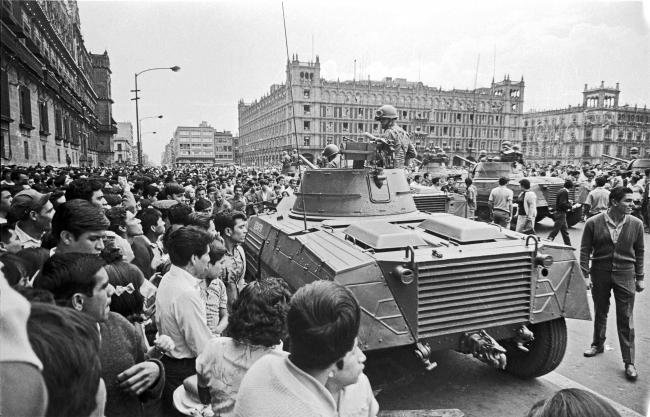
An encounter between the Mexican army and student protesters in the summer of 1968 in Mexico City's Zócalo (Wikimedia Commons)
An encounter between the Mexican army and student protesters in the summer of 1968 in Mexico City’s Zócalo (Wikimedia Commons)

Marc-William Palen
History Department, University of Exeter
Follow on Twitter @MWPalen

From Mexico’s Cold War on drugs to the imperial, racist origins of Nixon’s war on drugs, here are this week’s top picks in imperial and global history. Continue reading “This Week’s Top Picks in Imperial & Global History”

Are Trade Wars a Historical Myth?

Embargo Canada US

Marc-William Palen
History Department, University of Exeter
Follow on Twitter @MWPalen

This article was originally published on The Conversation. Read the original article.

Republican presidential hopeful Donald Trump’s protectionist prescriptions have led to renewed speculation about whether trade wars are on the horizon.

In other words, if, under a Trump presidency, the United States were to raise its tariffs against some of its biggest trading partners – China, Japan, Mexico – would those countries retaliate in kind? And what would this mean for the global economy?

I hadn’t planned on weighing in on the discussion. That is, not until I came across this brazen assertion by Ian Fletcher – former senior economist of the grassroots Coalition for a Prosperous America – in the Huffington Post:

Trade wars are mythical. They simply do not happen. If you google “the trade war of,” you won’t find any historical examples… History is devoid of them.

Based on his Google test, Fletcher precipitously concludes that trade wars are a myth, a bogeyman concocted by free traders.

I was intrigued by his claims, and, to put it mildly, more than a little skeptical.

As any historical sleuth might do in this situation, I decided to check the sources. I googled “trade war of” and the results were anything but empty.

As a historian of trade, however, I thought it might be even more persuasive to look further into some illuminating examples of trade wars in modern history. Continue reading “Are Trade Wars a Historical Myth?”

Free Course: ‘Empire – the Controversies of British Imperialism’

MOOC pic

Exeter’s Centre for Imperial and Global History is once again launching its free online course, which starts this week.

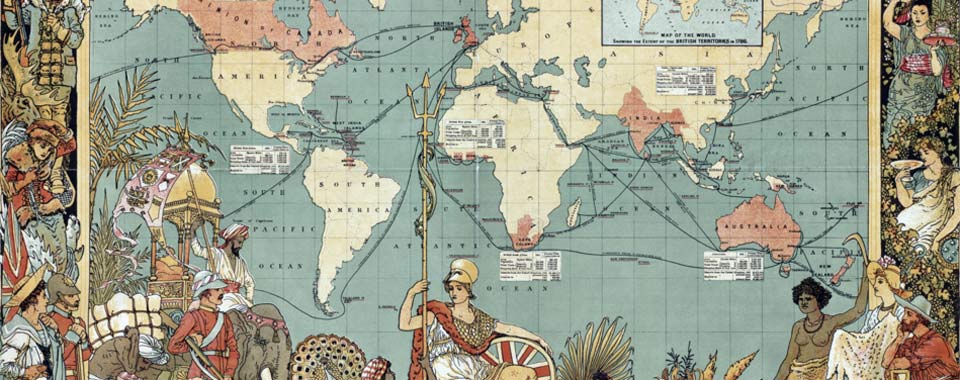
The British Empire was the largest empire ever seen. It ruled over a quarter of the world’s population and paved the way for today’s global economy. But British imperialism isn’t without controversy, and it continues to cause enormous disagreement among historians today. This free online course will help you understand why.

Over six weeks, we’ll explore the British Empire through six themes – money, violence, race, religion, gender and sex, and propaganda. You’ll get to hear the stories of the fascinating individuals who contributed to both its rise and fall. Continue reading “Free Course: ‘Empire – the Controversies of British Imperialism’”

This Week’s Top Picks in Imperial & Global History

The cover art for Sue in Tibet shows a smiling girl, poised for adventure
The cover art for Sue in Tibet shows a smiling girl, poised for adventure, William Arthur Smith.

Marc-William Palen
History Department, University of Exeter
Follow on Twitter @MWPalen

From rediscovering Tibetan children’s novels to Stalin’s growing popularity, here are this week’s top picks in imperial and global history. Continue reading “This Week’s Top Picks in Imperial & Global History”

Planning for the Referendum and After: Lessons from 1975

1975 referendum

David Thackeray
University of Exeter

Cross-posted from History & Policy

Forty-one years ago this month, James Callaghan finalised the renegotiation of Britain’s EEC membership at a Dublin meeting of the European Council. At the subsequent referendum the results were emphatic. The UK voted ‘yes’ to remaining in the EEC, the forerunner of today’s EU, by a two to one margin. Now with the EU referendum date set, this article considers the key differences between the 1975 and 2016 votes and the lessons of the 1975 renegotiation for policy-makers planning for the vote and its aftermath. Continue reading “Planning for the Referendum and After: Lessons from 1975”

Graveyard of Empires? Writing the Global History of Development in Cold War Afghanistan

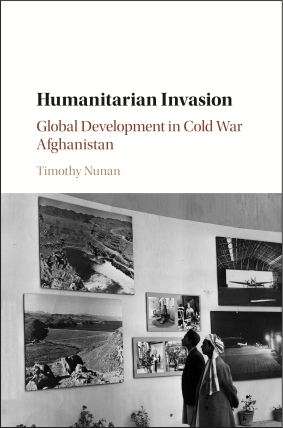
Nunan, Humanitarian Invasion (Book Cover)

Timothy Nunan
Harvard Academy for International and Area Studies
Follow on Twitter @timothynunan

How did Afghanistan in 2016 end up, yet again, as the graveyard of empires? Not only do Taliban franchises control much of the countryside outside of Kabul, but the start-up Islamic State battles them for influence. Tens of billion of dollars of aid have gone missing. Many Afghans are voting with their feet, forming one of the largest refugee diasporas in the world (a title they held until the Syrian Civil War).

Yet as my recent book, Humanitarian Invasion: Global Development in Cold War Afghanistan (Cambridge: Cambridge University Press, 2016) shows, tortured attempts to develop Afghanistan have a long history. Sure, events like the First Anglo-Afghan War (1839-1842) have left a deep imprint on how outsiders view the place. But for much of the twentieth century, neutral Afghanistan wasn’t at war with any of the superpowers. And when the Soviets went into Afghanistan, they did not annex it into some “Soviet empire.” The Democratic Republic of Afghanistan was a dues-paying member of the U.N. General Assembly, and Kabul played host to international conferences touting the regime’s solidarity with the Third World. Continue reading “Graveyard of Empires? Writing the Global History of Development in Cold War Afghanistan”

This Week’s Top Picks in Imperial & Global History

Ibrahim Rauza
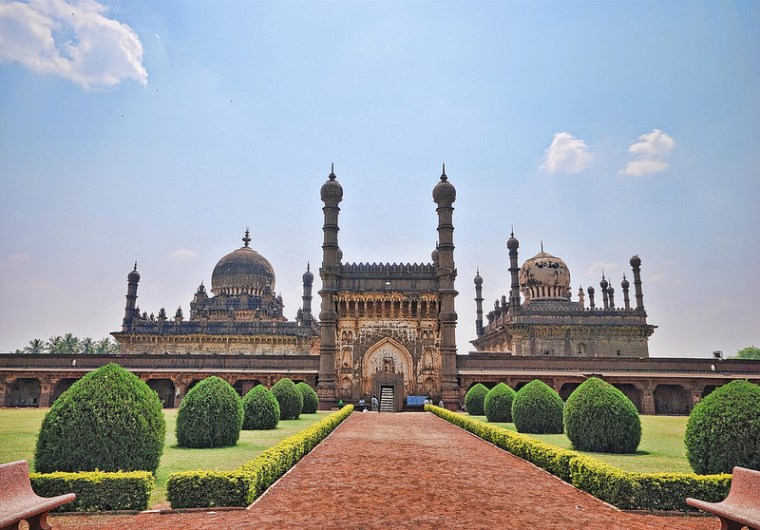
The Ibrahim Rauza complex, built by Ibrahim Adil Shah II (1580-1627). Photograph: Mukul Banerjee.

Marc-William Palen
History Department, University of Exeter
Follow on Twitter @MWPalen

From what is global history to uncovering illegal documents of the slave trade, here are this week’s top picks in imperial and global history. Continue reading “This Week’s Top Picks in Imperial & Global History”

Imagining Markets 3rd Workshop – Cambridge, 7 April

Cross-posted from Imagining Markets

Below are the details of the 3rd workshop of the Imagining Markets network. The network brings together scholars working in the fields of Imperial, European, and Asian studies, and scholars from cultural studies and economic studies, which have become increasingly separated branches of enquiry calling for reintegration. Working with and through a range of public policy intermediaries including History and Policy, the Churchill Archives Centre, and the Institute of Commonwealth Studies this project will provide policy-makers with an inter-disciplinary analysis of the long-term development of British overseas trade, which in turn will illuminate the diversity of cultural values and political perspectives that have, and continue to be, brought to bear in growing exports to key markets. There are still a handful of places available. If you wish to attend, please email Dr. David Thackeray. Continue reading “Imagining Markets 3rd Workshop – Cambridge, 7 April”

The Historians’ Group of the Communist Party – Ten Years that Reshaped History

In late 1946 a group of historians, friends and members of the Communist Party started regularly meeting in Marx’s House in London, picture here.
In late 1946 the Historians’ Group – made up of historians, friends, and members of the Communist Party – started regularly meeting in Marx’s House in London, pictured here.

Gil Shohat
Humboldt University Berlin

In today’s history cosmos, terms such as ‘History from Below’, ‘People’s History’ and ‘Social History’ belong to the essential canon of most academics and students. Thus, it is important to remember how these terms found their way into historiography before they were considered legitimate. Members of the Communist Party Historians’ Group in the UK laid the cornerstone for a new paradigm in historiography, today largely referred to as Social History, in the late 1940s and early 1950s. But exactly how did these historians perceive their own role as academic insurgents in the heart of ‘Whig history’ and what were the problems facing them as historians and members of the Communist Party of Great Britain (CPGB)? Continue reading “The Historians’ Group of the Communist Party – Ten Years that Reshaped History”

This Week’s Top Picks in Imperial & Global History

Lisbon 1975 2
Street scene, Lisbon 1975. Photo: Mieremet, Rob / Anefo, National Archives of the Netherlands / Anefo, licence CC-BY

Marc-William Palen
History Department, University of Exeter
Follow on Twitter @MWPalen

From 1970s colonialism in Lisbon to saving digital archives, here are this week’s top picks in imperial and global history.

Continue reading “This Week’s Top Picks in Imperial & Global History”