Feminism’s Forgotten Free-Trade Past

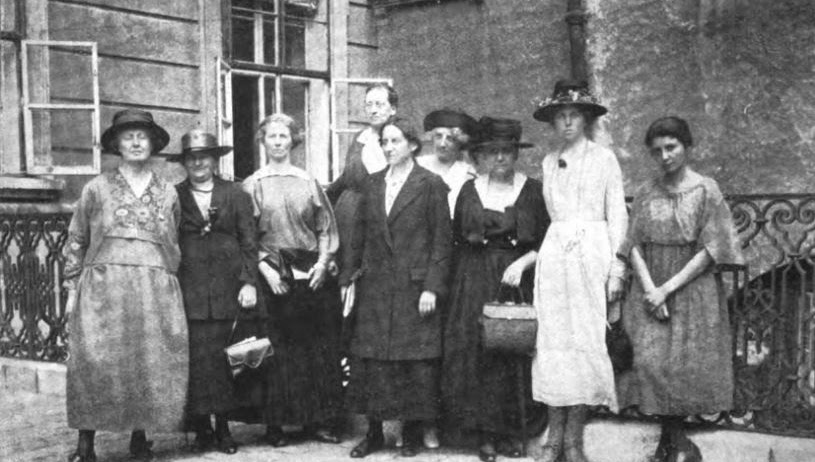
1921 WILPF Executive Committee: Front row, left to right: Cornelia Ramnodt-Hirschmann, Gabrielle Duchêne, Lida Gustava Heymann, Yella Hertzka, Jane Addams, Catherine Marshall, Gertrude Baer. Back row, left to right: Emily Greene Balch and Thora Daugaard. WikiCommons, https://en.m.wikipedia.org/wiki/File:1921_WILPF_Executive_Committee.jpg

Marc-William Palen
History Department, University of Exeter

Cross-posted from History Matters

A fragmenting world of trade wars. Food insecurity despite an abundance of food. European food wars. A broken Brexit Britain undermining European unity. The resurgence of right-wing nationalism. Human rights under attack. Children starving from wartime blockades.

The world disorder of 2024 would have looked all too familiar to the international women’s peace movement of a century ago.

Feminists back then tended to see themselves as the mothers of the world, believing that women’s active participation in politics would curb or counter men’s militant predilection for nationalism and war. ‘First wave’ feminist internationalists numbered among the leaders of the early-20th-century fight for world peace, what Harriet Alonso has described as “the suffragist wing” of the international peace movement from the First World War onwards.

Free trade was a key – but oft-overlooked – ingredient to their feminist vision for a peaceful world. Chicago social reformer Jane Addams, the figurehead of the international women’s peace movement, emphasized this free-trade dimension throughout the 1920s and 1930s.

Jane Addams made landfall in Europe in early July 1919 to bear witness to the destructive aftermath of the First World War. Addams’s main concern was the famine afflicting millions of Europe’s children.

Addams’s 1919 trek marked the beginning of what would become a multi-year European humanitarian mission of a new left-leaning feminist organization: the Women’s International League for Peace and Freedom (WILPF), which remains active today. Addams was WILPF’s inaugural president.

Addams had her first of many encounters with Europe’s malnourished children during a stopover in Lille in northern France. There, inside a schoolhouse, Addams looked on as a physician examined them by the hundreds. ‘Stripped to the waist’, the children looked more like ‘a line of moving skeletons; their little shoulder blades stuck straight out, the vertebrae were all perfectly distinct as were their ribs, and their bony arms hung limply at their sides.’

Adding to the macabre scene, an eerie quiet hung over the improvised emergency room. You see, the French physician on duty had lost his voice, a side effect of wartime shellshock. He therefore ‘whispered his instructions to the children as he applied his stethoscope and the children, thinking it was some sort of game, all whispered back to him.

Addams encountered similarly graphic scenes in Switzerland and throughout Germany. The 1919 WILPF mission’s findings reinforced her belief that, while the war may have ended, securing the peace had just begun.

Addams therefore headed a follow-up WILPF humanitarian mission amid the hot summer of 1921, this time to southeastern Europe, where she once again encountered mass hunger. ‘Food resources which were produced in Europe itself and should have been available for instant use,’ Addams wrote, ‘were prevented from satisfying the desperate human needs. Why? Because ‘a covert war was being carried on by the use of import duties and protective tariffs’, which the war’s food blockades had legitimized.

These small starving European states, seeking self-preservation, mistakenly ‘imitated the great Allies with their protectionist policies, with their colonial monopolies and preferences.’ To Addams, such suffering in the name of ‘hypernationalism’ only amplified the need for a new international system of ‘free labor and exchange’ The world faced a clear choice: either ‘freedom of international commerce or international conflict of increasing severity.’

To meet world food demands, her envisaged free-trade order would also require supranational regulation of global transportation lines to counter ‘the ambition of rival nations.’

 She called her cosmopolitan vision ‘Pax Economica’.

Continue reading “Feminism’s Forgotten Free-Trade Past”
Recovering the Socialist Free-Trade Tradition

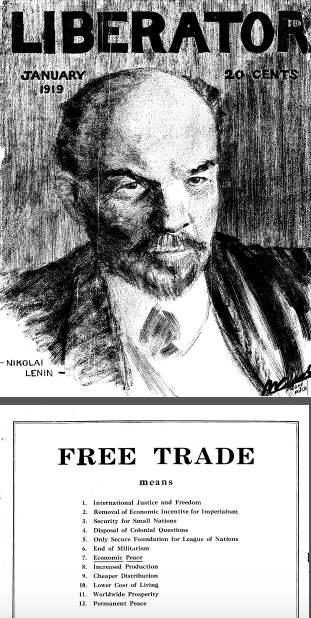
Figure 1: Front and back of the cover of the Jan. 1919 issue of the US Communist magazine the Liberator.

Marc-William Palen
History Department, University of Exeter
Follow on Twitter @MWPalen

[The following has been adapted from Marc-William Palen, “Marx and Manchester: The Evolution of the Socialist Internationalist Free-Trade Tradition, c1846-1946,” International History Review 43 (March 2021): 381-398.]

Free trade, or Freihandel, was a hot-button issue at the German Social Democratic Party (SPD) Congress held in Stuttgart in 1898, most notably because of the policy’s numerous advocates. SPD leader Karl Kautsky kicked things off with a resolution denouncing protectionism for counteracting ‘international solidarity.’ Luise Zietz, a German feminist and head of the SPD women’s movement, seconded Kautsky’s call: ‘We have to adopt a principled stance, and that is in favor of free trade and against protective tariffs.’ August Bebel, SPD chairman and longtime pacifist, followed up on Kautsky and Zietz’s free-trade endorsements, and the congress adopted a qualified resolution along these lines. Free trade would receive an even stronger SPD endorsement in 1900 because ‘free international exchange is . . . before all, a working-class question,’ German Marxist revisionist Eduard Bernstein explained in a subsequent letter to London’s 1908 International Free Trade Congress.[1] Their efforts were part of a rich socialist free-trade tradition that began germinating when Friedrich Engels and Karl Marx migrated to Britain in the 1840s, just as the island-nation was embracing free trade as both policy and ideology. The same British free-trade embrace was also giving rise at this time to the Manchester School (Manchester liberalism, Cobdenism), an economic ideology that tied international trade liberalization together with cheap food, democratization, anti-imperialism, and peace – a cosmopolitan concoction that socialist internationalists increasingly imbibed by the turn of the century.[2]

Recovering the free-trade dimensions of socialist internationalism, and the pacific influence of Britain’s Manchester School upon it, upends the commonly held assumption that socialists the world over have supported nationalism and protectionism amid their collectivist opposition to free-market capitalism.[3] Doing so also provides a much-needed prehistory to the growing body of literature on ‘socialist globalization’. This scholarship has focused primarily on socialist attempts to deepen regional and global interdependence through market integration and supranational governance amid the Manichean ideological divide of the Cold War.[4]  By contrast, earlier attempts have received far less attention, and the role of free trade within the socialist internationalist tradition less still. As a partial corrective, this article traces the evolution of socialist internationalist support for free trade across the century before the Cold War, wherein the cosmopolitan subscription to free trade increasingly made strange bedfellows among those capitalists and socialists seeking a more interdependent and peaceful world order. Continue reading “Recovering the Socialist Free-Trade Tradition”

America has a unique 300 year old view of free trade – UK must recognise this to strike a deal

Let battle commence. Novikov Aleksey

Emma Hart
University of St Andrews

With Boris Johnson hailing parliament’s vote towards Britain leaving the EU on January 31, there is a general consensus among the country’s leaders that there will be an intimate trading relationship with the US after Brexit. But whenever the question of a deal comes up in the media, there is usually much talk of stumbling blocks.

There is the war of words between UK chancellor Sajid Javid and US treasury secretary Steven Mnuchin over a digital tax on American companies in the UK, for instance. Or fears that the NHS will be sold off to US healthcare giants.

Much is also written about the difficulty the UK faces in steering a course between its EU neighbours and the overwhelming political might of Washington. For example, will the UK have to abandon the Iran nuclear deal to win free-trade concessions from America?

In light of the “special relationship”, you might wonder how these trade negotiations can be so testy before they are even underway. As my recent book suggests, the conflict may well lie in the historic trading relationship between the two countries. Much as Britain and America are “two nations divided by a common language”, they are also divided by their understanding of trade. To comprehend this, you have to go back to the American Revolution and beyond. Continue reading “America has a unique 300 year old view of free trade – UK must recognise this to strike a deal”

Brexit, Free Trade, and the Perils of History

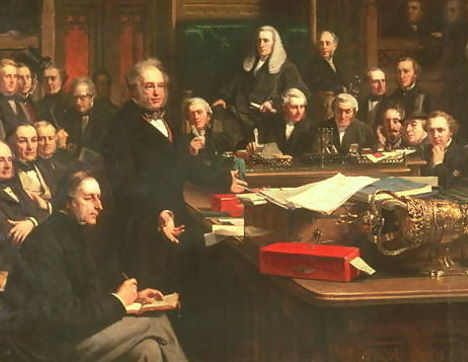
Lord Palmerston Addressing the House of Commons During the Debates on the Cobden–Chevalier Treaty in February 1860, as painted by John Phillip (1863).
Palmerston before the House of Commons amid the Debates on the Cobden–Chevalier Treaty in February 1860. Painting by John Phillip (1863).

Anthony Howe
University of East Anglia

Amid much discussion of alternatives to Britain’s current relationship with Europe, the Canadian, Norwegian, and Swiss models have featured widely. But surprisingly little attention has been paid to the closest historical model of what Brexiteers might hail as ‘a free trade Europe’.[1]

The first version of a ‘common market’ based on free trade treaties was created in Europe in the 1860s. Following the signing of the 1860 Anglo-French (Cobden-Chevalier) commercial treaty, a further 50-60 interlocking trade treaties were negotiated between European states, in effect creating a free trade area, the closest Europe got to a single market before the 1970s.

The economic benefits of this first common market are still contested by economic historians, but, as a model of a loose institutional framework it successfully lowered tariffs between participating states (only Russia of major European states remained outside it).

And at first glance this treaty network appears remarkably similar to the goals of those wishing to avoid a European super state in favour of simpler trade-based relationships. However, the fate of this model should be less than encouraging for the Leave campaign. Continue reading “Brexit, Free Trade, and the Perils of History”

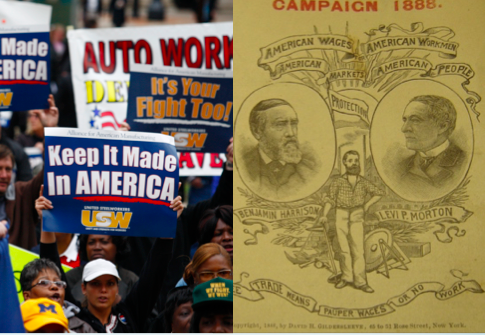
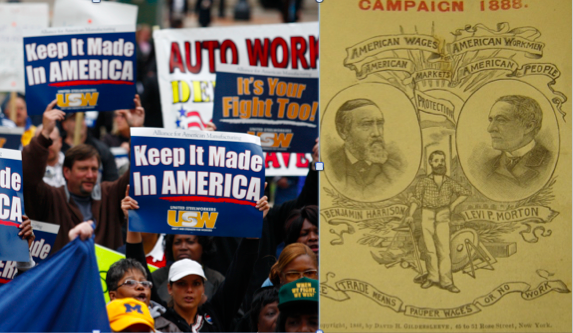
Donald Trump and the History of American Protectionism: A New Documentary


Screen Shot 2016-05-30 at 21.44.02

Featuring Marc-William Palen (Exeter), Helen Milner (Princeton), Bill Galston (Brookings Institution), Carla Hills (former US trade representative), David Auter (MIT), David Taylor (Pennsylvania Manufacturers’ Association), Bruce Springsteen, and Ferris Bueller, Edward Stourton examines America’s long history of resistance to free trade, and asks why it has again become such a potent political force in a new documentary for BBC Radio 4. Continue reading “Donald Trump and the History of American Protectionism: A New Documentary”

Debunking the Civil War Tariff Myth

tornintwo

Marc-William Palen
History Department, University of Exeter
Follow on Twitter @MWPalen

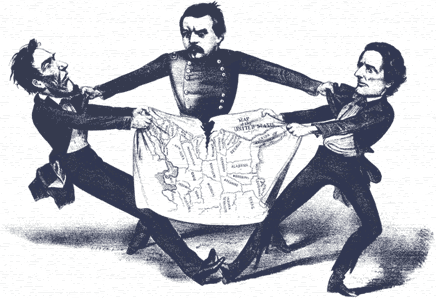
The outbreak of the American Civil War is now more than 150 years past. All the while, the question of what caused the conflict continues to spark disagreement, this despite a longstanding consensus among specialists that slavery – a cultural, political, ideological, and economic institution that permeated (and divided) mid-19th-century American society – was the primary cause of the war. One of the most egregious of the so-called Lost Cause narratives instead suggests that it was not slavery, but a protective tariff that sparked the Civil War.

On 2 March 1861, the Morrill Tariff was signed into law by outgoing Democratic President James Buchanan to protect northern infant industries. A pernicious lie quickly formed around the tariff’s passage, a lie suggesting that somehow this tariff had caused the US Civil War. By ignoring slavery’s central role in precipitating secession and Civil War, this tariff myth has survived in the United States for more than a century and a half – and needs to be debunked once and for all. Continue reading “Debunking the Civil War Tariff Myth”

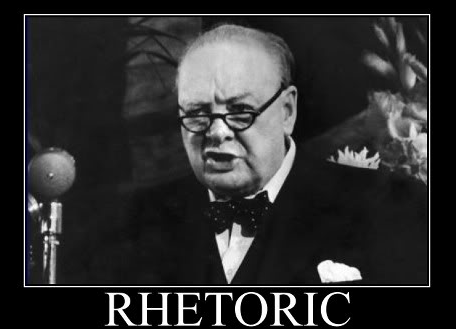
Tracing Churchill’s Rhetoric on Imperial Trade

Screen Shot 2013-12-15 at 8.52.43 AMRichard Toye

Churchill and the Culture of Imperial Political Economy

Winston Churchill is not famed for his views on economics. Yet they formed an important aspect of his outlook.  Continue reading “Tracing Churchill’s Rhetoric on Imperial Trade”

The Limits of Globalization

Marc-William Palen

Inimese_tegevusruumAfter last week’s post extolling the seemingly limitless avenues of historical inquiry offered through the study of globalization, it seems only fitting that I should now offer a somewhat contrary one on the limits of globalization.

Sycophantic proponents and adamant critics alike view globalization — the process of speeding up global integration via capital flows, markets, ideas, people, and technology — as an omnipresent and inexorable process. For devout acolytes from Richard Cobden to Thomas Friedman, it appears as a benign process that will one day make the world’s markets so interdependent that war itself will become anachronistic. For its harshest critics, and despite historical evidence and scholarship to the contrary, globalization remains an unstoppable force led by a secretive cabal of powerful multinational corporations hell-bent upon undermining national sovereignty in an endless search for profit. Continue reading “The Limits of Globalization”