
Marc-William Palen
History Department, University of Exeter
Follow on Twitter @MWPalen
Marc-William Palen
History Department, University of Exeter
Follow on Twitter @MWPalen
Marc-William Palen
History Department, University of Exeter
Follow on Twitter @MWPalen
Continue reading “This Week’s Top Picks in Imperial & Global History”
Thomas Zeiler
University of Colorado, Boulder
Thomas Zeiler is Professor of Diplomatic History at the University of Colorado Boulder. He has authored numerous books on U.S. diplomacy and globalization, including American Trade and Power (1992), Free Trade, Free World: The Advent of GATT (1999), Dean Rusk (2000), Globalization and the American Century (2003), and Unconditional Defeat: Japan, America, and the End of World War II (2004).
Cross-posted from E-International Relations
The “Conspiracy” of Free Trade: The Anglo-American Struggle Over Empire and Economic Globalisation, 1846-1896. By Marc-William Palen. Cambridge University Press, 2016
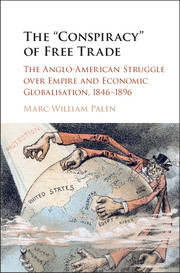 In the 2016 U.S. presidential election campaign, Bernie Sanders and Donald Trump made trade great again. That is, they reminded us that international trade policy, and particularly the American foreign commercial agenda, is as relevant today as it was in the nineteenth century, the last half of which is the era of focus for historian Marc-William Palen. The timing is striking. China has replaced European nations as competitors, and monetary manipulation and dumping rather than tariffs are the bete noires today. Yet contemporary protectionists are a throwback to expressions of economic nationalism last heard by a majority of politicians in the decades following the American Civil War. Protectionism guided American trade policies until the Great Depression, when freer (though still cautious) commercial relations traded places with the nationalism that had shaped the United States for its first century and a half.
The “Conspiracy” of Free Trade (the conspiracy a claim by American protectionists based in the Republican Party that British free traders were secretly trying to hinder U.S. prosperity at home and expansion abroad) is a corrective to decades of historiography that laissez-faire doctrine guided the Gilded Age. On the contrary, Palen’s sophisticated look into Anglo-American dialogue and domestic political maneuverings show that “ideological conflict between free traders and economic nationalists laid the imperial path for Anglo-American economic globalization” (xvi). His archival research is solid, though far surpassed by the extensive treatment of periodical and secondary sources; Palen has mined seemingly every commentary on the half century he covers. The author also lays out a simple binary of ideological visions – Cobdenite cosmopolitanism (the free traders) and a Listian nationalism (the protectionists) – that effectively expands the grand debate over the tariff into an even grander one over imperialism (and, in today’s terms, globalization). Continue reading “Zeiler on Palen, The “Conspiracy” of Free Trade”

Marc-William Palen
History Department, University of Exeter
Follow on Twitter @MWPalen

Marc-William Palen
History Department, University of Exeter
Follow on Twitter @MWPalen
Marc-William Palen
History Department, University of Exeter
Follow on Twitter @MWPalen
Continue reading “This Week’s Top Picks in Imperial & Global History”
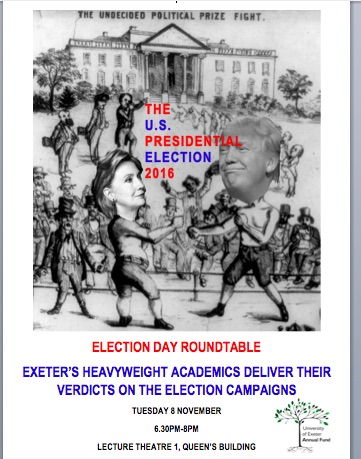
The final event in the U.S. Presidential series, which is possible thanks to the generous support of the Annual Fund, will be a roundtable chaired by Dr. Sinéad Moynihan (English) and featuring:
Dr. Gregorio Bettiza (Politics)
Dr. Bob Lawson-Peebles (English)
Dr. Amy McKay (Politics)
Dr. Marc-William Palen (History)
Professor Patrick Porter (Politics)
The participants will share their expertise on current and previous campaigns.
All welcome!
The US Presidential Election 2016 Talk
FINAL ROUNDTABLE
A Department of English seminar
Date
8 November 2016
Time
18:30
Place
Queens Building LT1, University of Exeter

Marc-William Palen
History Department, University of Exeter
Follow on Twitter @MWPalen
Continue reading “This Week’s Top Picks in Imperial & Global History”
Marc-William Palen
History Department, University of Exeter
Follow on Twitter @MWPalen
Continue reading “This Week’s Top Picks in Imperial & Global History”
Marc-William Palen
History Department, University of Exeter
Follow on Twitter @MWPalen

V. I. Lenin penned and published his influential pamphlet, Imperialism: The Highest Stage of Capitalism, in the midst of the First World War. Building upon Marxist contemporaries like Hilferding and Bukharin as well as non-Marxist theorists like J. A. Hobson, Lenin’s pamphlet would quickly come to embody the orthodox Marxist critique concerning the relationship between modern capitalism and imperialism. In this Talking Empire podcast, Dr Marc-William Palen discusses Lenin’s Imperialism and its legacy with Professor Richard Toye.
Christienna Fryar
SUNY Buffalo State
Cross-posted from New Books in History
 Accounts of late-nineteenth-century US expansionism commonly refer to an open-door empire and an imperialism spurred by belief in free trade. In his new book The “Conspiracy” of Free Trade: The Anglo-American Struggle over Empire and Economic Globalization, 1846-1896 (Cambridge University Press, 2016), Marc-William Palen challenges this commonplace. Instead, he notes, American adherents to Richard Cobden’s free-trade philosophy faced off against and ultimately lost to a powerful version of protectionist economic nationalism inspired by German-American economic theorist Friedrich List. The success of Listian protectionism spurred closed-door, aggressive US expansionism and also challenged free-trade orthodoxies in Britain, where political-economic policy also shifted toward protectionism by the end of the nineteenth century.
Marc-William Palen
History Department, University of Exeter
Follow on Twitter @MWPalen
Marc-William Palen
History Department, University of Exeter
Follow on Twitter @MWPalen
Continue reading “This Week’s Top Picks in Imperial & Global History”
Marc-William Palen
History Department, University of Exeter
Follow on Twitter @MWPalen
 Imperial & Global Forum
You must be logged in to post a comment.