Here are some of the Centre’s top reads for the week:
*For those of you who might have somehow missed Nicholas Kristof’s trolling of the ivory tower in the New York Times (‘Professors, We Need You!’), he took academics to task for not engaging enough with the public. Needless to say, it set off a (predictable) firestorm, with responses, among others, Continue reading “This Week’s Top Picks in Imperial and Global History”→
History does not repeat itself. The historians repeat one another.
—Max Beerbohm, 1896.
Historians are often charged — sometimes correctly — with precipitously proclaiming a “new” field of study: a field that, upon further investigation, is shown to be remarkably similar to earlier turns in the historiographical timeline. The post-colonial and subaltern “turns” of the 1980s are cases in point, as they, however unwittingly, tended to ignore the prodigious and overlapping work within Area Studies that had appeared in preceding decades. I duly began to wonder if the term “global history” might prove to be yet another illustrative example. Continue reading “Sleuthing the Origins of ‘Global History’”→
Another big week in imperial and global history has passed. Here are some of the centre staff’s top stories:
*Miranda Carter points out in the Guardian that the one-time bestselling British imperial adventure stories of Kipling, Stevenson, and Haggard have been almost forgotten — dangerous evidence that Britons are ignoring their imperial past:
It is a mistake to neglect our colonial past. We should not want to become like Japan, a nation that deliberately chose to forget the shame of the second world war. Japan has never apologised in the same way as Germany for its actions during the war, and has often seen itself as the victim of the conflict rather than the aggressor. In Britain, we haven’t truly processed our colonial history, and we should remind ourselves of it. One way cultures remember and digest the past is through stories, which is why the best of these colonial adventure stories deserve to be reread, in all their awkward ambivalence. . . . It is also why British writers should . . . tell stories that will illuminate parts of the colonial experience, particularly for an increasingly uninformed domestic audience. Postcolonialism throws up difficulties for western writers, but it can also open up new routes into stories about it.
*The nomination of The Act of Killing for an Oscar has put Indonesia’s bloody past into the forefront, connecting the anti-communist killings of the late 1960s with today’s modern-day gangsters and paramilitaries. Continue reading “This Week’s Top Picks in Imperial & Global History”→
It’s time for the weekend roundup in imperial and global history.
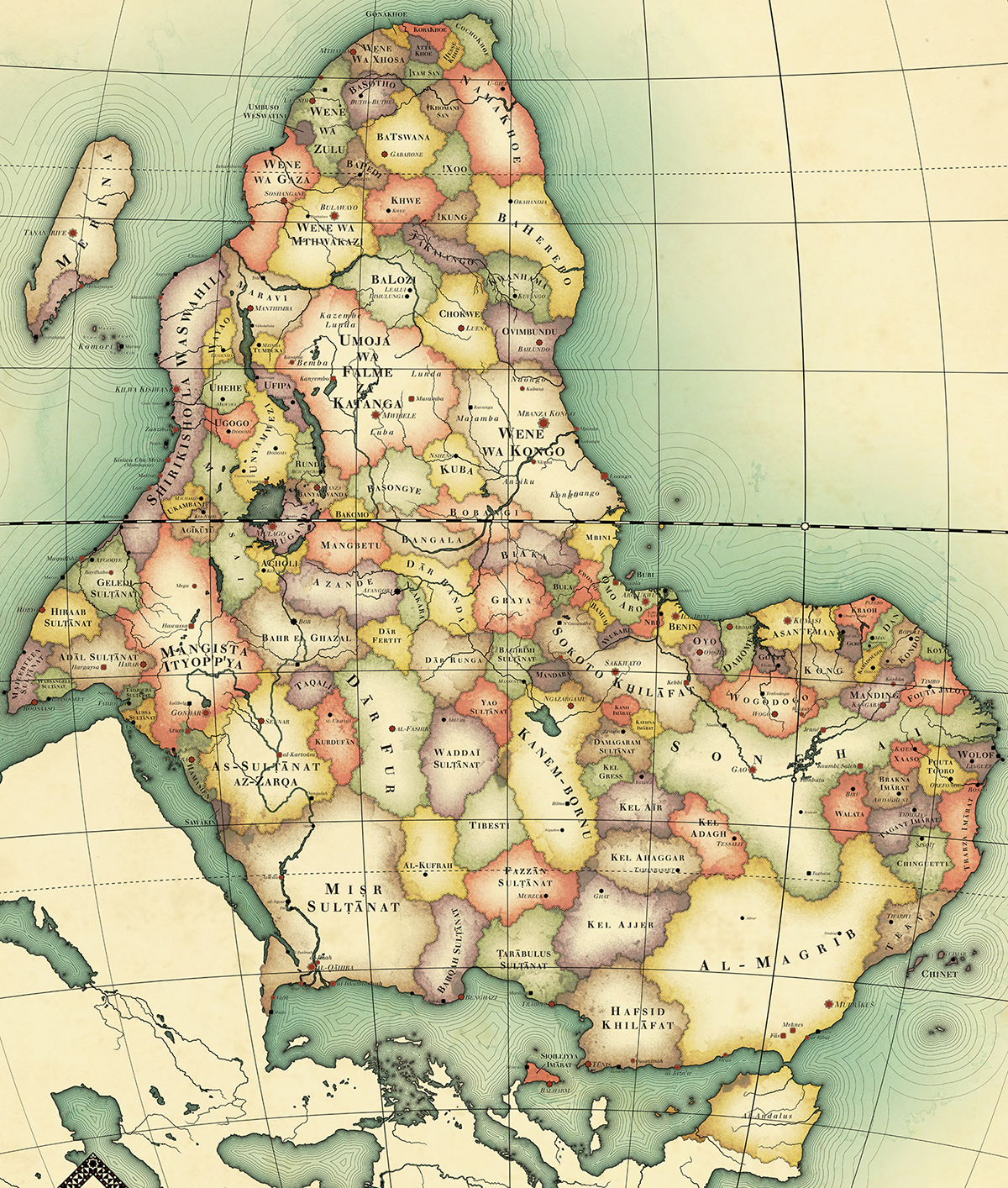
To kick things off, ever wonder what a map of Africa might look like if it had never been colonized? Swedish artist Nikolaj Cyon has done just that:
The Washington Post notes that ‘the map asks what Africa would look like today if colonialism had never happened. (Africa’s present-day borders were determined largely by colonialism, which continues to create lots of very big problems.) Cyon drew these boundaries based on a study of political and tribal units in 1844, the eve of Europe’s “scramble for Africa.” He oriented it with south at the top to subvert the traditional Europe-on-top orientation.’ Continue reading “This Week’s Top Picks in Imperial & Global History”→
In November 2012, a slim majority of Puerto Ricans voted in favor of U.S. statehood. And within the last week, Dr. José M. Saldaña, former president of the University of Puerto Rico, and former mayor of San Juan, Hernán Padilla, each once again raised the call for Puerto Rican statehood. Yet modern-day remnants of the American Empire continue to trouble US relations with Puerto Rico, which still holds a semi-colonial American status. To give the issue some much-needed historical perspective, what follows is a revised version of an article that previously appeared in the History News Network and the Australian newspaper.
Burn your outdated American flags; make room for the fifty-first star on the star-spangled banner.
For the first time in Puerto Rico’s more than hundred-year history as an American territory, on Election Day in November 2012, a slim majority voted in favor of U.S. statehood in a non-binding referendum that now goes to the U.S. Congress.
Puerto Ricans had been given a similar option three times before — in 1967, 1993, and 1998 — but with opposite results.
Why this apparent about face?
Because of a weakening economy, a decreasing population, and because “the current relationship simply does not create the number of jobs that we need,” says Puerto Rican Secretary of State Kenneth McClintock.
As it stands, 58 percent of Puerto Ricans now live in the mainland United States. Puerto Rico’s four-million residents — the 42 percent remaining on the island — are American citizens but can’t vote in American elections. Such has been the status quo since 1917.
But all this could change if Puerto Rico becomes the fifty-first state of the Union.
Whatever the outcome, this historic moment deserves due attention. Instead, aside from a brief flurry of superficial analysis, the implications of Puerto Rico’s self-determinative vote have gone largely ignored.
We might easily blame American political ADD for such a short attention span. More uncomfortably, such an imperial absence of mind is also a garish reminder of how much Puerto Rico’s complicated, century-long, semi-colonial status has become an accepted part of the American subconscious. Continue reading “America’s Absentminded Empire”→
We have been tackling some weighty subjects in the Forum this past week. In particular, the pros and cons of global history. A lighter approach to imperial and global history seemed in order. And who better to do so than an alien traveler of time and space like the Doctor?
Last Saturday witnessed the much anticipated 50th anniversary episode of the series. I had thought that my 3D glasses were enough to hide my attendance at its theatrical debut. But the cat, as they say, is out of the bag. It appears that I have failed miserably in keeping my secret Doctor Who obsession, well, a secret.
Today, one of my students sent me a link to a great article in the New Statesman. It explores the liberal contradictions of the intrepid Doctor, much as the Centre’s Professor Richard Toye did with Winston Churchill and empire last week. The author of the New Statesman article, Andrew Harrison, sets the ideologically confusing intergalactic stage thusly: Continue reading “Is Doctor Who an Anti-Imperialist?”→
After last week’s post extolling the seemingly limitless avenues of historical inquiry offered through the study of globalization, it seems only fitting that I should now offer a somewhat contrary one on the limits of globalization.
Sycophantic proponents and adamant critics alike view globalization — the process of speeding up global integration via capital flows, markets, ideas, people, and technology — as an omnipresent and inexorable process. For devout acolytes from Richard Cobden to Thomas Friedman, it appears as a benign process that will one day make the world’s markets so interdependent that war itself will become anachronistic. For its harshest critics, and despite historical evidence and scholarship to the contrary, globalization remains an unstoppable force led by a secretive cabal of powerful multinational corporations hell-bent upon undermining national sovereignty in an endless search for profit. Continue reading “The Limits of Globalization”→
[Update: Please also read Professor Bell’s response.]
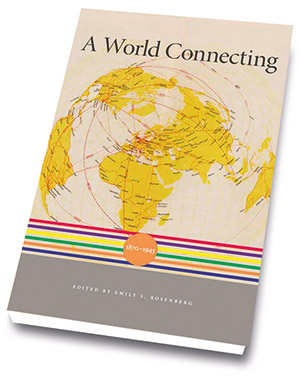
A recent New Republicarticle by David A. Bell on the limitations of the ‘global turn’ has been making the rounds this month, and deservedly so. Bell’s article reviews Emily Rosenberg’s 2012 edited volume A World Connecting: 1870-1945. [1] Nestled within it, however, is a much larger critique of the global historiographical shift toward ‘networks’ and ‘globalization’.
Bell’s criticisms are provocative. They are eloquent.






 Imperial & Global Forum
You must be logged in to post a comment.