6. Charlie Hebdo’s Anti-Imperialist Roots

Editor’s Note: In the weeks leading up to the new year, please help us celebrate 2015 at the Imperial & Global Forum by checking out the past year’s 10 most popular posts.

6. Charlie Hebdo’s Anti-Imperialist Roots
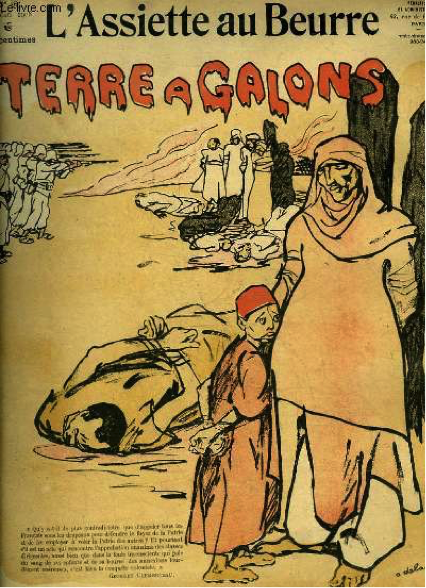
L’Assiette au Beurre, Terre à Galons ("A place to earn stripes"), March 14, 1908.

L’Assiette au Beurre, Terre à Galons (“A place to Earn Stripes”), March 14, 1908.

Daniel Foliard
Assistant Professor, Paris Ouest-Nanterre la Défense University

In a recent interview, George Wolinski (1934-2015), one of the Charlie Hebdo cartoonists killed in the Paris terrorist attacks on January 7, 2015, had claimed his magazine’s work was the legacy of L’Assiette au Beurre, an innovative satirical weekly published in France between 1901 and 1912.

Both stylistically and politically, the two periodicals, separated by more than a century, could also claim an affiliation with a long French tradition of dissent. Accordingly, although Charlie Hebdo is now known around the globe for its unmediated satire on religions, we should not overlook its position in the longer history of French anti-imperialism.

The 1881 laws on the freedom of the press had opened the golden age of French political caricature, paving the way for Samuel-Sigismond Schwarz to found L’Assiette au Beurre in 1901. The new illustrated weekly was, however, initially a failed commercial venture. [continue reading]
7. Australia & the Fascist Idea of Greater Britain

Editor’s Note: In the weeks leading up to the new year, please help us celebrate 2015 at the Imperial & Global Forum by checking out the past year’s 10 most popular posts.

7. Australia & the Fascist Idea of Greater Britain

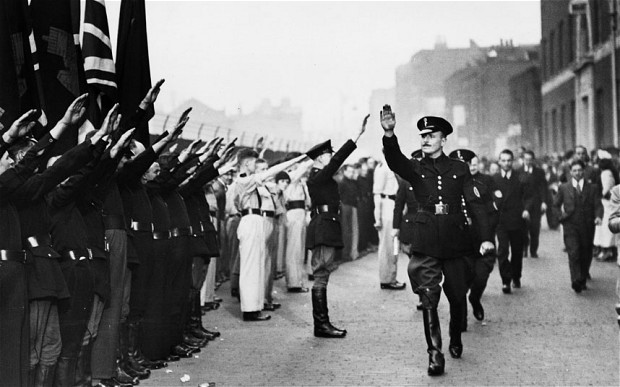
Oswald Mosley at a BUF parade, 1936.

Oswald Mosley at a BUF parade, 1936.

Evan Smith
Flinders University
Follow on Twitter @Hatfulofhistory

‘Our world mission is the maintenance and development of the heritage of Empire,’ the leader of the British Union of Fascists (BUF), Sir Oswald Mosley, declared in the BUF’s journal, Fascist Quarterly, in 1936. Although often overlooked by scholars of British fascism, this pro-imperial sentiment was central to the ideology of the BUF. For the BUF, the maintenance of the British Empire was imperative – key to keeping Britain’s place within the world and ensuring living standards in the domestic sphere.

Britain formed the metropole of the Empire, but the settler colonies (achieving Dominion status just prior to the inception of the BUF) were also seen as integral to the preservation of the Empire. Australia, New Zealand, Canada and South Africa were viewed by the BUF as bastions of the imperial spirit that would help revive Britain at the core of the Empire and create what Mosley described as a ‘Greater Britain’, resurrecting a term that had first appeared in the late Victorian period. [continue reading]

‘Filipino Muslims under US Colonial Rule’ – An @ExeterCIGH Talk by Dr. Karine Walther

Filipino Muslims under US Colonial Rule

A Centre Talk by

Dr. Karine V. Walther
Georgetown University School of Foreign Service in Qatar 

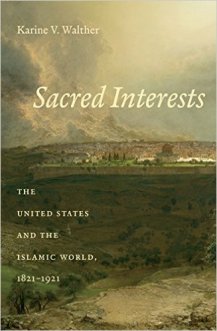
Abstract: When the United States annexed the Philippine Islands in 1898 after their victory over Spain during the Spanish-American War, they made over 300,000 Filipino Muslims— as well as over 6 million Catholics and 200,000 animists— American colonial subjects. Although Filipino Muslims, or Moros as they were called by the Spanish, and later, the Americans, constituted only a small percentage of the population, they controlled a third of the territory annexed by the United States in 1898. During their colonial governance of the Islands, the intellectual and spiritual roots driving American imperial rule over Filipino Muslims were entrenched in—and relied upon— orientalist tropes that cast Muslims as uncivilized or barbaric and, importantly, incapable of self-government. What was unique about this moment, however, was that contrary to previous American interactions with Muslims around the world, this marked the first time the United States would rule over Muslim subjects as part of its own empire. This talk will analyze how American colonial officials applied their perceptions of Islam to the governance of what they described as their new “Mohammedan wards” in the Philippines.

When: Friday, 11 December at 3.30

Where: Forum Seminar Room 5, University of Exeter, Streatham Campus

Sacred WaltherThis talk is taken from her wider book study, Sacred Interests: The United States and the Islamic World, 1821-1921 (University of North Carolina Press, 2015).
8. Living in the Age of the Storyteller: Global History and the Politics of Narrative

Editor’s Note: In the weeks leading up to the new year, please help us celebrate 2015 at the Imperial & Global Forum by checking out the past year’s 10 most popular posts.

8. Living in the Age of the Storyteller: Global History and the Politics of Narrative

globe-books

Lori Lee Oates
History Department, University of Exeter
Follow on Twitter @LoriLeeOates

In late June, I had the honour of hearing Professor David A. Bell speak at the Society for the Study of French History conference at the University of St. Andrews, Scotland. The theme of the conference wasTurning Points in French History and he spoke on the period between 1715 to 1815. Professor Bell went on to discuss ‘the global turn’. He noted that a significant percentage of current history Ph.D. students are using global analysis as the main methodology for their thesis. He then discussed the limits of this methodology, particularly as a largely structural analysis. He argued that the methodologies of ‘the linguistic turn’ might actually be more helpful to us in analyzing the process of why change continues after these same global structures break down. Linguistic analysis largely views language as a structure that is culturally inherited and something that limits our ability to comprehend society beyond those concepts that are available to us in our immediate environment. [continue reading]

9. Anticolonialism, Antifascism, and Imperial History

Editor’s Note: In the weeks leading up to the new year, please help us celebrate 2015 at the Imperial & Global Forum by checking out the past year’s 10 most popular posts.

9. Anticolonialism, Antifascism, and Imperial History

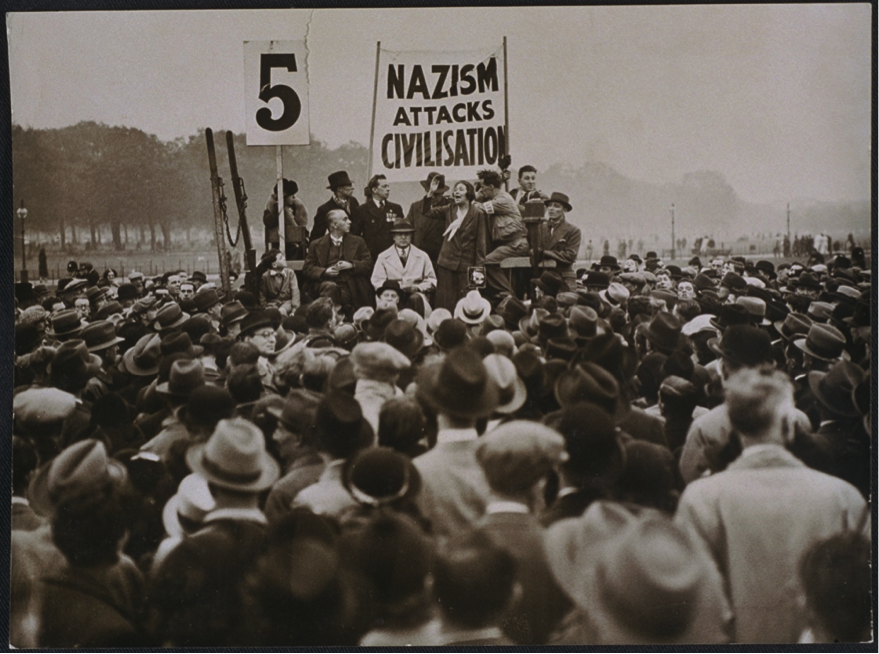
 Antifascist demonstrators in London, October 1935. Photo: National Media Museum/SSPL

Antifascist demonstrators in London, October 1935. Photo: National Media Museum/SSPL.

John Munro
Saint Mary’s University[1]

There’s a lot to be said for emphasizing the structuring role of colonialism and anticolonialism across the twentieth century. To contextualize the world wars, the Cold War, and contemporary global capitalism as embedded in a larger set of imperial continuities is to offer an indispensable corrective to the overemphasis of 1945 as epistemic break; the embellishment of US history as an empire-free zone; or the exaggeration of the distance between imperialism and free trade. Fredrik Petersson’s astute Versailles-to-Bandung emplotment of transnational anticolonial activism is thus a very compelling one, especially when read alongside several concurring periodizations.[2]But how we might conceive of antifascism in this empire-centered genealogy requires further attention. Whether antifascism was itself an anticolonialism, in other words, matters much for how we make sense of the twentieth century. [continue reading]

10. A Parisian Ho Chi Minh Trail: Writing Global History Through Interwar Paris

Editor’s Note: In the weeks leading up to the new year, please help us celebrate 2015 at the Imperial & Global Forum by checking out the past year’s 10 most popular posts.

10. A Parisian Ho Chi Minh Trail: Writing Global History Through Interwar Paris

Michael Goebel
Freie Universität Berlin
Follow on Twitter @mgoebel29

Antiimperial Metropolis cover

Anxieties over the possible political fallouts of African and Asian migration to Europe have a much longer history than the current refugee crisis might have you suspect. Colonial migration to interwar Paris, as I argue in Anti-Imperial Metropolisturned into an important engine for the spread of nationalism across the French Empire. Studying the everyday lives of these migrants, in turn, might also offer a way out of the impasse that global historians currently face.

Let me begin with an anecdote that encapsulates my argument: In autumn 1919, while statesmen gathered in Paris’s upscale banlieues to redraw the political world map, local police hired a discharged Vietnamese adjutant as an undercover agent. His task was “to exercise a discrete surveillance” over a compatriot of his who had distributed leaflets entitled “The Demands of the Annamite People” among diplomats and informal spokesmen in the city’s shabbier neighbourhoods. [continue reading]

This Week’s Top Picks in Imperial & Global History

algeria

Marc-William Palen
History Department, University of Exeter
Follow on Twitter @MWPalen

From Europe’s 1989 in reverse to how neoliberalism came to be, here are this week’s top picks in imperial and global history. Continue reading “This Week’s Top Picks in Imperial & Global History”

Innovative @ExeterCIGH Course Receives Commendation from Royal Historical Society

Screenshot 2015-12-02 19.00.18

Cross-posted from University of Exeter College of Humanities Research News

An online course run by leading historians at the University of Exeter has received a commendation from the Royal Historical Society (RHS) for excellence in the field of public history.

The course, Empire: The Controversies of British Imperialism has been officially commended by the RHS as part of the Public History Prize; the first national prize for public history in the UK.

The commendation, given in the web and digital category, recognises the work being undertaken within the University’s Department of History to engage people with the past in innovative ways using a wide variety of resources to entice new audiences to history in all its forms. Continue reading “Innovative @ExeterCIGH Course Receives Commendation from Royal Historical Society”

Centre Director Andrew Thompson to lead the Arts and Humanities Research Council

Andrew Thompson_1000785_0 (1)

Cross-posted from University of Exeter Research News

Professor Andrew Thompson, Director of the Centre for Imperial & Global History at the University of Exeter, has been appointed as interim Chief Executive of the Arts and Humanities Research Council (AHRC).

Professor Thompson’s research interests focus on the relationship between British, imperial and global histories and the effects of empire on British private and public life during the nineteenth and twentieth centuries.

The AHRC is a national funding agency supporting arts and humanities research and study in the UK. It funds world-class, independent researchers in a wide range of subjects: ancient history, modern dance, archaeology, digital content, philosophy, English literature, design and the creative and performing arts. Continue reading “Centre Director Andrew Thompson to lead the Arts and Humanities Research Council”

Final Call for Applications for Global Humanitarianism Research Academy

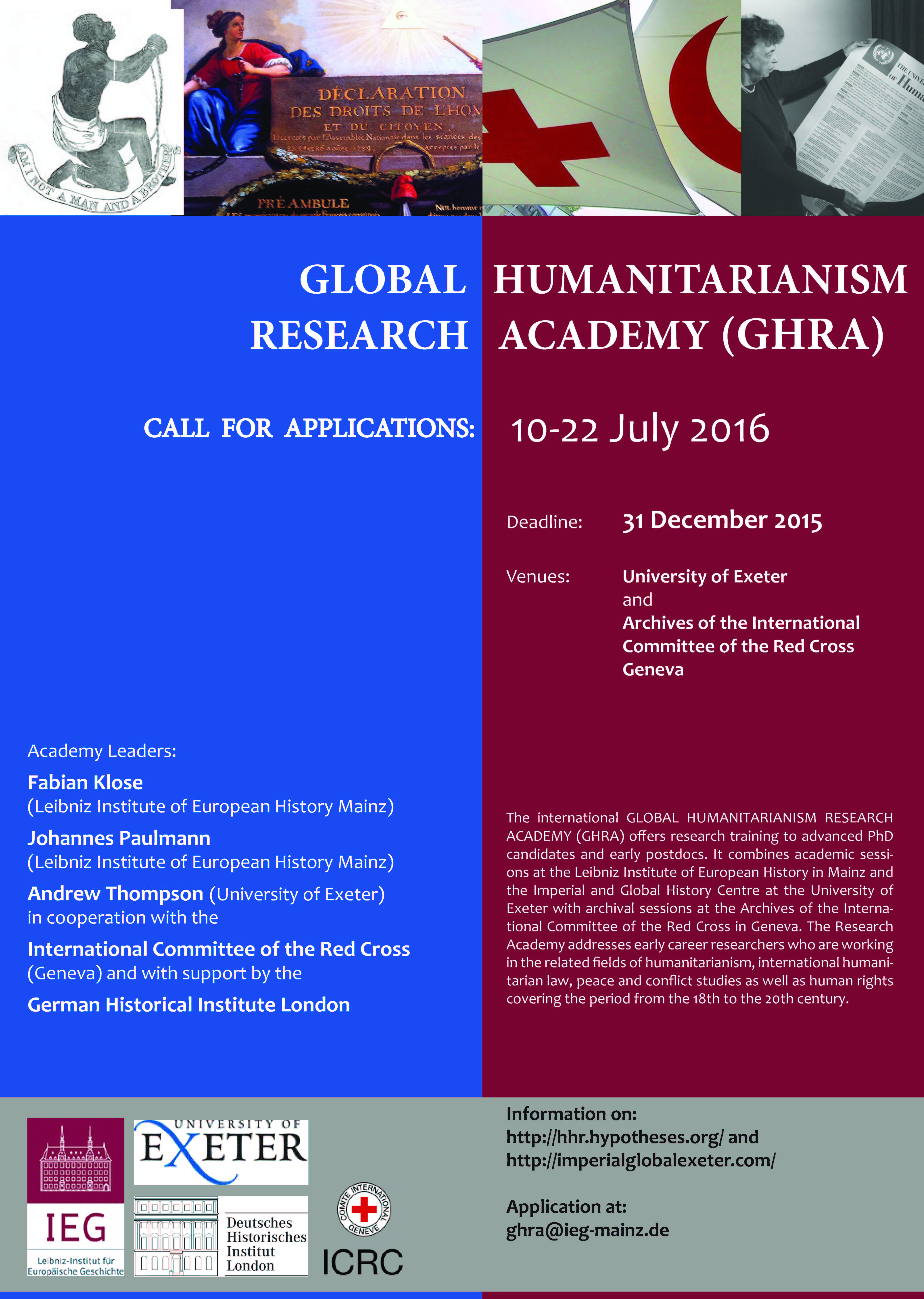
Poster_GHRA_2016 (1)

The second Global Humanitarianism Research Academy (GHRA) 2016 call for applications closes on 31 December 2015.

GHRA

Call for Applications:

Global Humanitarianism | Research Academy

International Research Academy on the History of Global Humanitarianism

Academy Leaders:                    

Fabian Klose (Leibniz Institute of European History Mainz)

Johannes Paulmann (Leibniz Institute of European History Mainz)

Andrew Thompson (University of Exeter)

in co-operation with the International Committee of the Red Cross (Geneva) and with support by the German Historical Institute London

Venues:                     University of Exeter, UK & Archives of the International Committee of the Red Cross, Geneva

Dates:                                          10-22 July 2016

Deadline:                                   31 December 2015

Screen Shot 2015-09-28 at 11.21.43

The international Global Humanitarianism | Research Academy(GHRA) offers research training to advanced PhD candidates and early postdocs. It combines academic sessions at the Imperial and Global History Centre at the University of Exeter and the Leibniz Institute of European History in Mainz with archival sessions at the Archives of the International Committee of the Red Cross in Geneva. The Research Academy addresses early career researchers who are working in the related fields of humanitarianism, international humanitarian law, peace and conflict studies as well as human rights covering the period from the 18th to the 20th century. It supports scholarship on the ideas and practices of humanitarianism in the context of international, imperial and global history thus advancing our understanding of global governance in humanitarian crises of the present. Continue reading “Final Call for Applications for Global Humanitarianism Research Academy”

This Week’s Top Picks in Imperial & Global History

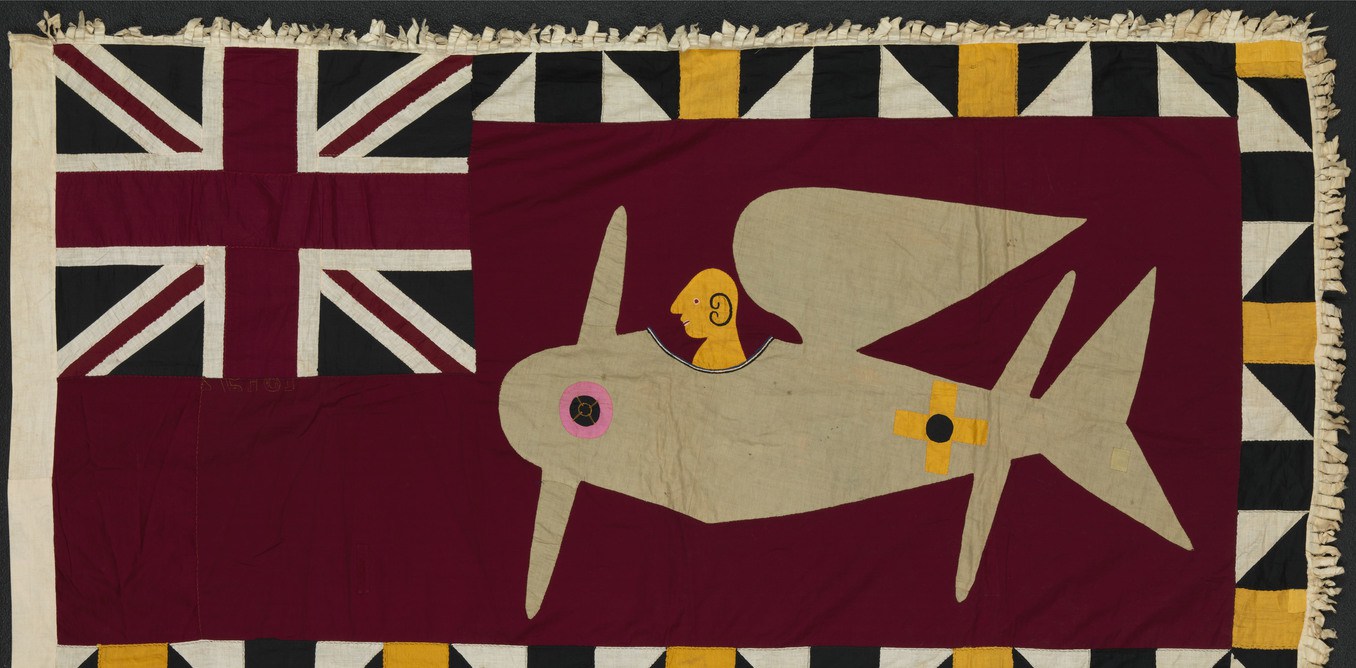
An Asafo flag made by the Fante artists of Africa’s Gold Coast.

Marc-William Palen
History Department, University of Exeter
Follow on Twitter @MWPalen

From imperial mass murder to globalizing Garveyism, here are this week’s top picks in imperial and global history.

Continue reading “This Week’s Top Picks in Imperial & Global History”

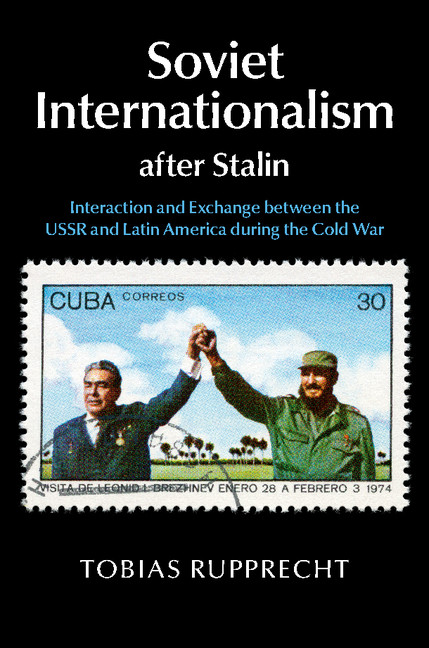
Soviet Internationalism in Latin America

SovietInternationalism

Tobias Rupprecht
History Department, University of Exeter

‘This is a great conservative system,’ reported the visitor following his trip to Moscow, ‘there is no lack of order, no anarchy, no lack of discipline! Everyone respects the authorities!’ While the liberal leaders of the materialist and soulless West allegedly no longer took up a stance against decadent art, degenerate music, and immoral sexual libertarianism, the leaders in the Kremlin, he claimed, heroically defended traditional family values and a ‘healthy patriotism’.

The tone of this argument will sound rather familiar to a contemporary observer of Russia’s reactionary domestic policies and its regression to Cold War style foreign intervention. A swashbuckling Vladimir Putin has attracted the tacit, and sometimes open, admiration from many Europeans who no longer feel represented by what they see as the liberal mainstream in politics and media. Continue reading “Soviet Internationalism in Latin America”

This Week’s Top Picks in Imperial & Global History

A shaded line drawing of a large stone building, people, dog and horse-drawn carriage.
The Melbourne Athenaeum, Melbourne’s first Mechanics Institute, in 1855. (State Library of NSW: ST Gill)

Marc-William Palen
History Department, University of Exeter
Follow on Twitter @MWPalen

From the colonial context of the Paris attacks to radical Scotland in Australia, here are this week’s top picks in imperial and global history. Continue reading “This Week’s Top Picks in Imperial & Global History”

First Steps Towards the Ph.D.

bookshelf

Earlier this month, experts from the University of Exeter shared their guidance and answered questions about how to develop a successful Ph.D. application in the Humanities. The video (below) is now available for viewing by anyone considering postgraduate study in the Humanities.

Themes covered in this video include:

  • How do I know if a Ph.D. is for me? What are the qualities required and what career paths can it lead to?
  • What is distinctive about a UK Ph.D. in contrast with postgraduate study in other countries, and how does the supervision system operate?
  • What are the keys to a successful research proposal, and how do expectations differ across disciplines?
  • How can I identify a university with a strong research culture, and how should I go about locating and contacting prospective supervisors?
  • Once I have embarked on a Ph.D., what kinds of training and career guidance can I expect to receive?

Continue reading “First Steps Towards the Ph.D.”

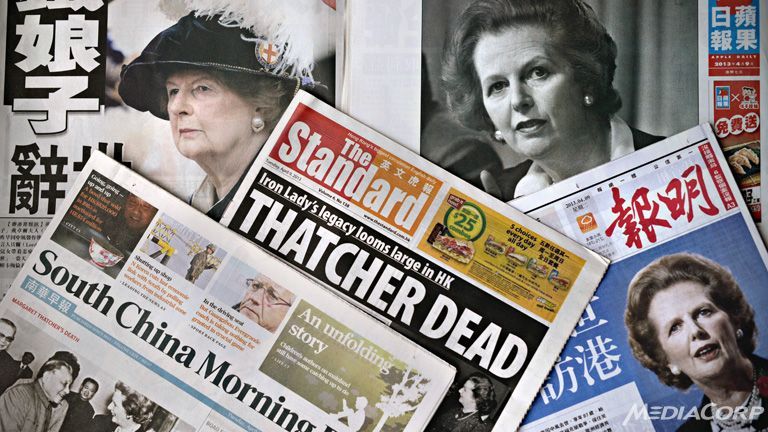
Making Thatcher’s World – A Talk by Martin Farr – This Wednesday at the University of Exeter

margret-thatcher-hong

We say socialism tends to stand together throughout the world”, Margaret Thatcher said on American TV in 1977. “We must have what I call the freer way of life likewise standing together”. Margaret Thatcher’s World derives from the fact that no democratic leader has provoked so great an international reaction, and no political brand – defined in many often contradictory ways, but a recognisable brand nonetheless – has had such international salience as Thatcherism, both at the time and subsequently.

It is striking in public discourse in countries across the world, how often the person and the ‘ism’ is used and misused, revered and abused. Frequently the spectre (or specter) of Thatcherism is invoked; the term and the person has become an epithet of approbation or opprobrium. The project is an international history and a reception study which includes such aspects as policy networks and processes, rhetoric, gender, and ideology. So it was that Johannesburg’s Business Day described “the global implementation of Thatcherism”, Tehran’s Shargh felt “the majority of the countries of the world have put the Thatcherism movement in their agenda”, Toronto’s Financial Post that “Thatcher’s legacy lives far and wide”, and Santiago’s El Mercuria wrote of “the woman who transformed the UK and shocked the world”. The application of the term goes beyond Britain, and even the West: President Ershad of Bangladesh has referred to “third world Thatcherism”, and the Times of India to “Thatcherism of the Tigris”. As she said in Moscow in 1987, “[I]t is universally true, you know, Thatcherism”.

Dr. Martin Farr will be presenting his paper ‘Making Thatcher’s World’ this Wednesday at the Centre for Imperial & Global History’s seminar series. Continue reading “Making Thatcher’s World – A Talk by Martin Farr – This Wednesday at the University of Exeter”