US Presidential Election Day Roundtable (8 Nov., Exeter)

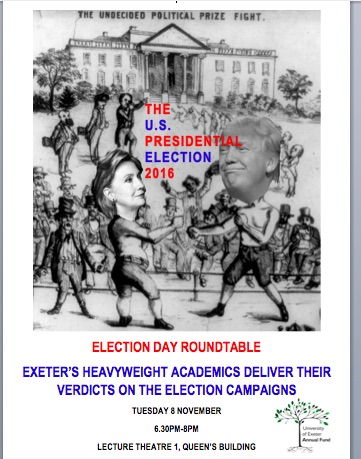
election-flyer

The final event in the U.S. Presidential series, which is possible thanks to the generous support of the Annual Fund, will be a roundtable chaired by Dr. Sinéad Moynihan (English) and featuring:

Dr. Gregorio Bettiza (Politics)
Dr. Bob Lawson-Peebles (English)
Dr. Amy McKay (Politics)

Dr. Marc-William Palen (History)
Professor Patrick Porter (Politics)

The participants will share their expertise on current and previous campaigns.

All welcome!

The US Presidential Election 2016 Talk
FINAL ROUNDTABLE

A Department of English seminar

Date
8 November 2016

Time
18:30

Place
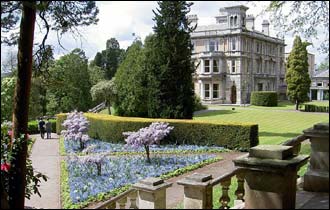
Queens Building LT1, University of Exeter

This Week’s Top Picks in Imperial & Global History

 A 1915 German poster, entitled L’Entente Cordiale, depicting a British spider weaving a web over Europe. Photograph: John Ellis/The British Library
A 1915 German poster, entitled L’Entente Cordiale, depicting a British spider weaving a web over Europe. Photograph: John Ellis/The British Library

Marc-William Palen
History Department, University of Exeter
Follow on Twitter @MWPalen

From Soviet maps of Brighton to a more accurate map of the world, here are this week’s top picks in imperial and global history.

Continue reading “This Week’s Top Picks in Imperial & Global History”

Sixty Years after Suez

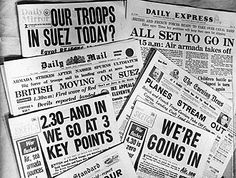
suez-newspapers

Richard Toye
Director, Centre for Imperial & Global History

Cross-posted from Politics Home

On 29 October 1956, Israeli forces launched an attack on Egypt. The following day Britain and France quickly issued an ultimatum to both sides to stop fighting. There was no compliance and, on 5 November, Anglo-French forces invaded Egypt in order to ‘separate the combatants’. The operation was a military success – and a catastrophic political failure.

For Britain and France’s actions had been based on a lie, and a pretty see-through one at that. The real motivation was to overthrow Egypt’s President Nasser, who just over three months earlier had nationalised the Suez Canal Company. In Paris and London, this was seen as a threat to Western Europe’s oil supply and to international order more generally. Initial efforts to get Nasser to ‘disgorge’ what he had seized, via diplomacy backed by coded threats, were unsuccessful.

Dwight Eisenhower, running for re-election to the White House on a platform of peace and prosperity, was not willing to back the use of force, and his Secretary of State, John Foster Dulles, was similarly cautious. Both men might have been willing to turn a blind eye to a spot of old-fashioned colonial atavism if the British and French had simply got on with it and launched an attack. Yet British Prime Minister Anthony Eden had a reputation to protect as an internationalist and a man of peace. To the frustration of his French allies, there was delay after delay as he looked for a pretext for action that would both allow him to destroy Nasser and to satisfy world opinion. Continue reading “Sixty Years after Suez”

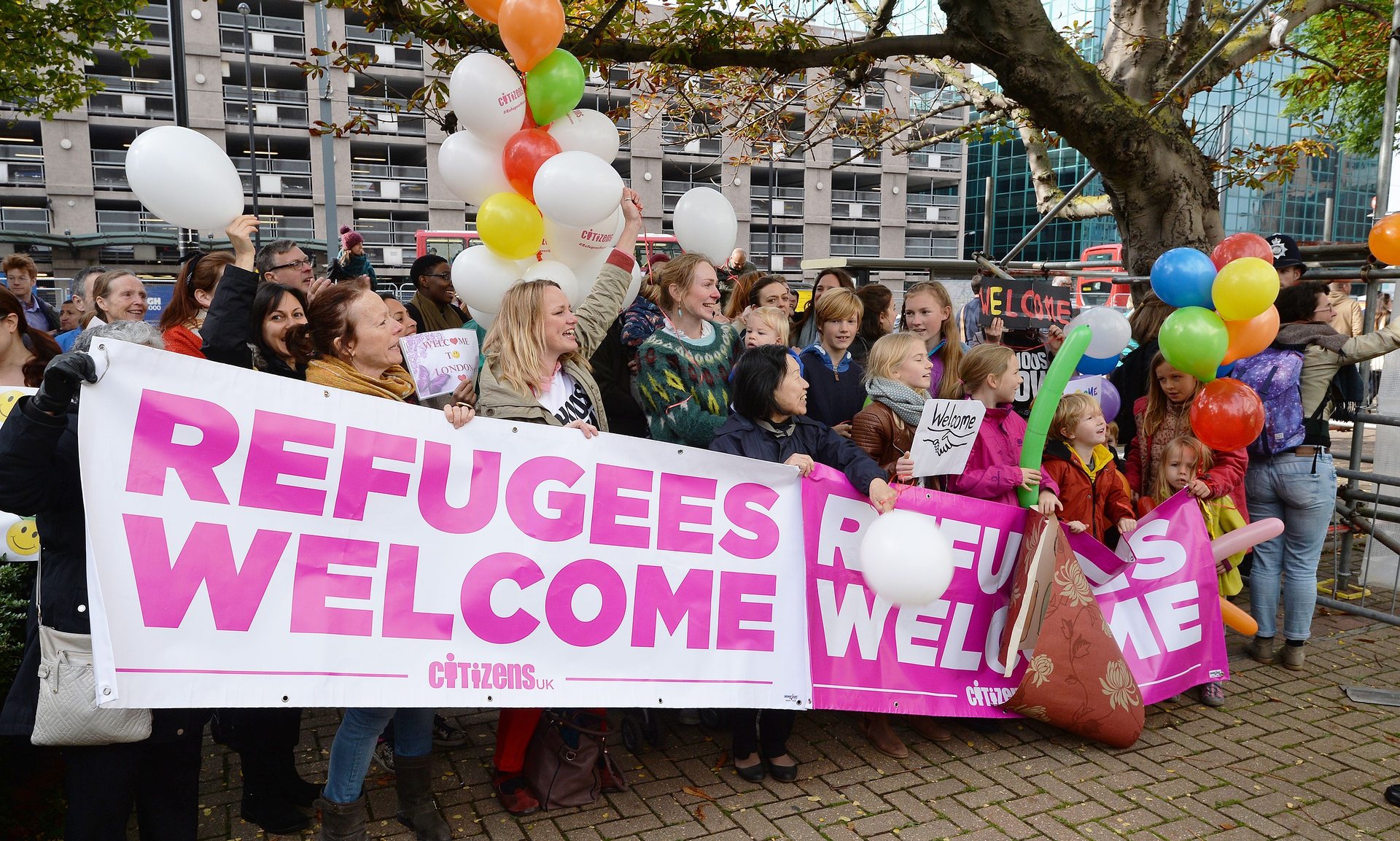
What is a Child? The Calais Child Refugees in Imperial Context

Members of the campaign group Citizens UK hold a ‘refugees welcome’ event outside Lunar House in Croydon. Photograph: John Stillwell/PA

Rhian Keyse
University of Exeter

The plight of child refugees being reunited with their families and resettled in the UK has been the cause of much attention in recent weeks. The charity Safe Passage UK says that it has identified 387 unaccompanied children in the infamous Calais ‘Jungle’ refugee camp who have a legal right to come to the UK, either because they have close relatives in the country, or because of the Dubs Amendment to the 2016 Immigration Act which gives the most vulnerable unaccompanied child refugees the right to asylum in the UK.[1]

Yet, as the first children arrive on British shores, controversy is raging in the media, with some commentators querying the age of certain of these refugees, and therefore their right to be included in the resettlement programme. David Davies, the MP for Monmouthshire, has called for dental checks and hand x-rays to examine the new arrivals, alleging that some adults are claiming to be children to exploit the ‘well of hospitality that exists in Britain’ and subvert entry requirements.[2] Such calls raise important questions about the nature of childhood, and the competing constructions of the category.

These debates are not new, and calls to categorize childhood in purely physical terms are starkly reminiscent of colonial debates over which colonial subjects were ‘children’ and therefore deserving of humanitarian intervention. My PhD research on local, imperial and international interventions into child and forced marriage in British colonial Africa during the first half of the twentieth century illuminates some of these debates, and speaks to the problems with insisting on a rigid definition of childhood based on physical development and chronological age. Categorization of children and young people in this way is notoriously inaccurate, has been described as ‘inappropriate and unethical’ by the British Dental Association, and fails to take into account the social and emotional aspects of their lived experience.[3] Continue reading “What is a Child? The Calais Child Refugees in Imperial Context”

This Week’s Top Picks in Imperial & Global History

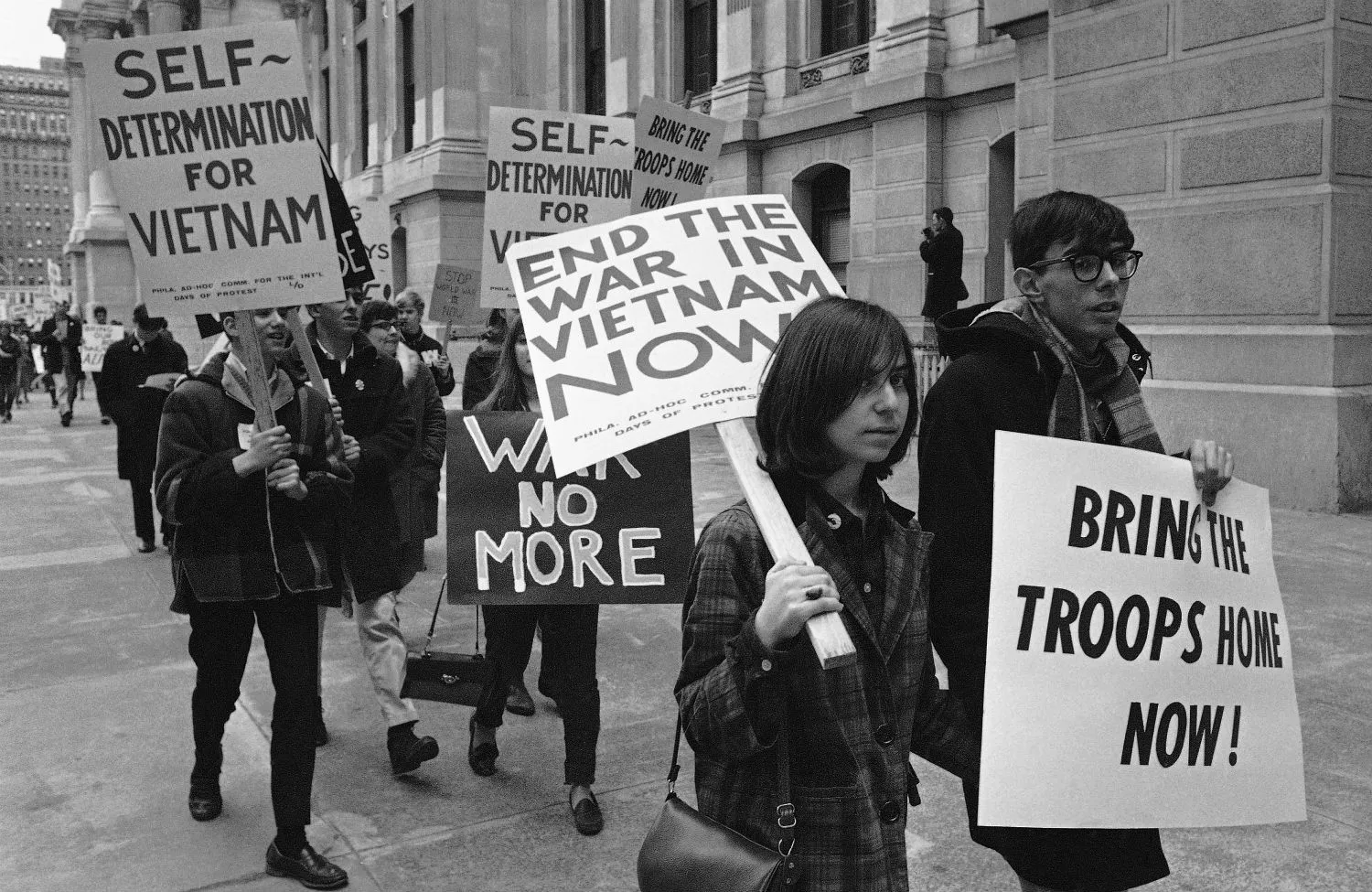
 Peace activists march in protest against the Vietnam War in 1968. (AP Photo/Bill Ingraham)
Peace activists march in protest against the Vietnam War in 1968. (AP Photo/Bill Ingraham)

Marc-William Palen
History Department, University of Exeter
Follow on Twitter @MWPalen

From the rise of America’s reactionary right to the rise of illiberal nationalism in Japan, here are this week’s top picks in imperial and global history.

Continue reading “This Week’s Top Picks in Imperial & Global History”

This Week’s Top Picks in Imperial & Global History

Portrait of Indian poet and musician Rabindranath Tagore. Cherishsantosh/Wikimedia Commons, CC BY-SA

Marc-William Palen
History Department, University of Exeter
Follow on Twitter @MWPalen

From remembering the first lyricist to win the Nobel to W.E.B. Dubois and world revolution, here are this week’s top picks in imperial and global history.

Continue reading “This Week’s Top Picks in Imperial & Global History”

This Week’s Top Picks in Imperial & Global History

Palmyra's world, c.first century AD
Palmyra’s world, c.first century AD

Marc-William Palen
History Department, University of Exeter
Follow on Twitter @MWPalen

From Brexit’s Edwardian imperial inheritance to when all roads led to Palmyra, here are this week’s top picks in imperial and global history. Continue reading “This Week’s Top Picks in Imperial & Global History”

Remembering a Democratic Legacy of the Great War in Interwar India

Stephen Legg
University of Nottingham

In 2019, India will embark upon a uniquely postcolonial set of centenaries. During the Great War the Defence of India Act (1915) had given the Government of India exceptional powers to silence dissent and crush any nascent “terrorist” or “revolutionary” movement. So effective had the powers proven, against both radical and moderate nationalists, that there were many within the colonial state who sought their extension into peace time. The “Rowlatt” (Anarchical and Revolutionary Crimes) Act of 1919 attempted this, and the resistance against the act was led by the ex-lawyer and future-Mahatma, Mr MK Gandhi. The centenary of the Rowlatt “Satyagraha” (the name for Gandhi’s non-violent, political “truth-force”, protest movement) will doubtless by commemorated by the Congress party and many others in India.

Yet both these commemorations may well be overshadowed in 2019 by the centenary of the “Jallianwala Bagh” massacre, in which the colonial state displayed the violence inherent in the Rowlatt regulations in Amritsar; the shooting of unarmed civilians that sparked a global outcry. While India was enduring violence at home it was plotting peace abroad. The year 1919 will also mark the centenary of India’s contribution to the Peace Treaty of Versailles. Few anticipated that India’s attendance at the conference would automatically make it a founder of the League of Nations, the only non-self-governing state to ever become a member. 1919 will be a busy year for centenaries; all of the above, in some way, are legacies of the First World War.

Who, then, will have time to commemorate the Government of India Act of 1919? Continue reading “Remembering a Democratic Legacy of the Great War in Interwar India”

This Week’s Top Picks in Imperial & Global History

tianxia

Marc-William Palen
History Department, University of Exeter
Follow on Twitter @MWPalen

From rethinking Pan-Africanism to the decolonial origins of global human rights, here are this week’s top picks in imperial and global history. Continue reading “This Week’s Top Picks in Imperial & Global History”

Lenin’s Imperialism, the Highest Stage of Capitalism – A New Talking Empire Podcast

lenin-imperialism

V. I. Lenin penned and published his influential pamphlet, Imperialism: The Highest Stage of Capitalism, in the midst of the First World War. Building upon Marxist contemporaries like Hilferding and Bukharin as well as non-Marxist theorists like J. A. Hobson, Lenin’s pamphlet would quickly come to embody the orthodox Marxist critique concerning the relationship between modern capitalism and imperialism. In this Talking Empire podcast, Dr Marc-William Palen discusses Lenin’s Imperialism and its legacy with Professor Richard Toye.

This Week’s Top Picks in Imperial & Global History

battleofalgiers

Marc-William Palen
History Department, University of Exeter
Follow on Twitter @MWPalen

From the end of war in the West to getting high with Hitler, here are this week’s top picks in imperial and global history. Continue reading “This Week’s Top Picks in Imperial & Global History”

The ‘Conspiracy’ of Free Trade – A Book Interview with Marc-William Palen

Christienna Fryar
SUNY Buffalo State

Cross-posted from New Books in History

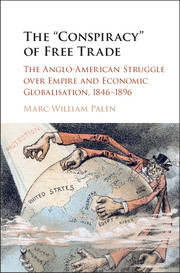
conspiracy of free trade coverAccounts of late-nineteenth-century US expansionism commonly refer to an open-door empire and an imperialism spurred by belief in free trade. In his new book The “Conspiracy” of Free Trade: The Anglo-American Struggle over Empire and Economic Globalization, 1846-1896 (Cambridge University Press, 2016), Marc-William Palen challenges this commonplace. Instead, he notes, American adherents to Richard Cobden’s free-trade philosophy faced off against and ultimately lost to a powerful version of protectionist economic nationalism inspired by German-American economic theorist Friedrich List. The success of Listian protectionism spurred closed-door, aggressive US expansionism and also challenged free-trade orthodoxies in Britain, where political-economic policy also shifted toward protectionism by the end of the nineteenth century.

Listen to the interview here.

This Week’s Top Picks in Imperial & Global History

fez-library

Marc-William Palen
History Department, University of Exeter
Follow on Twitter @MWPalen

From how to be a global historian to toppling statues of Gandhi, here are this week’s top picks in imperial and global history. Continue reading “This Week’s Top Picks in Imperial & Global History”

Podcast – ‘Brexit and food prices: the legacy of the Hungry Forties’

workhouseCross-posted from History & Policy’s Global Economics and History Forum

Plenty of attention is being paid to the political and constitutional effects of Brexit, but what will its economic impact be on life’s most basic commodities? How did food prices inform the debate in the weeks and months leading up to the referendum, and how have they informed debate in the past? How have the spectres of want and hunger been invoked over the last century and a half in political contexts, and are we paying them enough attention now?Screen Shot 2016-08-11 at 12.28.01 PM

Chaired by Dr Marc-William Palen (Exeter), four historians and policy makers debated these questions at King’s College London on 25 August 2016. Their combined expertise covered the period since the 1840s, the “Hungry Forties,” which live in political memory as the UK’s last serious sustained period of food poverty. The discussion, an initiative of History & Policy’s Global Economics & History Forum (@HandPGlobal) and sponsored by the Economic History Society and Imagining Markets, was aimed at policy makers and practitioners working in the area of food poverty and food security, and attendees came from the Food Standards Agency, the health sector, private consultancy and academia as well as interested members of the public. Continue reading “Podcast – ‘Brexit and food prices: the legacy of the Hungry Forties’”

This Week’s Top Picks in Imperial & Global History

perrys-landing
Commodore Perry’s landing at Shimoda (Shizuoka), 1854

Marc-William Palen
History Department, University of Exeter
Follow on Twitter @MWPalen

From censoring images of war to uncovering authoritarian internationalism, here are this week’s top picks in imperial and global history.

Continue reading “This Week’s Top Picks in Imperial & Global History”