Marc-William Palen
History Department, University of Exeter
Follow on Twitter @MWPalen

Marc-William Palen
History Department, University of Exeter
Follow on Twitter @MWPalen
Conquerors: How Portugal Seized the Indian Ocean and Forged the First Global Empire by Roger Crowley (Faber & Faber, September 2015; RandomHouse, December 2015)
Cross-posted from Asian Review of Books
“Had there been more of the world,” wrote Luís de Camões of the Portuguese explorers, they “would have discovered it.” That’s a line from Roger Crowley’s fantastic new narrative history, The Conquerors: How Portugal Seized the Indian Ocean and Forged the First Global Empire.
Crowley is out to reset the primacy of Columbus and the Spanish discovery of the Americas that resides in contemporary Western society. The age of exploration was a European endeavor but particularly an Iberian one. The Portuguese explorers were the ones who did the bulk of the discovering. Moreover, as Crowley relates, Portuguese swashbuckling penetrated the heart of Asian commerce and achieved a stunning dominance there. The Portuguese, within a matter of years, had created the first Western-dominated world empire since Alexander the Great. Their achievement was Act One in the saga of the rise of the West – and what a bloody, thrilling and unlikely victory it was. Continue reading “Conquerors: How Portugal Seized the Indian Ocean and Forged the First Global Empire”
Cross-posted from British Scholar Society
23-5 June, Senate House, University of London
Deadline for Submissions: Monday, 4 January 2016
Notifications as to Inclusion: Friday, 22 January 2016
This is the call for papers for the ninth annual Britain and the World Conference, which will be in London in June 2016. Paper and panel proposals should focus on Britain’s interactions with the world from the beginning of the seventeenth century to the present. Established scholars, scholars at the beginning of their careers, and graduate students are all equally welcome to apply and present at the conference.
The keynote speaker is Professor Catherine Hall (University College London), and the three plenary speakers are Professor Stephen Conway (University College London), Professor Margaret Hunt (Uppsala University), and Professor Philip Murphy (Institute of Commonwealth Studies).
The Britain and the World Conference is always a very sociable conference, and the 2016 conference will be no different, with the Conference Icebreaker on the Thursday evening, the Dinner Party on the Friday evening, and a post-conference night out in Soho beginning on the Saturday evening.
Continue reading “CFP: Britain and the World Conference 2016 – Deadline Jan. 4”
Editor’s Note: In the weeks leading up to the new year, please help us celebrate 2015 at the Imperial & Global Forum by checking out the past year’s 10 most popular posts.
Jamie Martin
Harvard University
Follow on Twitter @jamiemartin2
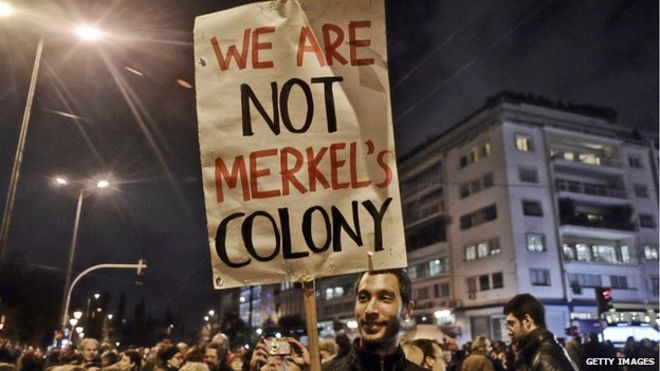
When news broke two weeks ago of the harsh terms of a new bailout for Greece, many questioned whether the country still qualified as a sovereign state. “Debt colony,” a term long used by Syriza and its supporters, was suddenly everywhere in the press. Even the Financial Times used the language of empire: “a bailout on the terms set out in Brussels,” as a 13 July editorial put it, “risks turning the relationship with Greece into one akin to that between a colonial overlord and its vassal.”
Suggestions like these have invited historical comparison. One parallel that’s been mentioned is that of Egypt during the late nineteenth century. In 1876, as a heavily indebted Egypt approached bankruptcy, the Khedive Ismail Pasha agreed to the creation of an international commission, staffed by Europeans, with oversight of the Egyptian budget and control over certain sources of public revenue. This arrangement, designed to ensure the timely servicing of foreign debts, opened a new and extended period of intensified European intervention in Egypt – the Caisse de la Dette Publique was not abolished until 1940. [continue reading]
Editor’s Note: In the weeks leading up to the new year, please help us celebrate 2015 at the Imperial & Global Forum by checking out the past year’s 10 most popular posts.
Marc-William Palen
History Department, University of Exeter
Follow on Twitter @MWPalen
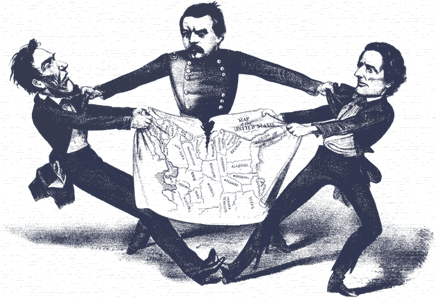
The outbreak of the American Civil War is now more than 150 years past. All the while, the question of what caused the conflict continues to spark disagreement, this despite a longstanding consensus among specialists that slavery – a cultural, political, ideological, and economic institution that permeated (and divided) mid-19th-century American society – was the primary cause of the war. One of the most egregious of the so-called Lost Cause narratives instead suggests that it was not slavery, but a protective tariff that sparked the Civil War.
On 2 March 1861, the Morrill Tariff was signed into law by outgoing Democratic President James Buchanan to protect northern infant industries. A pernicious lie quickly formed around the tariff’s passage, a lie suggesting that somehow this tariff had caused the US Civil War. By ignoring slavery’s central role in precipitating secession and Civil War, this tariff myth has survived in the United States for more than a century and a half – and needs to be debunked once and for all.
In trying to make their case but lacking adequate evidence for the 1860-61 period, “Lost Cause” advocates instead commonly hark back to the previously important role that another protective tariff had played in the 1832 Nullification Crisis. They then (mistakenly) assume the political scenario to have been the same three decades later – that southern secession from 1860-61 was but a replay of the divisive tariff politics of some thirty years before. From this faulty leap of logic, the argument then follows that the Republican Party’s legislative efforts on behalf of the Morrill Tariff from 1860 until its March 1861 passage became the primary reason for southern secession – and thus for causing the Civil War. [continue reading]
Editor’s Note: In the weeks leading up to the new year, please help us celebrate 2015 at the Imperial & Global Forum by checking out the past year’s 10 most popular posts.
RICHARD TOYEOur free online course Empire: The Controversies of Imperialism has now been running two weeks; between them, the participants have already made thousands of comments, often arguing their respective points of view quite vigorously. One persistent theme of debate is the degree to which it is possible to pass judgements on the actions of people in the past, who were operating on the basis of standards that are different from those held today. This is an important and difficult issue for historians in general, although the contentious topic of ‘Empire’ seems to throw it into particular relief. Everyone can agree that we shouldn’t reach assessments that are anachronistic; it is much harder to reach agreement on what constitutes anachronism. [continue reading]
Editor’s Note: In the weeks leading up to the new year, please help us celebrate 2015 at the Imperial & Global Forum by checking out the past year’s 10 most popular posts.
David Thackeray, Marc Palen, and Richard Toye
University of Exeter
As 3rd-year students scramble to finish their dissertations and as 2nd-year students begin formulating topics for their own, it’s worth noting the dramatic expansion in the availability of sources for the study of modern British and British imperial history in recent years.
Many of these sources are free to use. However, it is often hard to keep track of what materials are now available. What follows is a short guide (which is by no means comprehensive) but gives an introduction to some of the most important sources and may be of particular use to students planning dissertations, as well as other researchers. Please feel free to add your own suggestions in the ‘comments’ section. [continue reading]
Editor’s Note: In the weeks leading up to the new year, please help us celebrate 2015 at the Imperial & Global Forum by checking out the past year’s 10 most popular posts.
Samuel Moyn
Harvard University
Andrew Sartori
New York University
In his bestselling recent novel, The Thousand Autumns of Jacob de Zoet, David Mitchell provides a vignette of global intellectual history, as he imagines it took place in the last years of the eighteenth century at Dejima, the manmade island in Nagasaki’s harbor and the sole contact point between Japan and “the West” for more than two hundred years.
In Mitchell’s portrait, however, the intended isolation of the country that Dejima is supposed to secure is not working perfectly. The novel begins with the title character’s success in smuggling in a contrabandBible. He has help in doing so, thanks to the connivance of a young Japanese translator, Ogawa, with whom he strikes up a nervous friendship.
When the two first meet, instead of calling de Zoet on his illegal smuggling, the Japanese translator asks him about another book in his chest, “book of Mr. … Adamu Sumissu.” Jacob de Zoet replies: “Adam Smith?” It turns out that he is carrying a Dutch translation of Smith’s 1776 Wealth of Nations, a copy of which Ogawa had borrowed from someone else four years before. But he had had to return it to its owner in the midst of translating it. Now he has a new copy at hand, and can finish the job.
The presence of Smith at the outset of the novel seems right, for it reminds the reader of the history of capitalism that Smith portrayed, one of whose effects was the creation of new global relationships, such as those Mitchell imagines in his depiction of Dutch commerce. [continue reading]
Editor’s Note: In the weeks leading up to the new year, please help us celebrate 2015 at the Imperial & Global Forum by checking out the past year’s 10 most popular posts.
Daniel Foliard
Assistant Professor, Paris Ouest-Nanterre la Défense University
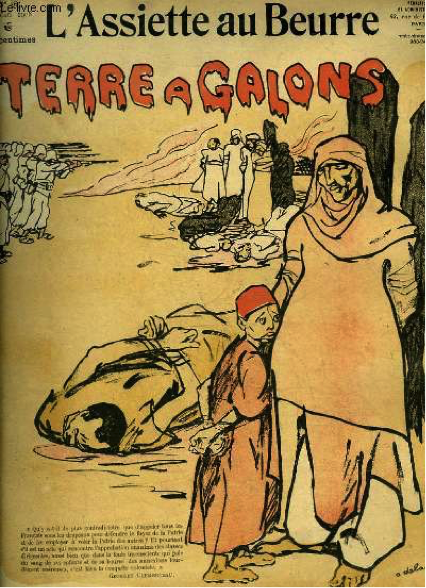
In a recent interview, George Wolinski (1934-2015), one of the Charlie Hebdo cartoonists killed in the Paris terrorist attacks on January 7, 2015, had claimed his magazine’s work was the legacy of L’Assiette au Beurre, an innovative satirical weekly published in France between 1901 and 1912.
Both stylistically and politically, the two periodicals, separated by more than a century, could also claim an affiliation with a long French tradition of dissent. Accordingly, although Charlie Hebdo is now known around the globe for its unmediated satire on religions, we should not overlook its position in the longer history of French anti-imperialism.
The 1881 laws on the freedom of the press had opened the golden age of French political caricature, paving the way for Samuel-Sigismond Schwarz to found L’Assiette au Beurre in 1901. The new illustrated weekly was, however, initially a failed commercial venture. [continue reading]
Editor’s Note: In the weeks leading up to the new year, please help us celebrate 2015 at the Imperial & Global Forum by checking out the past year’s 10 most popular posts.
Evan Smith
Flinders University
Follow on Twitter @Hatfulofhistory
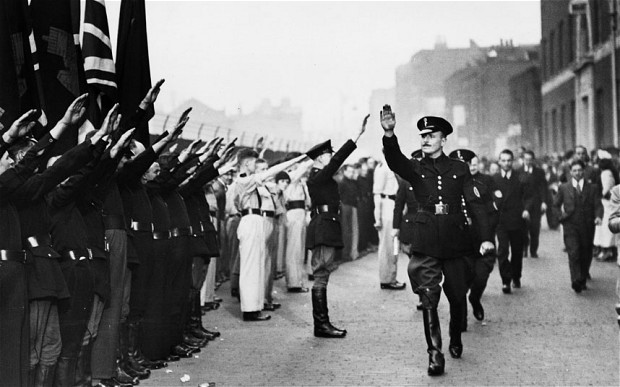
‘Our world mission is the maintenance and development of the heritage of Empire,’ the leader of the British Union of Fascists (BUF), Sir Oswald Mosley, declared in the BUF’s journal, Fascist Quarterly, in 1936. Although often overlooked by scholars of British fascism, this pro-imperial sentiment was central to the ideology of the BUF. For the BUF, the maintenance of the British Empire was imperative – key to keeping Britain’s place within the world and ensuring living standards in the domestic sphere.
Britain formed the metropole of the Empire, but the settler colonies (achieving Dominion status just prior to the inception of the BUF) were also seen as integral to the preservation of the Empire. Australia, New Zealand, Canada and South Africa were viewed by the BUF as bastions of the imperial spirit that would help revive Britain at the core of the Empire and create what Mosley described as a ‘Greater Britain’, resurrecting a term that had first appeared in the late Victorian period. [continue reading]
A Centre Talk by
Dr. Karine V. Walther
Georgetown University School of Foreign Service in Qatar
Abstract: When the United States annexed the Philippine Islands in 1898 after their victory over Spain during the Spanish-American War, they made over 300,000 Filipino Muslims— as well as over 6 million Catholics and 200,000 animists— American colonial subjects. Although Filipino Muslims, or Moros as they were called by the Spanish, and later, the Americans, constituted only a small percentage of the population, they controlled a third of the territory annexed by the United States in 1898. During their colonial governance of the Islands, the intellectual and spiritual roots driving American imperial rule over Filipino Muslims were entrenched in—and relied upon— orientalist tropes that cast Muslims as uncivilized or barbaric and, importantly, incapable of self-government. What was unique about this moment, however, was that contrary to previous American interactions with Muslims around the world, this marked the first time the United States would rule over Muslim subjects as part of its own empire. This talk will analyze how American colonial officials applied their perceptions of Islam to the governance of what they described as their new “Mohammedan wards” in the Philippines.
When: Friday, 11 December at 3.30
Where: Forum Seminar Room 5, University of Exeter, Streatham Campus
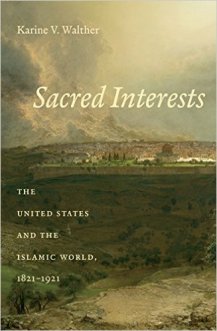
This talk is taken from her wider book study, Sacred Interests: The United States and the Islamic World, 1821-1921 (University of North Carolina Press, 2015).
Editor’s Note: In the weeks leading up to the new year, please help us celebrate 2015 at the Imperial & Global Forum by checking out the past year’s 10 most popular posts.
Lori Lee Oates
History Department, University of Exeter
Follow on Twitter @LoriLeeOates
In late June, I had the honour of hearing Professor David A. Bell speak at the Society for the Study of French History conference at the University of St. Andrews, Scotland. The theme of the conference wasTurning Points in French History and he spoke on the period between 1715 to 1815. Professor Bell went on to discuss ‘the global turn’. He noted that a significant percentage of current history Ph.D. students are using global analysis as the main methodology for their thesis. He then discussed the limits of this methodology, particularly as a largely structural analysis. He argued that the methodologies of ‘the linguistic turn’ might actually be more helpful to us in analyzing the process of why change continues after these same global structures break down. Linguistic analysis largely views language as a structure that is culturally inherited and something that limits our ability to comprehend society beyond those concepts that are available to us in our immediate environment. [continue reading]
Editor’s Note: In the weeks leading up to the new year, please help us celebrate 2015 at the Imperial & Global Forum by checking out the past year’s 10 most popular posts.
Antifascist demonstrators in London, October 1935. Photo: National Media Museum/SSPL.
John Munro
Saint Mary’s University[1]
There’s a lot to be said for emphasizing the structuring role of colonialism and anticolonialism across the twentieth century. To contextualize the world wars, the Cold War, and contemporary global capitalism as embedded in a larger set of imperial continuities is to offer an indispensable corrective to the overemphasis of 1945 as epistemic break; the embellishment of US history as an empire-free zone; or the exaggeration of the distance between imperialism and free trade. Fredrik Petersson’s astute Versailles-to-Bandung emplotment of transnational anticolonial activism is thus a very compelling one, especially when read alongside several concurring periodizations.[2]But how we might conceive of antifascism in this empire-centered genealogy requires further attention. Whether antifascism was itself an anticolonialism, in other words, matters much for how we make sense of the twentieth century. [continue reading]
Editor’s Note: In the weeks leading up to the new year, please help us celebrate 2015 at the Imperial & Global Forum by checking out the past year’s 10 most popular posts.
Michael Goebel
Freie Universität Berlin
Follow on Twitter @mgoebel29
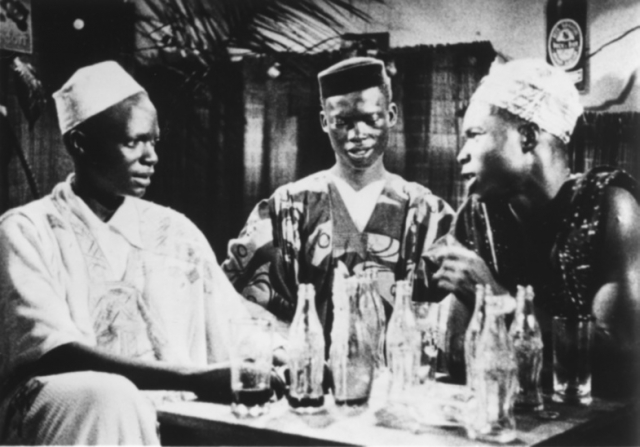
Anxieties over the possible political fallouts of African and Asian migration to Europe have a much longer history than the current refugee crisis might have you suspect. Colonial migration to interwar Paris, as I argue in Anti-Imperial Metropolis, turned into an important engine for the spread of nationalism across the French Empire. Studying the everyday lives of these migrants, in turn, might also offer a way out of the impasse that global historians currently face.
Let me begin with an anecdote that encapsulates my argument: In autumn 1919, while statesmen gathered in Paris’s upscale banlieues to redraw the political world map, local police hired a discharged Vietnamese adjutant as an undercover agent. His task was “to exercise a discrete surveillance” over a compatriot of his who had distributed leaflets entitled “The Demands of the Annamite People” among diplomats and informal spokesmen in the city’s shabbier neighbourhoods. [continue reading]
Marc-William Palen
History Department, University of Exeter
Follow on Twitter @MWPalen
You must be logged in to post a comment.