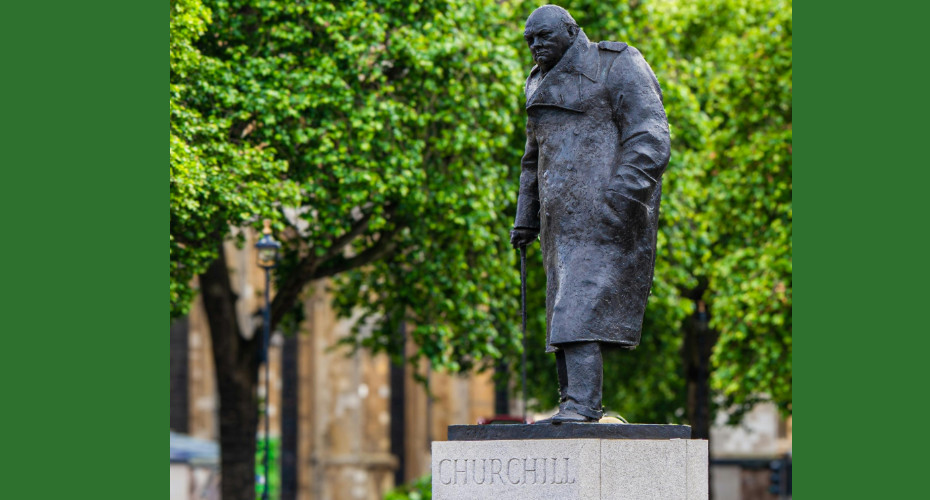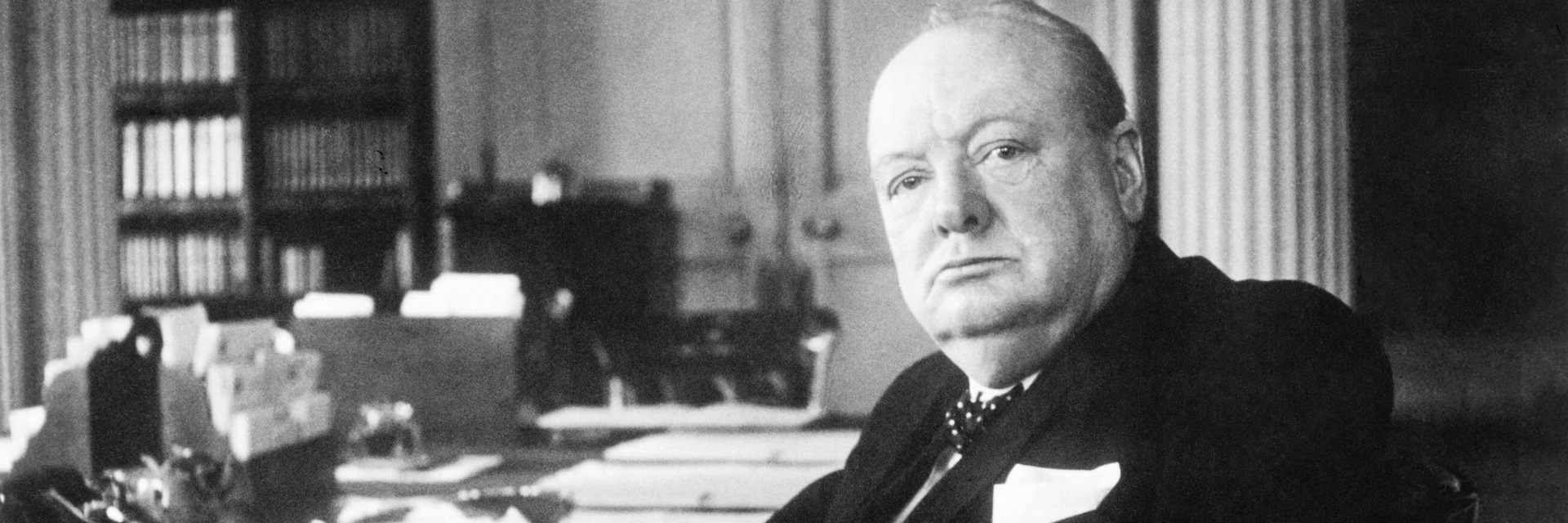
Experts analyse extraordinary wartime career of Winston Churchill in new podcast

Churchill: The Finest Half Hour covers the most momentous years in Churchill’s remarkable life, when the outbreak of war with Nazi Germany saw him recalled from the political wilderness

Kerra Maddern

cross-posted from University of Exeter News

The extraordinary career of Winston Churchill and the events which led to him becoming Britain’s leader during World War Two are the focus of a fascinating new podcast.

Churchill: The Finest Half Hour brings together two leading international academic experts on the politician Professor Richard Toye and Dr Warren Dockter.

They analyse in detail Churchill’s dramatic rise to power and bring global audiences fascinating facts and fresh insights into the career of one of the most remarkable figures of 20th century history.

Churchill: The Finest Half Hour covers the most momentous years in Churchill’s remarkable life, when the outbreak of war with Nazi Germany saw him recalled from the political wilderness to take charge of the Royal Navy.

Continue reading “Experts analyse extraordinary wartime career of Winston Churchill in new podcast”

Signs of Resistance: Linguistic Landscapes and Urban Tensions in Santa Marta, Venice

Berizzi Mariachiara[1], Boam Olivia[2], Fourie Nicholas Charles[3], Pizarro Jacinto Laura[4], Yücel Dinç Fatma[5]

 Linguistic Landscapes‘, Venice International University Summer School 2025

Faculty: Kurt Feyaerts, KU Leuven (Coordinator); Richard Toye, University of Exeter (Coordinator); Matteo Basso, Iuav University of Venice; Geert Brône, KU Leuven; Claire Holleran, University of Exeter; Eliana Maestri, University of Exeter; Michela Maguolo, Iuav, University of Venice; Paul Sambre, KU Leuven

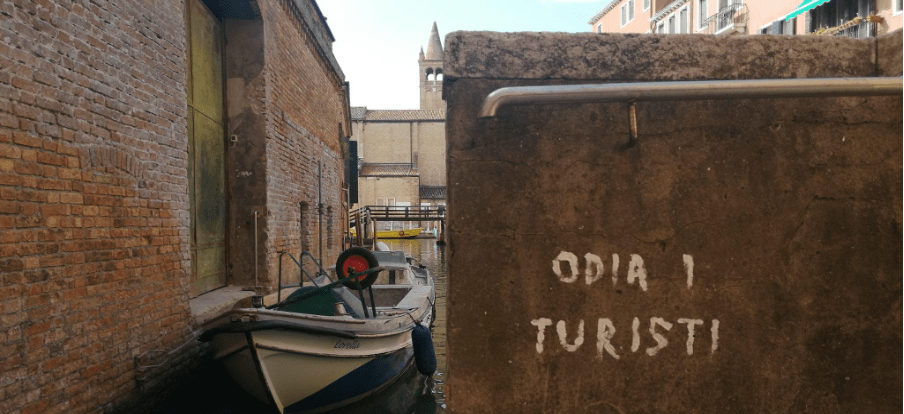
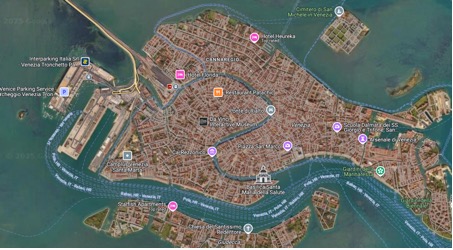
In Santa Marta, a quiet Venetian district, the city itself becomes a text: walls, streets, and public spaces speak through signs, graffiti, and infrastructures that reveal five interwoven themes: Anti-tourism, Transport & Mobility, Multilingualism & Symbolic Resistance, Government & Authority, and Prison as an Edge. From anti-tourism sentiments to the symbolic tensions of incarceration, our investigation examines how language, infrastructure, and public space interact to shape meaning and mobility. As shown in Figure 1, which provides a satellite view of Venice highlighting key landmarks and mobility nodes, our study is grounded in the spatial reality of the city. We begin by analysing local resistance to mass tourism, then move through the spatial logic of transport hubs like Piazzale Roma. We further consider multilingualism and graffiti as forms of symbolic resistance, explore the role of governance in shaping visibility and authority, and finally, interpret the Santa Maria Maggiore prison as both a physical and discursive edge.

Satellite view of Venice highlighting key landmarks and mobility nodes, including Santa Marta and Piazzale Roma. (Snapshot by Boam Olivia Boam, 3 July 2025)
Continue reading “Signs of Resistance: Linguistic Landscapes and Urban Tensions in Santa Marta, Venice”

Venice in absentia: A linguistic landscape of San Francesco della Vigna

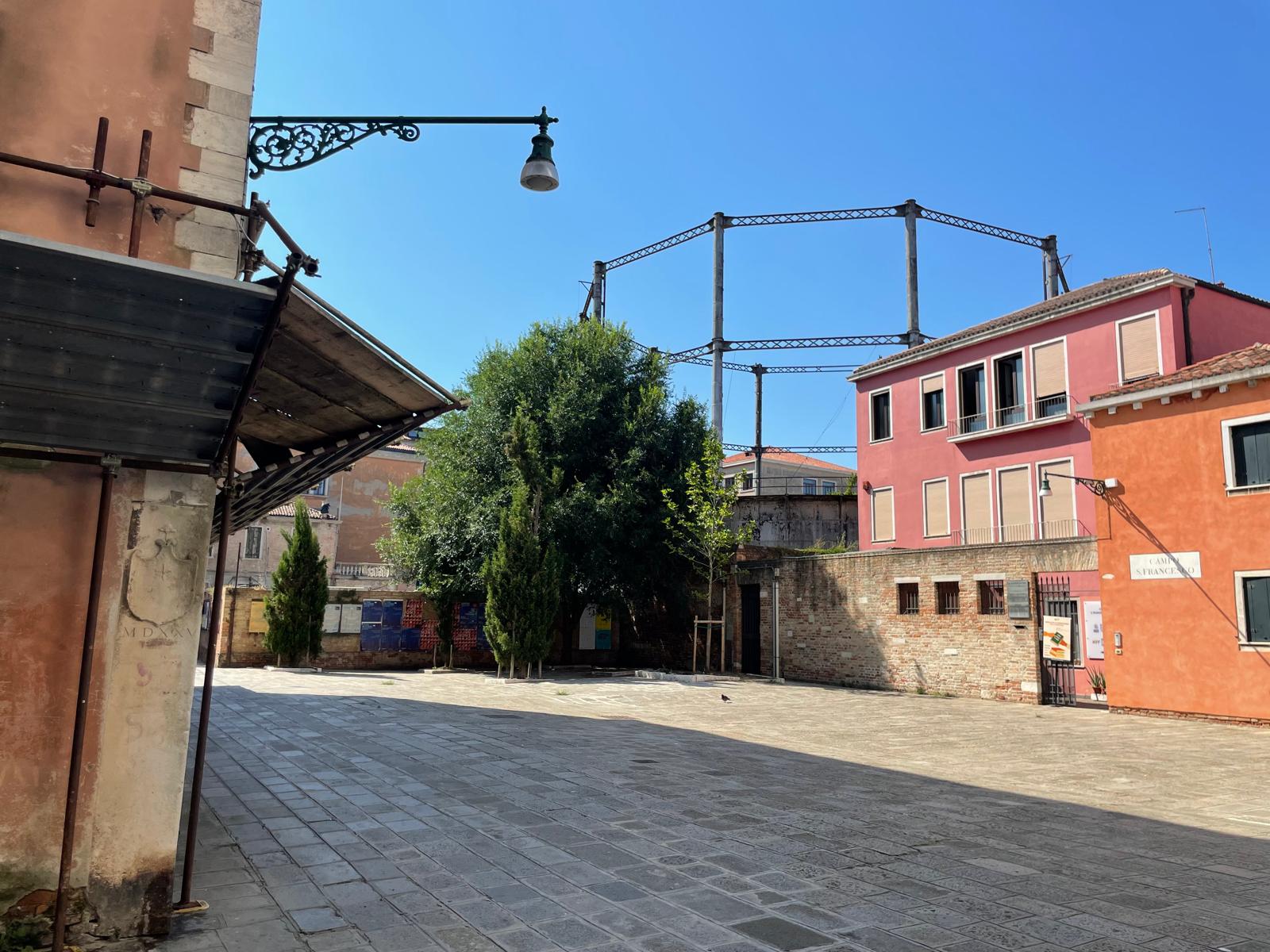
Campo San Francesco, San Francesco della Vigna

Hualing Zhai[1], Quinten Heymans[2], Bartolomeo Perazzoli[3], Sophie Paynter[4], Alice Wadsworth[5]

Students of ‘Linguistic Landscapes‘, Venice International University Summer School 2025

Faculty: Kurt Feyaerts, KU Leuven (Coordinator); Richard Toye, University of Exeter (Coordinator); Matteo Basso, Iuav University of Venice; Geert Brône, KU Leuven; Claire Holleran, University of Exeter; Eliana Maestri, University of Exeter; Michela Maguolo, Iuav, University of Venice; Paul Sambre, KU Leuven

Introducing San Francesco della Vigna

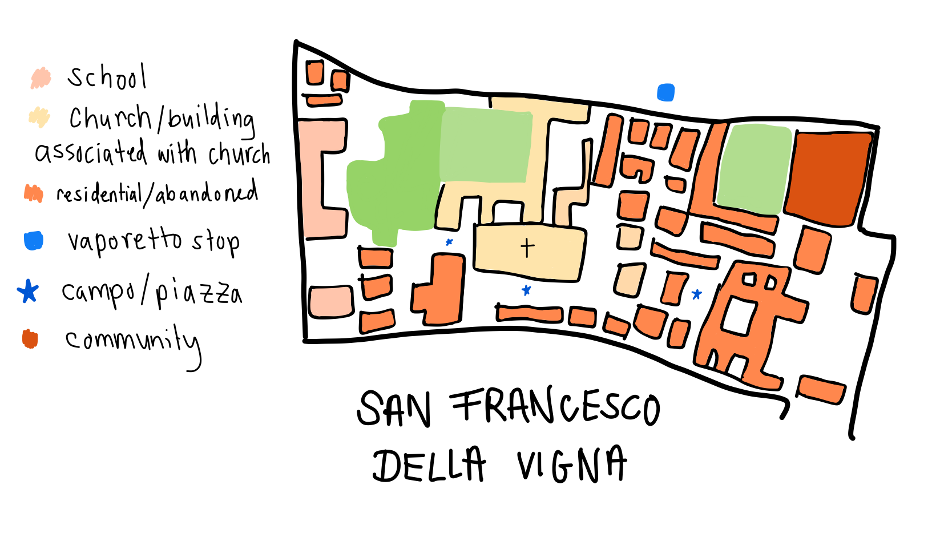
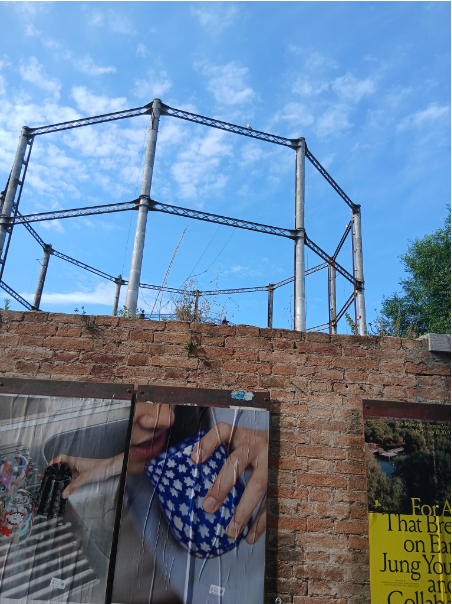
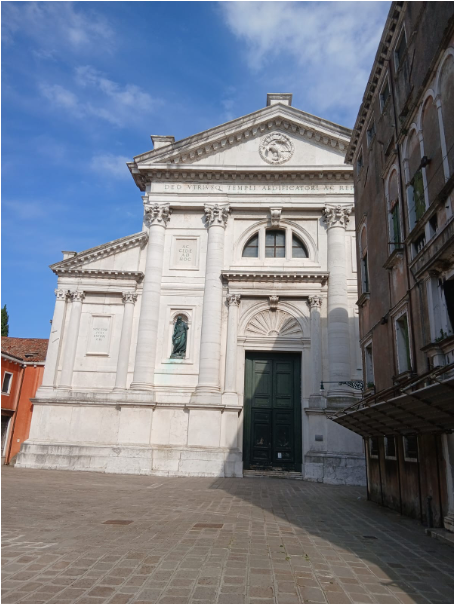
San Francesco della Vigna (later also SFdV), located on the northeastern edge of Venice, presents a sharp contrast to the city’s typical romantic image. The area may feel, in some ways, stuck in time, with the campo (the Venetian equivalent of a piazza) overlooked by a large gasholder (image 3) on one side, and the beautiful if somewhat imperious 16th-century church of San Francesco della Vigna (image 4). Our group, as part of the 2025 VIU Linguistic Landscapes summer school, explored this working-class neighbourhood focusing on the themes of presence and absence. At first, the area seems quiet and almost forgotten, with few signs of life such as shops, cafés, or passersby. However, through exploring the linguistic and semiotic landscapes and the soundscape of the area, we found a quietly strong local identity to be bubbling away beneath the seemingly barren surface.

Map of San Francesco della Vigna (Alice Wadsworth)
Campo San Francesco
Church of San Francesco della Vigna

We were lucky enough to explore every inch of the isola, and the walls were deep in conversation with the neighbourhood and with each other. So perhaps this work, and any work of mapping out a linguistic landscape, can be considered a kind of ethical ‘eavesdropping’. We observed- and listened- from outside but we were also able to conduct a few interviews as part of our research. Interviews with residents highlighted ongoing gentrification and local feelings of resistance. One construction worker noted that scaffolding usually indicates Airbnb renovations, reflecting economic and demographic changes.

Continue reading “Venice in absentia: A linguistic landscape of San Francesco della Vigna”

New Archaeology and History PhD Funding Opportunities and Masterclasses

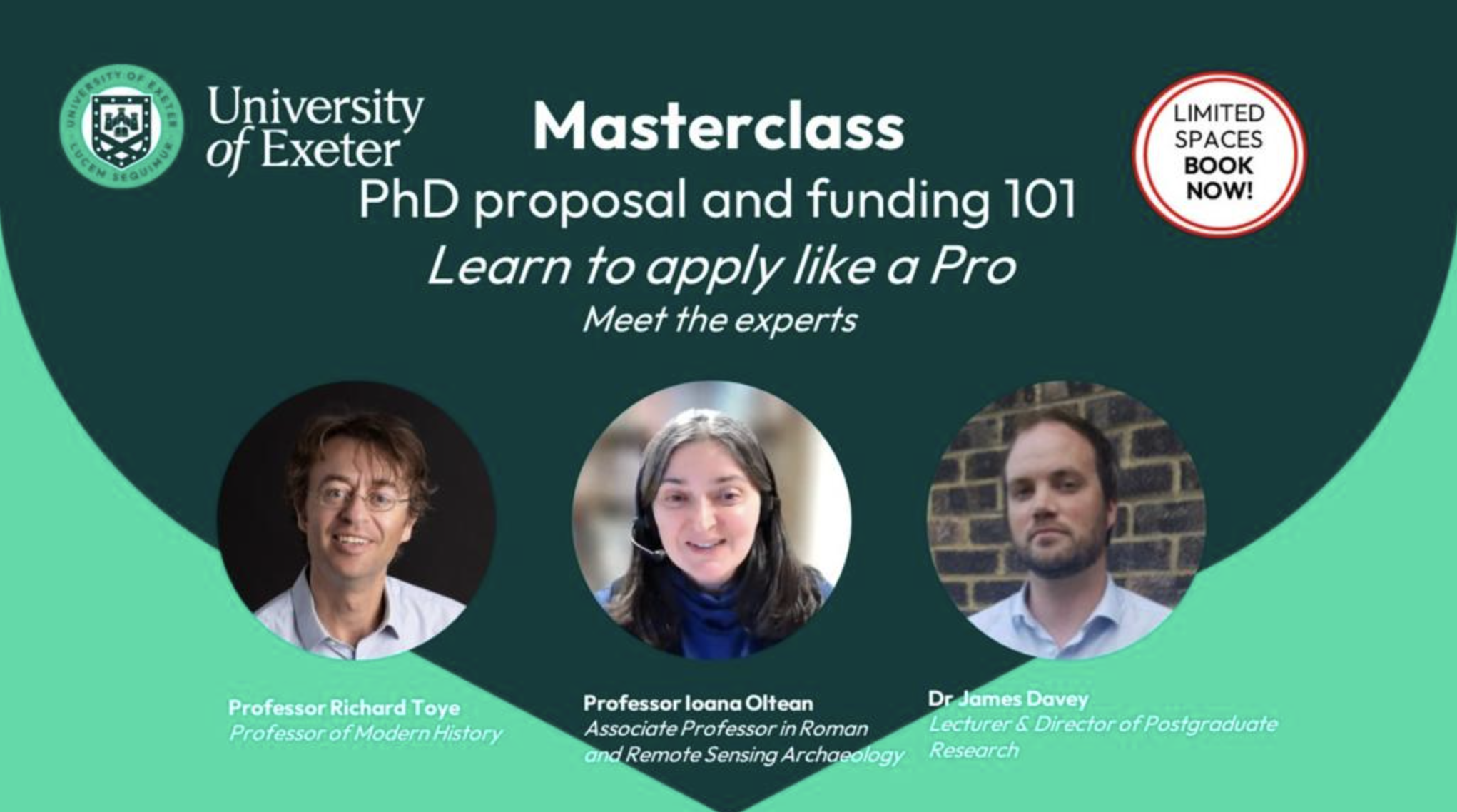
Interested in pursuing a PhD in Archaeology or History at the University of Exeter?

Then be sure to check out these new funding opportunities and free masterclasses for writing a strong proposal.

AHRC South, West and Wales Doctoral Training Partnership (SWWDTP)

  • This is for projects that fall within the Arts and Humanities, so appropriate for any student wanting to do a PhD in Archaeology or History
  • They are advertising up to 39 studentships this year: this includes up to 35 student-led and up to 4 Collaborative Doctoral Awards.
  • Students are expected to apply with supervisors drawn from two separate participating institutions (the other institutions are: Aberystwyth, Amgueddfa Cymru (National Museums Wales), Bath Spa, Bristol, Cardiff, Cranfield, Reading, Southampton, UWE). Any single-institution supervisions must be strongly justified and made clear that there are no reasonable alternatives within the DTP.
  • Applications will open on 25 November 2024 and close on 20 January 2025.
  • More details can be found here: https://www.sww-ahdtp.ac.uk/prospective-students/how-to-apply/
Continue reading “New Archaeology and History PhD Funding Opportunities and Masterclasses”

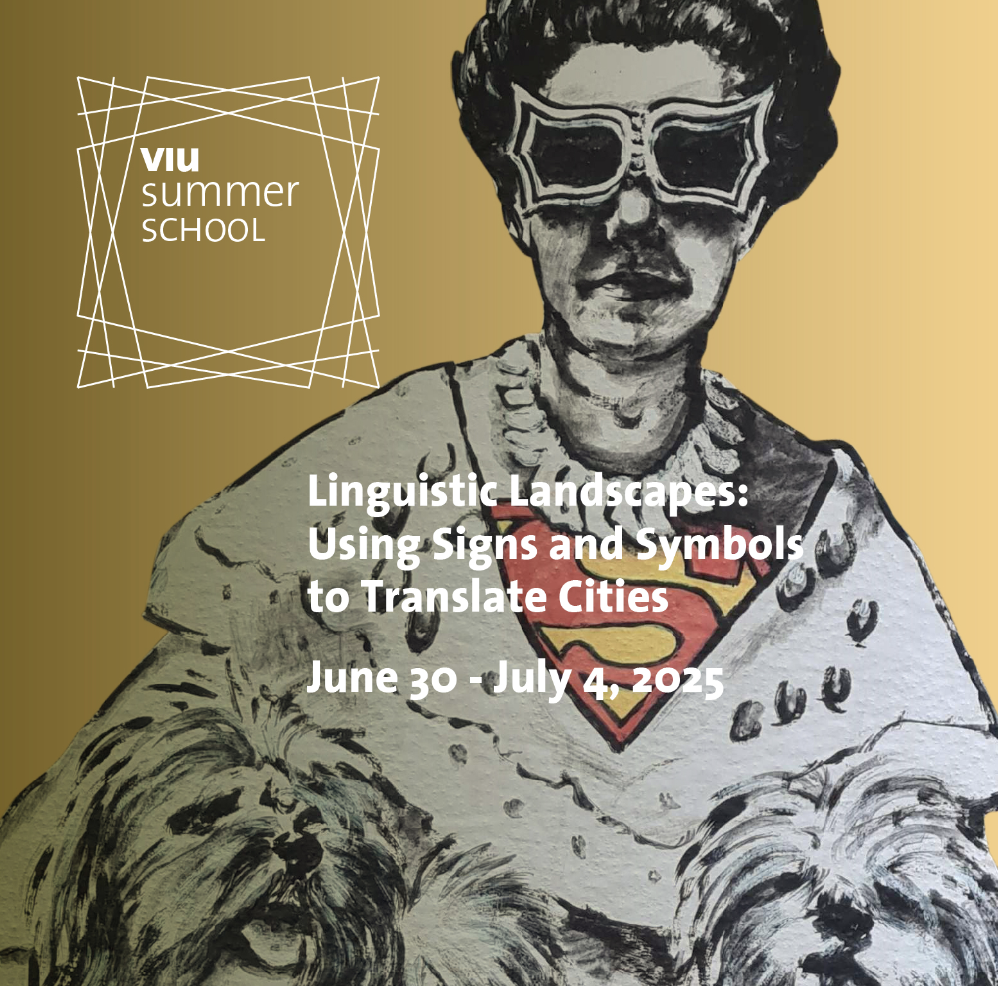
Venice Summer School 2025 – Call for Applications – ‘Linguistic Landscapes: Using Signs and Symbols to Translate Cities’

June 30 – July 4, 2025

Call for applications: December 2, 2024 – March 2, 2025

Cross-posted from Venice International University

This course focuses on the growing interdisciplinary field of Linguistic Landscapes (LL), which traditionally analyses “language of public road signs, advertising billboards, street names, place names, commercial shop signs, and public signs on government buildings”, as they usually occur in urban spaces.

More recently, LL research has evolved beyond studying only verbal signs into the realm of semiotics, thus extending the analytical scope into the multimodal domain of images, sounds, drawings, movements, visuals, graffiti, tattoos, colours, smells as well as people. 

Students will be informed about multiple aspects of modern LL research including an overview of different types of signs, their formal features as well as their functions.

Faculty

Kurt Feyaerts, KU Leuven (Coordinator)
Richard Toye, University of Exeter (Coordinator)
Matteo Basso, Iuav University of Venice
Geert Brône, KU Leuven
Claire Holleran, University of Exeter
Eliana Maestri, University of Exeter
Michela Maguolo, Independent researcher
Luca Pes, Venice International University
Paul Sambre, KU Leuven

Continue reading “Venice Summer School 2025 – Call for Applications – ‘Linguistic Landscapes: Using Signs and Symbols to Translate Cities’”

“Anytown Joins Lobby For Fairer Deal For World’s Poor”: Mass Lobbies Against World Poverty in Thatcher’s Britain

Richard Toye
University of Exeter

This post is based on a paper delivered at the recent CIGH workshop on ‘New Approaches to Imperial and Post-Imperial Politics’.

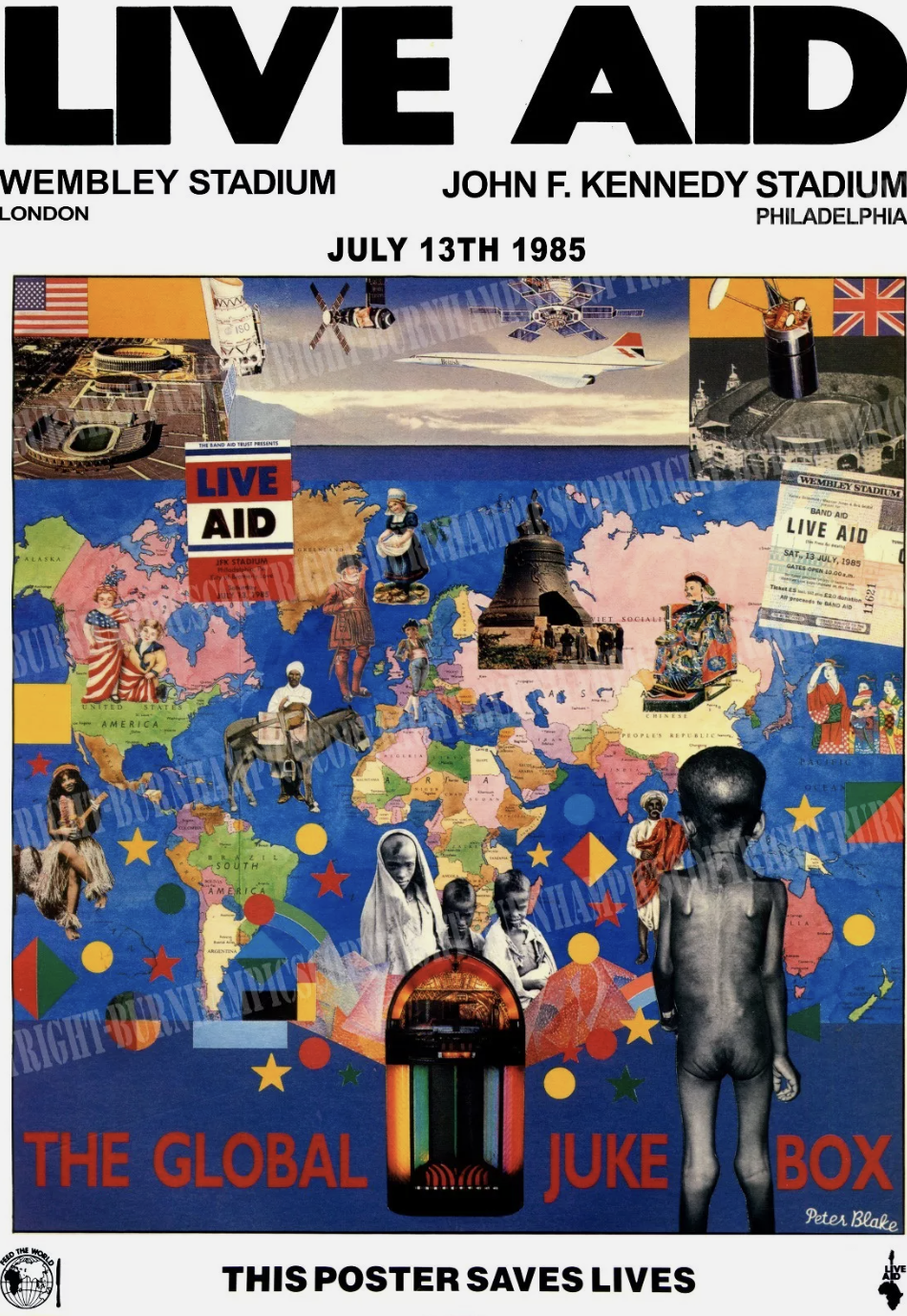
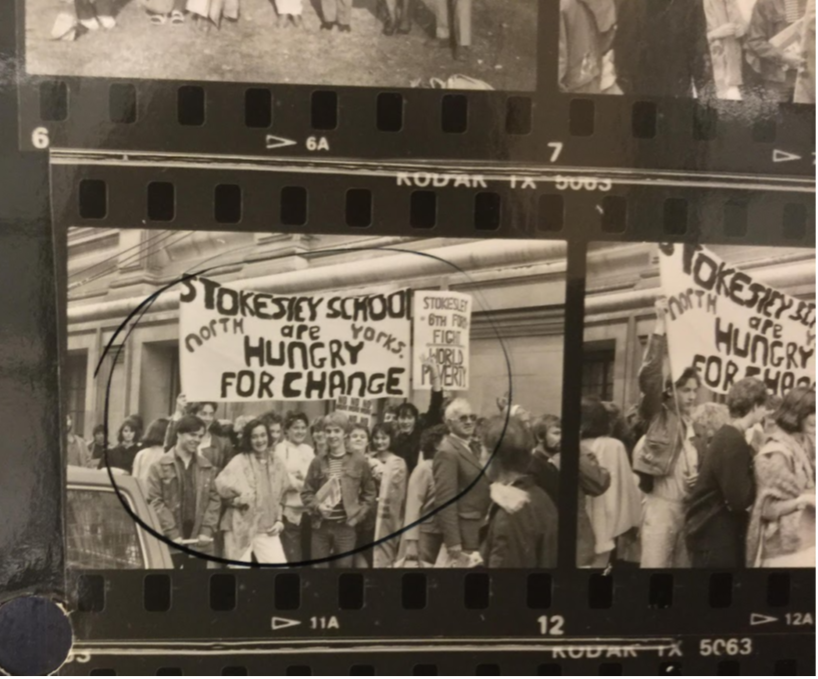
The origins of this post lie in some photographic contact sheets I discovered in the Oxfam Archive at the Bodleian Library, dating back to 1985. These captured a significant mass lobby against world poverty that took place that year. What immediately caught my eye was the slogan “Hungry for Change,” a rallying cry from the 1980s, which brought back memories of my own experiences as a teenage volunteer in an Oxfam shop in Brighton.

Not only did the mass lobby involve school children traveling all the way from North Yorkshire and other far-flung places to participate, but the photos also underscored the fact that someone, likely Oxfam itself, found it worthwhile to document the event by hiring a photographer. The day’s activities were intended not merely as a protest but as an “image-event”.

But the research I’ve done on this topic isn’t just about this one exciting day. It’s about a broader phenomenon of political activism during the 1980s, focusing on the mass lobbying efforts around aid, humanitarianism, and the struggle against poverty. This era was marked by well-organized efforts by NGOs, churches, and concerned citizens who sought to challenge the dominant policies of the time.

Continue reading ““Anytown Joins Lobby For Fairer Deal For World’s Poor”: Mass Lobbies Against World Poverty in Thatcher’s Britain”

Considering a PhD @ExeterClio or @UofEArchaeology? Sign up for our free MOOC and Masterclass

Course: Masterclass PhD Application | Exeter Online Courses Moodle

After this short course you should be able to:

• Maximise your chances of gaining admittance to a PhD programme and winning funding
• Identify and get guidance from potential supervisors
• Select appropriate content and structure for the proposal
• Use suitable tone, language, length, and style
• Use suitable referencing and formatting conventions
• Understand differences between disciplines
• Know how to avoid common errors
• Review a sample proposal
• Submit your idea and choose suitable next steps

Also, be sure to sign up for a free PhD Masterclass

The Digital Turn and Global History, Exeter-Copenhagen Collaborative Workshop

David Thackeray
University of Exeter

The Centre for Imperial and Global History at the University of Exeter hosted a workshop with colleagues from Hum:Global, the Global Humanities centre at Copenhagen University, this April on the challenges that the development of digital technologies poses for historians of global history. Amongst the key themes that connect our papers is a concern that many digitisation initiatives continue to focus on the history of the nation state and are driven by commercial imperatives. Existing approaches run the risk of reinforcing historical inequalities in access to knowledge between the Global North and South, an issue which has been discussed at length in a recent ‘History Lab’ feature in the American Historical Review. These concerns are becoming more pressing with the rapid advance of AI.

Jon Lawrence introduced the Living With Machines project (2018-23), a major collaboration led by the Alan Turing Institute and the British Library. As part of this project, the team have explored new ways of using the British Library’s existing digitised newspapers accessible to researchers in new ways. This involves critically reflecting on the decisions which were made regarding which papers to digitise twenty years ago and developing a more representative view of the nineteenth-century newspaper landscape through the development of an ‘environmental scan’.

Stuart Ward discussed his new project which uses the round-the-world travels of Sir Charles Dilke to consider how global imaginaries were reshaped in the late 1860s. Dilke was a young man when he undertook his circumnavigation, which followed the British empire around the globe, and the project was improvised rather than being meticulously planned. One of the challenges of this project will be to use historical newspapers to better understand Dilke’s mental world. Dilke avidly read the local press during his travels to consider how the connections between the different places he visited were being transformed by rapid advances in communications.

Continue reading “The Digital Turn and Global History, Exeter-Copenhagen Collaborative Workshop”

Linguistic Landscapes: Using Signs and Symbols to Translate Cities (March 5 Deadline)

Deadline: March 5

The Summer School Linguistic Landscapes: Using Signs and Symbols to Translate Cities aims at equipping participants with a comprehensive understanding of modern Linguistic Landscapes (LL) research. This course focuses on the growing interdisciplinary field of LL, which traditionally analyses “language of public road signs, advertising billboards, street names, place names, commercial shop signs, and public signs on government buildings”, as they usually occur in urban spaces. More recently, LL research has evolved beyond studying only verbal signs into the realm of semiotics, thus extending the analytical scope into the multimodal domain of images, sounds, drawings, movements, visuals, graffiti, tattoos, colours, smells as well as people.  Students will be informed about multiple aspects of modern LL research including an overview of different types of signs, their formal features as well as their functions.

Suitable for: current final year Undergraduates (finalists, BA3), MA and MPhil/PhD Students in Linguistics, Sociology, Classical Studies, (Business) Communication Studies, History, Cultural Studies, Political Studies, Translation Studies or any other related discipline.

Read more about 2023 student experiences here.

For further information visit the VIU website or send an email to summerschools@univiu.org

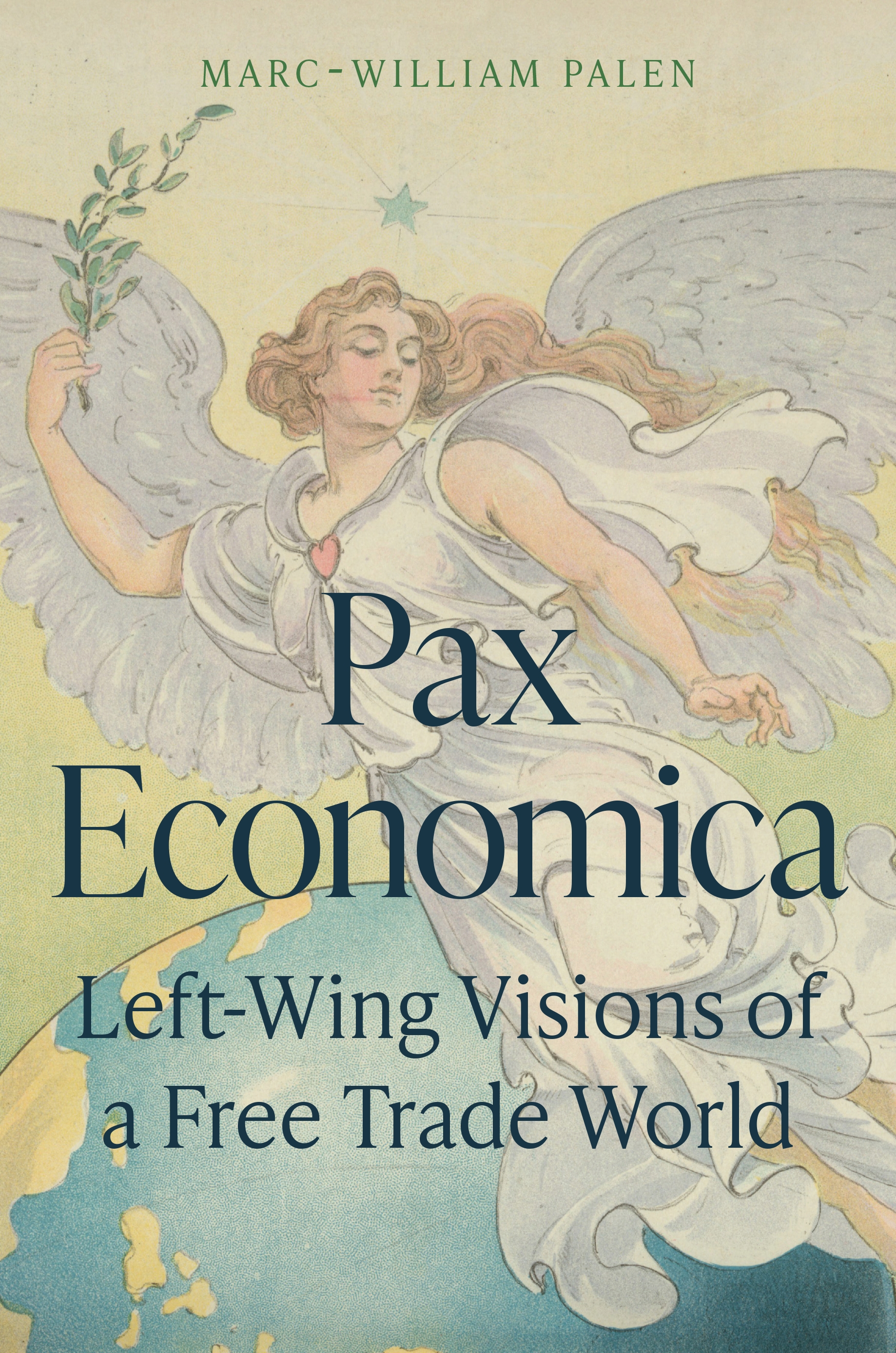
Pax Economica: Left-Wing Visions of a Free Trade World

Richard Toye and Marc-William Palen
University of Exeter

In this episode of the Talking Empire series, Professor Richard Toye sat down with Marc-William Palen to discuss his new book Pax Economica: Left-Wing Visions of a Free Trade World (Princeton University Press, 2024). Pax Economica recovers the radical left-wing origins of free trade and globalization.

Through a wide-ranging discussion – from Gershwin musicals, to Norman Angell, to cheap food, and neoliberalism – Palen discusses with Toye the ways in which the book’s actors strike a stark contrast to today’s common association of free trade with right-wing free marketeers. Pax Economica‘s counterhistory of an idea traces how – beginning in the mid-19th century – liberal radicals, socialist internationalists, feminists, and Christians joined left-wing forces to undermine imperialism and war.

Through networks crisscrossing the British, American, Spanish, German, Dutch, Belgian, Italian, Russian, French, and Japanese empires, these left-wing globalists condemned the economic nationalist turn to high tariffs and government subsidies among the industrializing empires after 1870. They argued that the extreme protectionism and trade wars of the rival Euro-American empires created the monopolies, trusts, geopolitical conflict, and colonial expansion that followed, culminating in two world wars.

Their envisaged left-wing free trade order – what they called their “pax economica” – instead promised peace, prosperity, democracy, and decolonization, to be maintained through supranational governance via the League of Nations, the United Nations, and the World Trade Organizaiton. The book’s findings offer timely lessons for our increasingly economic nationalist and war-torn world.

Click here for further details and to purchase a copy.

Linguistic Landscapes: Using Signs and Symbols to Translate Cities

June 24-28, 2024

Call for applications: December 1, 2023 – March 5, 2024 via the VIU website

This course focuses on the growing interdisciplinary field of Linguistic Landscapes (LL), which traditionally analyses “language of public road signs, advertising billboards, street names, place names, commercial shop signs, and public signs on government buildings”, as they usually occur in urban spaces.

More recently, LL research has evolved beyond studying only verbal signs into the realm of semiotics, thus extending the analytical scope into the multimodal domain of images, sounds, drawings, movements, visuals, graffiti, tattoos, colours, smells as well as people. 

Students will be informed about multiple aspects of modern LL research including an overview of different types of signs, their formal features as well as their functions.

Continue reading “Linguistic Landscapes: Using Signs and Symbols to Translate Cities”

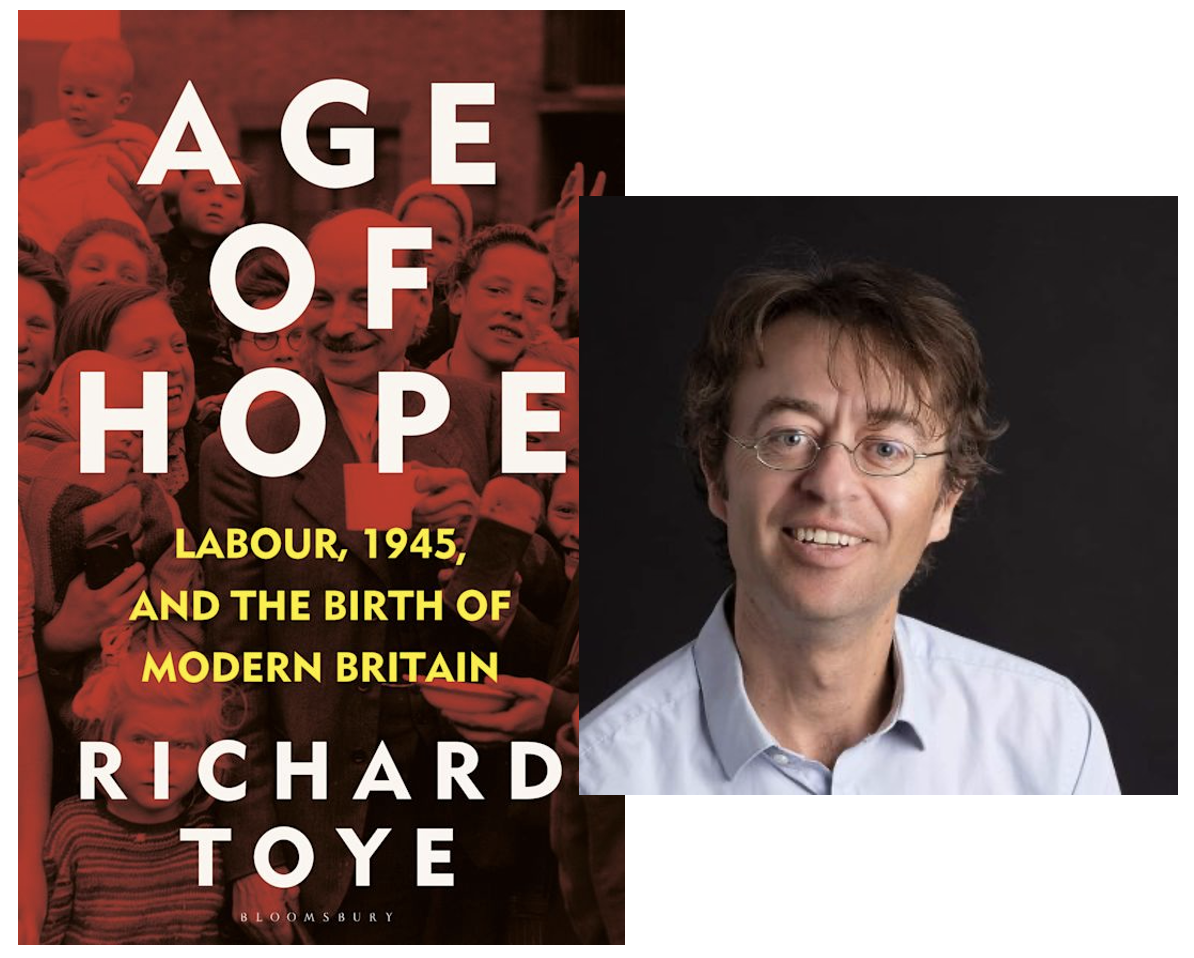
Age of Hope: A CIGH Interview with Richard Toye

Marc-William Palen and Richard Toye
University of Exeter

Richard Toye, Professor of Modern History at the University of Exeter, needs little introduction to readers of the Imperial & Global Forum. Toye is a leading historian of modern British politics, the British Empire, and postwar internationalism. Among his previous publications are The Labour Party and the Planned Economy, 1931-1951 (2003), Churchill’s Empire (2010), Arguing about Empire: Imperial Rhetoric in Britain and France, 1882-1956 (with Martin Thomas, 2017), Winston Churchill: A Life in the News (2020), and, with David Thackeray, Age of Promises: Electoral Pledges in Twentieth Century Britain (2021). Toye is also former director of the Centre for Imperial and Global History and the host of the Imperial & Global Forum’s ‘Talking Empire’ podcast series. You can follow him on Twitter/X @RichardToye and on Threads @Richard_John_Toye. His newest publication, Age of Hope: Labour, 1945, and the Birth of Modern Britain, will be published with Bloomsbury on 12 October 2023, in advance of the 100th anniversary of the first Labour government in 2024. Age of Hope is the subject of our interview today. 

MP: Briefly, how would you summarize Age of Hope

RT: It is an attempt to put the Labour government of 1945 into long-term perspective. This involves both going back to the 1880s, when many of its leading figures were born, and forward to the present day, when its legacy continues to be felt. Although I hope that readers of all political persuasions can profit from it, I don’t attempt to be absolutely politically neutral. Especially in the conclusion I make some suggestions about how the Labour Party might learns some of the lessons of the Attlee era as it stands (probably) on the edge of power. 

Continue reading “Age of Hope: A CIGH Interview with Richard Toye”

Richard Toye on the Iraq War 20 years on

Professor Richard Toye (University of Exeter) weighs in on the 20th anniversary of the invasion of Iraq for International Affairs and TRT World.

Symposium: The Iraq war 20 years on

Oula Kadhum, Louise Fawcett, Richard Toye, Aysegül Kibaroglu, and Ramazan Caner Sayan
International Affairs

20 years on from the start of the Iraq war, the conflict continues to cast a long shadow. In this blogpost we bring together contributors to International Affairs to discuss the war’s impact on contemporary international relations. From its lasting effects on the Iraqi diaspora and Iraq’s water system to the long-term shifts it triggered in the wider politics of the Middle East and British foreign policy, the authors of this symposium outline some of the many ways in which the Iraq war still shapes international politics. [continue reading]

Continue reading “Richard Toye on the Iraq War 20 years on”

Parliamentary Empire, British Democracy and settler colonialism: a new Talking Empire podcast


Professor Richard Toye interviews Professor David Thackeray, also of the University of Exeter and the centre of Imperial Global History. David is principal investigator on a project funded by the Leverhulme Trust, which is called ‘Parliamentary Empire, British Democracy and settler colonialism, 1867 to 1939’.

Linguistic Landscapes: Using Signs and Symbols to Translate Cities

June 26-30, 2023

Call for applications: December 1, 2022 – February 28, 2023 via the VIU website

This course focuses on the growing interdisciplinary field of Linguistic Landscapes (LL), which traditionally analyses “language of public road signs, advertising billboards, street names, place names, commercial shop signs, and public signs on government buildings”, usually as they occur in urban spaces. More recently, LL research has evolved beyond studying only verbal signs into the realm of semiotics, thus extending the analytical scope into the multimodal domain of images, sounds, drawings, movements, visuals, graffiti, tattoos, colours, smells as well as people. 

Students will be informed about multiple aspects of modern LL research including an overview of different types of signs, their formal features as well as their functions.

Faculty
Kurt Feyaerts, KU Leuven
Claire Holleran, University of Exeter
Eliana Maestri, University of Exeter
Michela Maguolo, Iuav University of Venice
Luca Pes, Venice International University
Paul Sambre, KU Leuven
Richard Toye, University of Exeter

Continue reading “Linguistic Landscapes: Using Signs and Symbols to Translate Cities”