
Mitchel Stuffers
Assistant Editor at CIGH Exeter & PhD Candidate in History, University of Exeter
From Venezuela as an ‘ambiguous colony’ to Türkiye’s role in European security, here are this week’s top picks in imperial and global history.
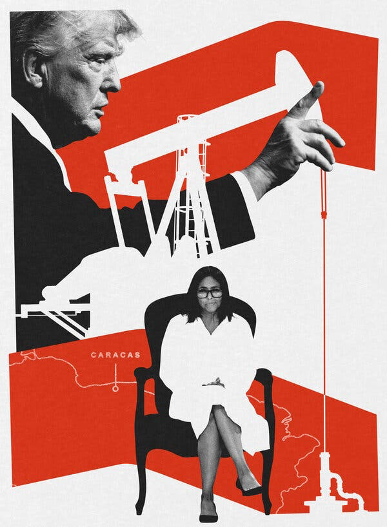
Is Venezuela a Colony Now? A Sovereign State? Modern Empires Rule in Ambiguity
Linda Kinstler
New York Times
Since U.S. Special Forces captured President Nicolás Maduro of Venezuela in January, a steady stream of American officials and oil executives has visited Caracas. They flew there to do what generations of colonial administrators and businesspeople have done before them, effectively running another country. As The Times recently reported, Secretary of State Marco Rubio directs the acting president, Delcy Rodríguez, via text message and controls her government’s access to its own oil revenues. She tells him whom she wants to hire, and he tells her which Maduro apparatchiks to purge. Under Rubio’s tutelage, Rodríguez opened the nation to U.S. companies. According to the Trump administration, it’s too soon to talk about democratic elections; that has to wait until Venezuela’s energy sector is stable and its economy has recovered.
This asymmetrical relationship has led observers to reach for familiar yet somehow anachronistic terms: Venezuela has been described as President Trump’s “puppet regime,” as his “colony,” as an American protectorate and client state. [Continue reading]
Nicaragua’s president says country will not hold any more elections
Tiago Rogero
Guardian
Nicaragua’s long-serving president, Daniel Ortega, has said the country will hold no further elections to prevent the opposition from coming to power. The 80-year-old authoritarian leader, who has been in office since 2007, also said he would work with the congress he controls to pass new laws that would “build a wall” against the opposition. Ortega made the announcement on Sunday during the official ceremony marking the 47th anniversary of the 1979 Sandinista revolution, in which he helped overthrow the brutal dictatorship of Anastasio Somoza.
Although his administration and that of his wife and “co-president”, Rosario Murillo, had already been marked by the steady erosion of democracy in the Central American country, many are describing his announcement as a significant rhetorical escalation. “With this decision, Ortega and Murillo have sealed the country’s transition to a full-fledged family dictatorship,” said Tiziano Breda, Latin America senior analyst at the NGO Armed Conflict Location and Event Data. [Continue reading]
Hegseth announces new policy to test troops for low testosterone
Toropin & Matthew Perrone
AP News
[US] Defense Secretary Pete Hegseth announced Wednesday that he is rolling out a new screening program for “testosterone deficiency” among troops, calling it necessary to allow them to operate at their “absolute best.” The screenings will be conducted annually as part of service members’ required medical screenings for those 30 and older, he said. Troops under 30 can volunteer to be tested. In a video on social media, Hegseth said receiving testosterone replacement therapy would be voluntary. In the video, Hegseth simply refers to troops, though it appears he is talking about only testing men in uniform for hormone irregularities.
The move comes as other Trump administration officials have begun to advocate for men to have easier access to testosterone replacement therapies, but the messaging from Hegseth and others blends known science on the hormone with broader, and less substantiated, claims.When asked what conditions Hegseth was looking to address with the new policy, the Pentagon referred to Hegseth’s remarks in the video that mentioned keeping troops “strong, resilient and capable” and that the rigors of the modern battlefield demand “maximum psychological and mental readiness.” [Continue reading]
Rare 16th century cannon, weighing over 1000kg, stolen from fort in MP’s Shivpuri
P Naveen
Times of India
In a daring overnight operation, an armed gang of 25 to 30 men allegedly stormed the centuries-old hill fort in Shivpuri district and escaped with a rare 16th-century cannon weighing over 1,000 kg after threatening unarmed security guards. This fort is under the protection of state archaeology department. The latest theft has revived memories of a similar incident in 2007, when another historic Mughal-era cannon, measuring about seven feet in length and weighing nearly 30 quintals, was stolen from the fort’s Kachahari Mahal premises.
The latest heist took place on the intervening night of July 15 and 16 at Narwar Fort, a historic hill fort associated in local tradition with Kush, the son of Lord Rama, and the legendary King Nala and Damayanti. The stolen cannon was one of 14 historic artillery pieces displayed in the fort’s open courtyard. Only 13 remain now. According to security guards, the gang entered the fort through a rugged rear approach using loading vehicles brought specifically to transport the massive cannon. [Continue reading]
European security cannot be confined to the EU, says Turkish Foreign Minister Fidan
Editorial Team
TRT World
Turkish Foreign Minister Hakan Fidan has said that the ambit of European security cannot be limited to EU states and requires a broader approach where Türkiye plays a role in the continent’s security architecture. Speaking at an event titled “European Security After the Ankara Summit: Strengthening Cooperation Among NATO Allies Across Europe,” organised in Ankara by the Foreign Ministry’s Center for Strategic Research (SAM) and Chatham House, Fidan said NATO should focus on building long-term strategic capacity rather than merely responding to existing threats.
Fidan said that despite tensions between the US and Europe, he does not expect them to turn into an uncontrolled crisis at the NATO summit and that US President Donald Trump’s participation will be important in managing differences. Strengthening Europe’s defence capabilities is essential not only for NATO’s future but also for Europe’s strategic resilience, he said, adding that mutual blame between Europe and the US is not expected to dominate the Ankara summit. [Continue reading]


You must be logged in to post a comment.